
Supplying Russia’s Africa Corps in Mali depends on ports and roads the Kremlin does not control, and over the past two years that dependence has cost the Russians their ability to go on the offensive in northern Mali. It has not cost them their place beside the government in Bamako, because the junta keeps them to protect its own hold on power rather than to win back the north, and so far the Russians have done that job even after their defeats in the field. That is the central contradiction of Russia’s presence in Mali. How well the Russians can fight depends mostly on the docks of Togo and Guinea and the roads of Burkina Faso, while whether they stay in the country at all depends on the Malian junta alone, and a coastal government’s decision to let Russian armor and military cargo through has no direct bearing on the junta’s decision to keep the Russians. Kyiv and the West can make this supply line longer and more expensive for Moscow, but the only actor able to shut it down for good is an African coastal government that closes its dock to Russian ships.
Introduction
On July 9, 2026, the Russian cargo ship Mikhail Britnev docked in Lomé, the capital of Togo on the Gulf of Guinea. It was carrying armored vehicles for Bamako, the capital of Mali, home to one of the largest Russian military contingents in Africa. From Lomé the vehicles traveled roughly 1,800 kilometers overland through Togo and Burkina Faso, and each of those two countries decided on its own whether to let the Russian convoy cross its territory. Through Burkina Faso the convoy was led by the Burkinabe army, which escorted it as far as Sikasso in southern Mali and handed it over to a Malian escort. On July 25, sixteen days after the ship tied up in Lomé, Malian television showed the convoy arriving in the capital. There it was received by the Africa Corps, a formation of the Russian Ministry of Defense created in 2023 to replace the Wagner Group private military company after Wagner’s one-day mutiny that summer. In Mali the Africa Corps guards the country’s military leadership and fights alongside it against jihadists and Tuareg rebels in a war that has been going on since 2012.
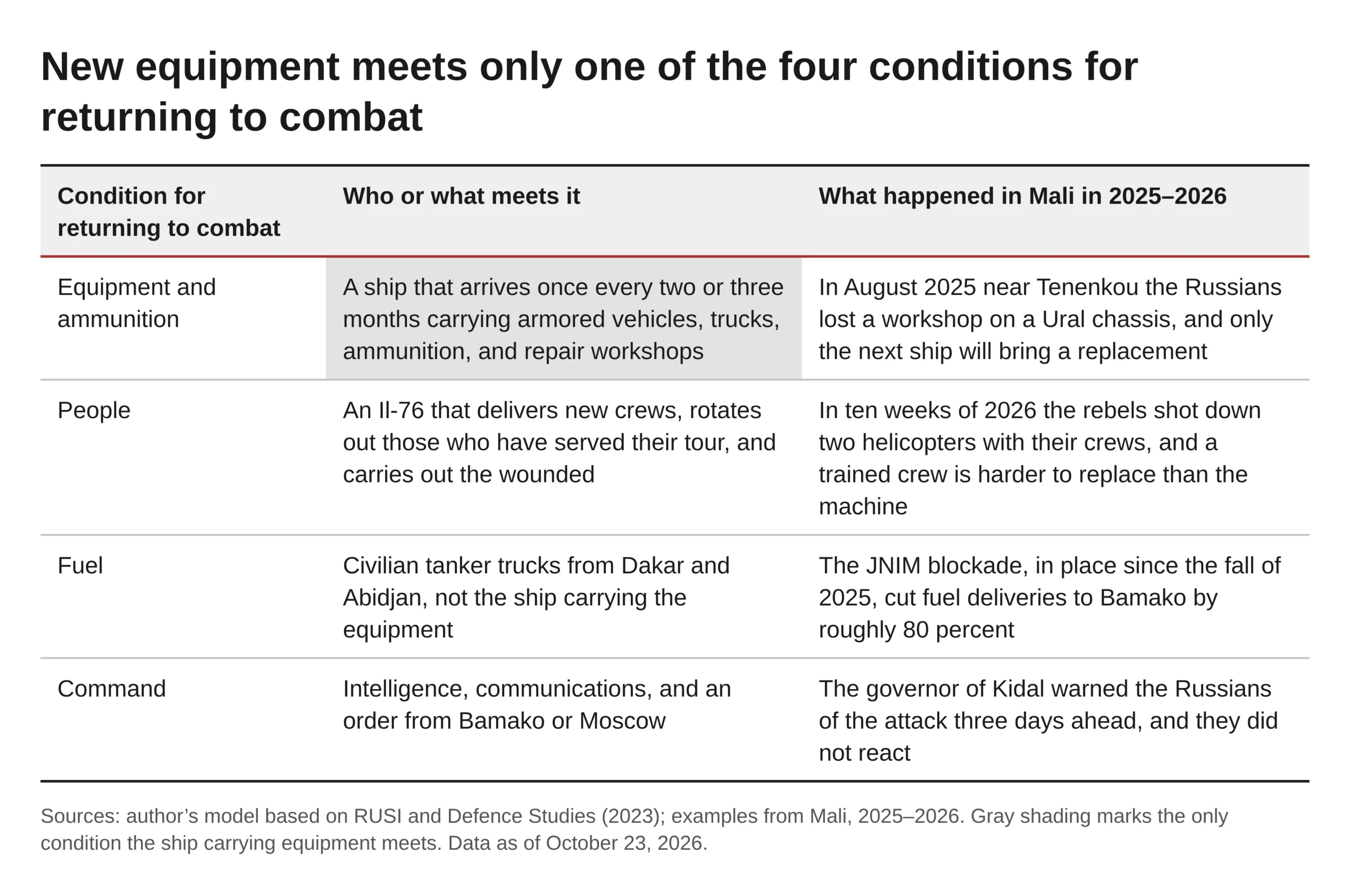
The Africa Corps fights with the weapons these voyages bring, and along the entire route from Baltiysk or Murmansk to Bamako, Moscow fully controls only the two ends: the dock in Russia and the base in the Malian capital. Everything in between runs through other countries’ ports and borders, through Togo, Guinea, and Burkina Faso, and a September investigation into the Mikhail Britnev’s voyage laid out that chain in detail. In practice it means that a port crane in Lomé lifts a Russian container only when the local port authority allows it. Farther along, on land, a Burkinabe border guard opens the gate, and the fuel for the military convoy most likely arrived in tanker trucks from Dakar or Abidjan, because more than 95 percent of Mali’s fuel comes in through the ports of Senegal and Côte d’Ivoire. Even the mobile workshops that repair the vehicles arrive by the same sea route, and the Russians have already lost at least one of them: in the summer of 2025 jihadists lying in ambush near Tenenkou in central Mali knocked out a repair truck on a Ural chassis that had come in earlier through Conakry, the capital of neighboring Guinea. Taken together, these facts show that the last word on supplying the Russian contingent does not always belong to its Russian commander.
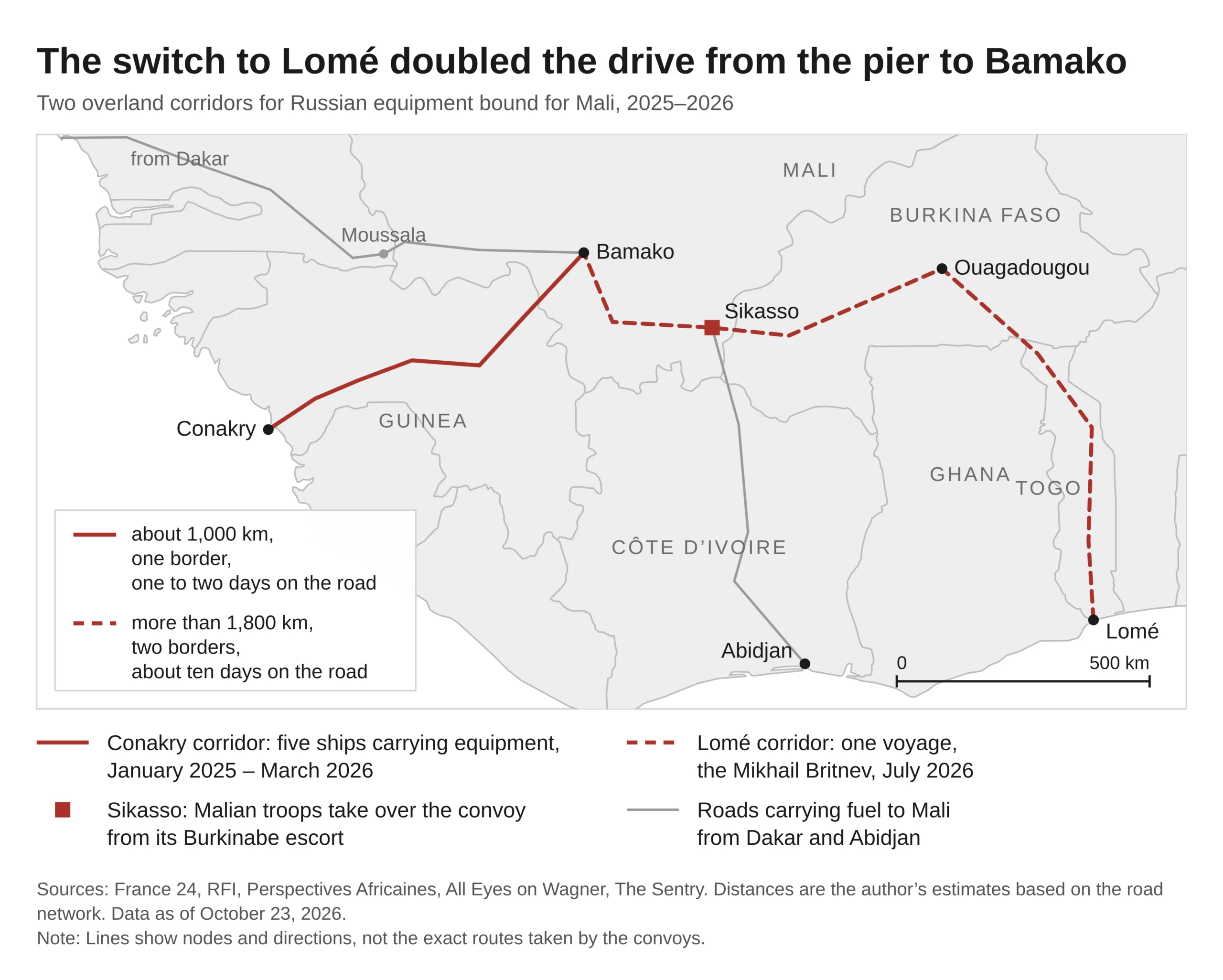
The Russians have already paid for this dependence on other people’s decisions, and the bill started coming due a year before the July voyage, in the fall of 2025. That was when jihadists cut the roads leading to Bamako and slashed fuel deliveries to the capital by roughly 80 percent, after which guarding civilian tanker trucks became the Africa Corps’s daily work. Six months later, in April 2026, the Russians lost their northern garrisons as well, in the space of a single week. Their unit had to pull out of Kidal, the administrative center of the region of the same name in northeastern Mali, which the Malian army and Wagner had retaken from the Tuareg in November 2023, and it left under the escort, in effect under the protection, of the Tuareg Azawad Liberation Front, the very rebels who have now taken the town back. In the summer of 2026, after those defeats in the north, the Mikhail Britnev and its armor for the Russians were received by Lomé in Togo rather than by the Russians’ usual port of Conakry in Guinea, through which the earlier deliveries had flowed for a year and a half. The Russian military convoy therefore had to drive 1,800 kilometers and cross two borders on its way to Bamako, whereas convoys from Conakry had covered about 1,000 kilometers and crossed only one. The convoy still reached Bamako, and the junta that rules Mali, for all the Russians’ military failures, did not give up its Russian contingent, because military regimes under pressure rarely part with a bodyguard on whom their own survival depends.
That is the central contradiction of Russia’s presence in Mali. The Africa Corps can no longer fight the way it fought in 2024, when it advanced alongside the Malian army against the jihadists and the Tuareg in the north; now it mostly guards its own bases and the civilian tanker trucks on the roads to the capital. Whether it can return to the offensive depends on how much equipment and fuel reaches Bamako, and most of that cargo comes by sea, because aircraft can carry only a small fraction of it. For the junta, the longer route changes nothing about the price, since Bamako pays about $10,000 per Russian fighter per month regardless of which port the equipment comes through. What changes is how much the junta gets for its money, because the Russians’ combat capability has been falling for the second year running, and the Malian army now has to escort their convoys from the border as well, as it did in July near Sikasso, where it took the convoy over from the Burkinabe. Still, the government in Bamako fears losing the palace more than it fears losing the desert in the north. The junta itself expelled the French army in 2022 and the following year forced out the UN peacekeepers as well, so the only foreign troops left between the jihadists and the Malian palace are the Russians, who arrived in the country at the end of 2021. The junta keeps paying Moscow for this thinning screen even after the loss of Kidal, and the main question for the Africa Corps in Mali is no longer whether it will be thrown out of the country but whether new equipment and fuel will keep reaching it, because without them there is no offensive and no reliable defense either.
Two Gates on Someone Else’s Shore
Equipment and fuel reach an army only when the owners of the road want them to, and commanders learned that simple truth nearly 2,500 years ago. Xenophon of Athens, who commanded the Greek mercenaries in the army of the Persian prince Cyrus the Younger, describes in his Anabasis how in 401 BC, during Cyrus’s campaign against his brother, the Persian king Artaxerxes, the supply wagons bogged down on a muddy stretch of road, and the prince ordered the nobles of his entourage to haul them out themselves. They obeyed, threw off their purple cloaks, jumped into the mud, and had the wagons on firm ground faster than anyone could have imagined. Cyrus had authority over everyone who touched his baggage train, and that is exactly the authority the commander of the Africa Corps lacks. He has no one to give such an order to, and the people pulling Russian equipment out of the mud are the governments of other states, starting at the very beginning of the road across the continent, at the two sea gates on the Atlantic coast of West Africa.
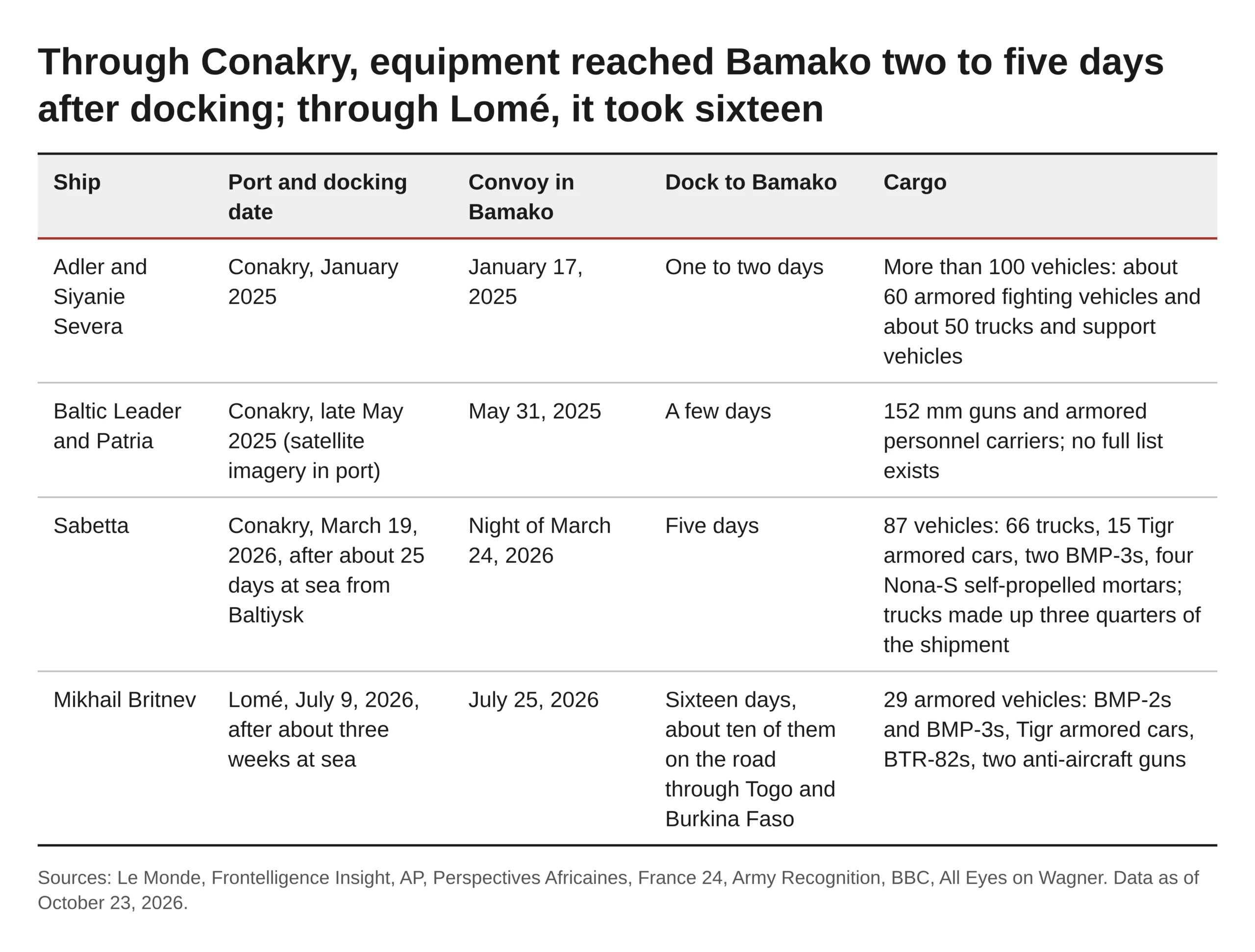
The Guinean gate is older than the Togolese one, and the large seaborne deliveries began there, when on January 17, 2025, the first convoy of more than 100 vehicles, unloaded in Conakry from the sanctioned ships Adler and Siyanie Severa, arrived in Bamako; a port worker later called that voyage a test of the route ahead of much larger shipments. At the end of May, satellite imagery caught the Russian ro-ro ships Baltic Leader and Patria in the same port with 152 mm guns and armored personnel carriers, and shortly afterward, on May 31, a convoy carrying that equipment drove into the Malian capital under police escort. So in the first five months of 2025 four Russian ships unloaded equipment in Conakry, and their cargo went on in three large convoys, all three of which passed through Guinea to Bamako. In March 2026 the cargo ship Sabetta came through the same corridor, and its path from the Russian dock to the Malian base can be traced almost day by day. Around February 22 it left Baltiysk under the protection of the landing ship Alexander Shabalin, and in early March a British patrol vessel and a naval helicopter shadowed the pair through the English Channel. Almost a month after leaving the Baltic, on March 19, the ship arrived in Conakry, the equipment was unloaded and formed into a convoy, and on the night of March 24 the convoy entered Bamako and moved on to the military base at Kati, 15 kilometers from the capital. Eighty-seven vehicles came ashore that time, among them 15 Tigr armored cars, two BMP-3 infantry fighting vehicles, four Nona-S self-propelled mortars, and 66 trucks. Three quarters of the shipment, in other words, consisted of vehicles for hauling fuel, ammunition, and people rather than fighting vehicles, and Chinese-made Norinco armored cars were also spotted in footage of the convoy. The Sabetta was the fifth ship carrying equipment that Conakry had received in 14 months, one every two to three months. The appeal of the port lies above all in distance. From the Guinean dock to Bamako is about 1,000 kilometers and one border, a day or two on the road for a convoy, whereas from Lomé in Togo, where the Russians moved their unloading only in the summer of 2026, the same capital is more than 1,800 kilometers away across two borders.
Russian business, moreover, has been working on the Guinean coast for decades, and the Sabetta tied up at the bauxite pier used by a subsidiary of the aluminum giant Rusal, founded by Oleg Deripaska, although the company itself denied any part in the transit. Permission to use the pier that way reportedly came from Guinea’s president himself, Mamadi Doumbouya.
Moscow prepared the second gate, the Togolese one, in advance, to spread the risk to its military logistics in the Sahel. Over the course of 2025 Togo and Russia signed a military cooperation agreement, which Moscow ratified in October and which provides for joint exercises, military training, intelligence sharing, and, among other things, port calls by Russian warships in Togo. For Togo, transit is the state’s main source of income: about 90 percent of the country’s foreign trade passes through the port of Lomé, which has become the main seaport for landlocked Burkina Faso and Niger. With that much riding on it, a sanctioned ship at the pier exposes the whole port to secondary sanctions, so after the Mikhail Britnev’s call the Togolese opposition demanded that the government publish its agreements with Moscow and explain what foreign troops, Russian and Turkish, were doing in the country, and got no answer. The cargo itself could not be hidden, because the convoy was filmed the whole way: the ship had brought BMP-2 and BMP-3 infantry fighting vehicles, Tigr armored cars, BTR-82 armored personnel carriers, and two anti-aircraft guns. The Togolese government let the convoy through, and in ten days it reached Bamako by way of Burkina Faso.
The same Mikhail Britnev that Lomé received in July 2026 is on the American sanctions list, but no one closed the pier to it, because American restrictions bind only persons under U.S. jurisdiction, and the European Union has closed its ports and maritime services to Russian ships only within the Union itself, so neither Togo nor Guinea is bound by those rules. Western sanctions can hold up such voyages only when the payment or the insurance passes through an American or European bank, and even then the last word always belongs to the African government, and in 2025 and 2026 not a single Russian ship carrying equipment for Mali was left without a pier.
No one has ever officially explained why the July voyage went to Lomé. Guinea reportedly did not want to accept a sanctioned cargo, although there is no evidence of such a refusal, and the reason may be more mundane, since the port of Conakry is smaller than Togo’s and ships wait a long time there to unload. The only hint of a sudden change of plans is that a day before docking in Lomé the ship’s navigation data still listed Dakar in Senegal, at the other end of the coast, as its destination, so either the route was changed at the last moment or, more likely, the real destination was concealed until the end. Whatever the reason, Russian supply to Mali only got harder as a result, because the sea gate that had fed the Africa Corps for a year and a half had to be replaced with a road almost twice as long, and at the new site everything has to be set up from scratch, from arrangements with the port authorities to tractor-trailers and convoy security. And before a ship even reaches the pier, it spends three weeks at sea, and the owners of that sea are not Russian either.
Three Weeks Under NATO’s Watch
By sea, a ship carrying equipment takes three to four weeks to get from Baltiysk to an African pier, and NATO navies watch it the whole way. The Sabetta took about 25 days to reach Conakry, the Mikhail Britnev about three weeks to reach Lomé, and both were escorted by the same landing ship, the Alexander Shabalin, which in June put to sea with an anti-drone net already rigged on board. An ordinary merchant ship needs no such escort, so the mere presence of a landing ship alongside is a silent admission that these voyages to Africa, at least, are no longer routine in Moscow’s eyes.
The narrowest stretch of the route is the English Channel, and that is where the British tracked the Sabetta and the Alexander Shabalin in early March 2026. The same week the Royal Navy shepherded another such pair through the strait, the landing ship Alexander Otrakovsky with the cargo ship Sparta IV, and at the end of August three British ships and a helicopter spent 72 hours shadowing the destroyer Admiral Levchenko and two sanctioned vessels. Watching is not the same as seizing, of course, but on June 14, 2026, it came to that too, when British Royal Marines took six hours to seize the tanker Smyrtos, a member of Russia’s shadow fleet, in the Channel. The ship was sailing under the flag of Cameroon, but a few days earlier the Cameroonian authorities, under pressure from the European Union, had struck it and 35 other vessels from their registry. After that no flag on its stern was legal anymore, and under the law of the sea a ship with no flag state can be stopped and boarded by a warship of any state even on the high seas, let alone in that state’s own territorial waters. The captain, an Indian citizen, was charged under British sanctions law and held in custody pending trial, and after that episode some of the ships bound for Russia started going the long way around, north of Scotland.
The British cannot repeat that kind of seizure with a Russian cargo ship carrying armor, and the difference lies in international law rather than in resolve. The Smyrtos was sailing without a legal flag, whereas the Sabetta and the Mikhail Britnev sail under the Russian flag with a Russian warship beside them, so any attempt to board becomes an incident between two states rather than a police operation against a smuggler. Sanctions on such a ship bite through banks and insurers rather than at the pier, which is why on the Mikhail Britnev’s voyage to Lomé they worked only halfway. The ship’s operator, Eco Shipping, has been under American sanctions since May 2024, which did nothing to stop it from docking in Lomé. But the protection and indemnity (P&I) clubs, the mutual insurers that cover damage from a spill or a collision in port, do not accept sanctioned ships, so in the event of an accident there may be no one to pay, and the state that let such a ship in risks being left with the losses on its own. That is the argument Western embassies can put to the port authorities in Lomé or Conakry.
What the loss of a single such ship means, the British learned in the Falklands War. On May 25, 1982, an Argentine anti-ship missile set the container ship Atlantic Conveyor ablaze, and six Wessex helicopters and three heavy Chinook transport helicopters burned with it, after which British infantry walked to Stanley, the islands’ capital. Russian supply to Mali rests on just such occasional voyages, since a ship with equipment arrives once every two or three months, and the loss of one cargo ship would mean a quarter without new equipment for the Africa Corps.
Nor has such a loss been hypothetical for some time, because east of Gibraltar Russian ships have already started to burn. On December 23, 2024, the Ursa Major, flagship of Oboronlogistika, the Russian Defense Ministry’s shipping company, sank between Spain and Algeria after an explosion that Moscow called a terrorist attack; Spain, whose rescuers pulled the crew from the water, has yet to publish the findings of its investigation. Almost two years later, in early September 2026, the Russian ro-ro ship Lady Mariia took more than ten drone hits between Crete and Libya. Kyiv has commented on none of these incidents, but since October 2025 more than 200 Ukrainian officers and specialists have been operating in western Libya with the consent of the government in Tripoli, and Libyan officials said that the strike on the gas carrier Arctic Metagaz in March 2026 was launched from there. From the same Libyan coast, Ukrainian Sea Baby naval drones with a declared range of at least 1,000 kilometers keep the entire central Mediterranean within striking range.
That range does not yet reach the Gulf of Guinea, because from the Libyan coast to Conakry or Lomé is several thousand kilometers around the whole of West Africa, and there have been no confirmed Ukrainian strikes there so far. The explosion aboard the tanker Mersin off Dakar in November 2025 was initially attributed to Ukrainian drones, but a Senegalese investigation ruled out that explanation. So the maritime link in Russia’s supply chain remains vulnerable in NATO waters and in the Mediterranean, yet almost invulnerable on the final leg, where the cargo comes ashore in Africa, and it will stay that way until naval drones learn to cover several thousand kilometers. Ukraine’s largest underwater drone, the Toloka, so far comes with a promised range of 2,000 kilometers, and even that would not be enough to reach Lomé from the Libyan coast.
And even where the drones do reach, a strike remains a matter of international law, which, as the title of last year’s report on the subject puts it, is not dead yet, though states now comply with provisional measures of the International Court of Justice in roughly half of all cases, down from four in five before. Lawyers at West Point, the U.S. military academy, consider strikes on shadow-fleet tankers lawful only under the American interpretation, which allows attacks on anything that sustains an enemy’s ability to wage war; other states do not accept that interpretation, but they do not contest it either, and it rests on that very silence. A Russian ship with armored vehicles on board is a more obvious military target than a tanker full of oil. But the launch position of Ukrainian drones depends on Tripoli’s permission, and Greece’s protest over a Ukrainian drone found near the island of Lefkada in the Ionian Sea is a reminder that someone else’s sea has owners too, just like someone else’s road. The sea route to Africa remains open to the Russians, but it is slow and under foreign eyes, so the Russians send their urgent cargo by air.
Cuius est solum, eius est usque ad coelum
The sky is faster than the sea, but no less dependent on other people’s consent, because most Russian cargo aircraft cannot reach the Sahel without a stopover, and they have to land wherever they are allowed to. Most often that means Algeria: between March 2025 and April 2026, 167 cargo flights were recorded between Algeria and Russia. Some of them may have been serving the Algerian army itself, which has flown Russian equipment for decades, but the Russian carrier Gelix Airlines itself admitted that it refuels in Algeria and transfers cargo there from one aircraft to another. Over the summer of 2025 two of its Il-76s flew from there to Conakry eight times, and what they carried is unknown.
For more than a year there were no direct flights on from Algeria to Mali, because a diplomatic crisis had broken out between the two neighbors. In April 2025 the Algerian army shot down a Malian drone, after which the two states closed their airspace to each other and reopened it only in July 2026, and all that time it was Algiers and Bamako that opened and closed the short air route to Mali.
So Libya became the main air route for supplying the Africa Corps. After the fall of Assad in Syria in December 2024, Russia leaned on Khalifa Haftar, whose Libyan National Army controls the east of the country and receives, in exchange for its runways, weapons and dinars printed in Russia, and air cover when it needs it. As early as May 2025 a Russian An-124, after a stop in Libya, visited Bamako and Ouagadougou. Russia is building up six Libyan air bases for this route, and construction is already under way at no fewer than three of them. At Al-Khadim air base in eastern Libya, three hangars went up in 2025 and barracks were added the following year. Meanwhile at Brak al-Shati in the south of the country a hangar and two aircraft maintenance buildings have been built, and the Russian contingent there has grown from 300 to 450 since December 2024. Farthest south, near the border with Chad, Russian technicians working with Syrian soldiers restored the runways and depots of the Maaten al-Sarra base specifically for flights to Mali and Burkina Faso. The stopover cannot be avoided, because most Russian cargo aircraft lack the range to fly from Russia to the Sahel, and the only aircraft flying directly to the Sahelian capitals have been passenger Il-96s, which carry personnel rather than equipment.
In all, over the nineteen months from January 1, 2025, to July 31, 2026, 75 flights were linked to the Russian presence in the central Sahel, and these are recorded flights, including movements within the region, rather than 75 separate deliveries from Russia. It is also a lower bound, because a crew can simply switch off the ADS-B signals by which aircraft broadcast their position. And who is doing the flying shows what sanctions against airlines are worth. Thirty-one of those flights were made by the 224th Flight Unit, a nominally civilian airline of the Russian Defense Ministry that has been under U.S. sanctions since 2023 and keeps flying to the Sahel regardless. Another 26 fell to the presidential Rossiya squadron and the Ministry of Emergency Situations, and as of the summer of 2026 the Kyrgyz carrier Sapsan Airlines, the Burkinabe carrier Liz Aviation, and the Emergency Situations Ministry itself were on no sanctions list at all. The busiest aircraft, the An-124 registered RA-82030, landed in Syria and Libya on every trip.
In other words, Moscow did not lose the Syrian base at Hmeimim near Latakia after Assad fell. In December 2025, Russian military aircraft were flying there through Turkish airspace as routinely as before the war in Ukraine, even though in 2022 Ankara had banned Russian aircraft carrying troops to Syria from its skies. The weak point of this air route lies in Libya: if Haftar loses the east of the country or makes peace with Ankara, whose troops broke his offensive on Tripoli in 2020, air supply to the Sahel will drop sharply.
At the Russian end of the route, the bottleneck is the aircraft themselves, and they are not unlimited either. In 2025 Russian military transport aviation had about 110 Il-76s, less than a third of the Soviet fleet, and the only plant, in Ulyanovsk, built just seven new ones that year. The Ukrainian strike on the airfield at Pskov in August 2023 destroyed or damaged four to six of these aircraft, roughly a year of the plant’s output in a single night. After that, in the summer of 2025, Russia moved its transports beyond the Urals, to Omsk and Ulan-Ude, thousands of kilometers from the front. Not every aircraft was moved, though, and in November Ukrainian drones destroyed an Il-76 at Taganrog on the Sea of Azov. No one publicly links these strikes to Africa, and the Sahel does eat up only a small share of flight hours, but every Il-76 in the repair shop is missing from the Ukrainian front and the Malian one at the same time.
And there are fewer and fewer places in Mali for such an Il-76 to land. Tessalit in the far north of the country, with its 2,500-meter runway, was abandoned without a fight by the Malian army and the Africa Corps on May 1, 2026. In Bamako itself, fighters of JNIM, the al-Qaeda-linked Group for the Support of Islam and Muslims, had already destroyed six aircraft at Senou airport on September 17, 2024, among them two Malian C-295 transports, each of which carries about seventy soldiers or nine tons of cargo. Aircraft like these are built for soldiers and light loads, and armored vehicles are too heavy for them. In Gao, the largest city in the north, the Azawad Liberation Front claimed an attack with 25 kamikaze drones on the airport in March 2026. So an aircraft buys time only where there is intact concrete under its wheels and a garrison that keeps the enemy away from that concrete, and even then it brings a small fraction of what a ship can carry. By sea or by air, the cargo ends up with people, and people need fuel and food every day, whenever the next ship may come.
New Wine into Old Wineskins
The Russians in Mali did not change the name over the door overnight. The Africa Corps began deploying at the end of 2024, while Wagner announced its departure from Mali only on June 6, 2025, and some of its fighters never left the country at all. Command and supply thus passed under the direct management of the Russian Defense Ministry, and now every failure is Moscow’s to answer for, rather than a private company’s that everything could once be blamed on.
At the end of June 2026 the strength of this expeditionary corps was estimated at 1,500 to 2,500 men, and more than 1,200 of them in one way or another serve the aviation group in Bamako: Su-24M bombers, about ten Mi-8 helicopters, four Mi-24P attack helicopters, at least one Mi-26 heavy transport helicopter, and Orion drones. Even a contingent this modest burns through its imported stocks of fuel and food every day. Generators on the bases burn diesel even when no one is going anywhere, and patrols around the base and along the roads to the capital wear out tires. Fifteen helicopters, on top of that, need ground crews and technicians who have to be brought from Russia.
Hence the large share of support vehicles in every shipment, as in the March delivery from the Sabetta, where 66 of the 87 vehicles were trucks: it is the repair workshop that keeps armor from grinding to a halt thousands of kilometers from the factory, and the ambulance that carries the wounded out after a fight. But those trucks say nothing about what the Russian command intends. Working equipment is needed just as much for guarding a base as for a march north; the only difference is where it will be sent, and that is visible neither during loading in Baltiysk nor during unloading in Lomé or Conakry, and becomes clear only on the roads of Mali.
What a long campaign in a single country does to an army, France has already demonstrated in Mali with Operation Serval in 2013 and its sequel, Operation Barkhane. At the height of the operation roughly a quarter of the contingent was busy supplying the force, and the commander of one battalion reported that in six weeks each of his vehicles had covered 2,500 to 5,000 kilometers off-road. When the French ran short of their own aerial refueling aircraft they had to ask for American ones, and over two and a half years American tankers refueled French aircraft in flight 2,702 times, three times a day on average. The Russians in Mali have no such ally, and every new convoy has to be fueled and repaired before the previous one is back. And all of this logistical work takes place inside the Malian economy, where civilian transport needs fuel too, and in the fall of 2025 the competition for fuel became a problem for the Malian government itself.
How to Turn an Assault Force into Tanker Guards
It was the fuel blockade that turned the Africa Corps from a force that was attacking in the north in 2024 into, for the most part, an escort for civilian tanker trucks. In September 2025 JNIM began hunting tankers on the roads to Bamako and burning them, and between mid-September and early November six such attacks were documented, in which more than 130 fuel tankers burned. Residents of Bamako stood in line for fuel, and at night the city dimmed enough for satellites to see it.
Worse than a jihadist attack itself, though, is that the road now always holds the prospect of the next one, and after six attacks in seven weeks no driver sets out without an armed escort anymore. So in May 2026 the Russians and the Malian army together escorted a convoy of roughly 700 tanker trucks to Bamako, the fuel for an entire capital, and from then on the convoys only grew longer: on June 26 the column had 807 tankers, in July more than 900, and 971 on September 14. For June and July the Malian army reported escorting 15,589 tanker trucks, of which only 7,417 were loaded; the rest were returning empty, also under guard, so every delivered tanker costs two armed escorts on average, there and back. The Malian army does not break down how many of these convoys the Russians handled, and Russian participation has been seen only in individual columns. It all began in the fall of 2025, when the jihadist blockade cut fuel deliveries to the capital by roughly 80 percent and the government had to turn convoy protection into a separate operation under a brigadier general.
Mali produces no fuel of its own, so on April 1, 2026, the government approved plans for a strategic reserve covering 45 days of consumption and for expanded storage, though it has never reported whether the reserve was actually filled. The fee for a truck run from Dakar to Bamako rose from 1.4 million to 3.6–4 million CFA francs, nearly threefold, from roughly 2,100 euros to 5,500–6,100, and at the Moussala border crossing between Senegal and Mali, where trucks diverted after the attacks on the main Dakar–Bamako highway, the line in August was 15 kilometers long. The capital waited for fuel, and in October 2025 Moscow promised Mali 160,000 to 200,000 tons of petroleum and agricultural products without naming a date or a port. By the end of March 2026 there was still no sign of Russian fuel in Mali, while Russia supplied its own contingent through a separate channel, and in a single week that March two Ilyushin transports landed in Bamako with cargo for the Africa Corps.
The point is that cargo for the Russian contingent and fuel for Mali itself reach Bamako by two different chains, and the JNIM blockade has touched each of them in its own way. It has not yet broken the Russian chain, which runs from Baltiysk by sea to a West African port and on by convoy to Bamako. Ships with equipment kept coming, and the convoy from the Mikhail Britnev reached the capital in July 2026, even though moving the unloading from Conakry to Lomé stretched the trip from port to Bamako from a day or two to more than two weeks. What broke was the second chain, Mali’s civilian fuel supply from Dakar and from Abidjan in Côte d’Ivoire, and it is those tanker trucks that the Africa Corps now escorts with its armor. For the Russian units, a fuel shortage on the civilian market does not yet mean a shortage of their own, since Bamako can give the military priority. But an armored vehicle assigned to an escort does nothing else for the duration of the run, even though it never leaves the order of battle, and a government that has to hold its capital chooses guarding tankers over an offensive on Kidal. So as long as the Africa Corps’s armor is escorting fuel convoys on the roads to Bamako, there is none left for an offensive in the north.
A War Along the Roads
The Soviet war in Afghanistan showed long ago how much of an army this kind of road security ties down. There, about 85 percent of Soviet and Afghan government forces were guarding cities, airfields, and the roads between them, and only 15 percent were left for operations against the mujahideen. When the Soviet General Staff asked for 30 to 35 divisions for that war, fewer than six such formations were in the country, because Afghan roads lacked the capacity to supply a larger force. In the Sahel the fighting is concentrated along the roads in just the same way, and about 70 percent of the battles and attacks in North and West Africa over 24 years took place within a kilometer of a road. So an army fighting in this region has to control the roads first of all, and guarding them, as in Afghanistan, eats up the bulk of its strength, while a mobile enemy on motorcycles and pickups chooses for itself where and when to hit the convoys.
In Mali the Russians arrived at a similar distribution of forces in less than a year, and it started with an ambush in September 2025 near Kayes, a town in the west of the country on the road from Dakar. A convoy of more than 80 tankers was traveling there under a Malian-Russian escort, and during the attack the escort was forced to withdraw. Five days later a satellite image showed about 30 burned-out vehicles. After that episode, escorting convoys took more and more of the Russians’ strength, and there were fewer and fewer engagements involving them, from 537 in 2024 to 402 in 2025, that is, from an average of 45 a month to 33, and by early 2026 such clashes were down to about 24 a month. By June 2026 the Africa Corps was increasingly shutting itself in at its bases in the north and center of the country and husbanding its manpower. Instead of infantry, it was more often aircraft that went into action, dropping cluster bombs on villages in the Kidal region, fighting from the air in places the ground units no longer reached.
Malian roads wore down the Russians’ predecessors on this ground in the same way. The last convoy of the UN mission left Kidal for Gao at the end of October 2023, and its 143 vehicles, with no air cover, spent eight days covering 350 kilometers of sand tracks through the desert. Along the way the convoy struck improvised explosive devices six times and brought 37 wounded into Gao, and over ten years in Mali the mission lost more than three hundred soldiers. In its cautious manner the Africa Corps increasingly resembles the French in the last years of Barkhane, whom the Malian government eventually threw out of the country for getting nowhere. Any regular army, then, can be stopped without winning a single battle against it; it is enough to make it spend its main strength guarding its own rear.
Losses That Cannot Be Replaced
And that is exactly what Bamako’s enemies are after, because control of the road to the capital is worth more to them than any captured town. Starting in the fall of 2025, the JNIM blockade spread from the Dakar–Bamako and Abidjan–Bamako roads to the Conakry–Bamako road, which until recently had been relatively safe and had carried Russian equipment for a year and a half. At the end of April 2026 the group declared a blockade of every road into the capital itself.
The only way around blocked roads is by air, but in the north the Azawad Liberation Front has meanwhile learned to shoot down helicopters. The Africa Corps lost one near Gao on April 25, 2026, together with its crew and the troops on board, and on July 6 the rebels downed a second, a Mi-24, over a convoy headed for Anefis, a small town on the road between Gao and Kidal, probably with an anti-aircraft gun mounted on a pickup. In ten weeks the Russians lost two of the roughly fifteen helicopters they have in Mali, more than a tenth. A U.S. Army field guide states the rule: equipment an army has in short supply, once the enemy has learned to find it, is lost faster than its owner can replace it, and a trained crew is harder to replace than the machine. And the threat keeps growing, because in three years drones in the Sahel have progressed from quadcopters dropping munitions to fiber-optic FPV drones, steered not by radio but through a thin cable that unspools in flight, so electronic warfare cannot jam them.
Convoys on these roads were taking losses before such drones appeared. On August 1, 2025, a convoy bound for the forward base at Dioura in central Mali ran into a JNIM ambush near Tenenkou, and that is when the jihadists knocked out the mobile workshop on a Ural chassis that had come through Conakry. Video from the scene shows at least three dead Russians, and Russian military bloggers complained afterward that not a single helicopter had covered the convoy. Even the lone success of the summer of 2026, the recapture of Anefis, cost the Malian army dearly. First, on July 5, the Front and JNIM took the town, and although Malian and Russian forces retook it by July 9, the convoy returning from there to Gao on July 17–18 lost more than 50 Malian soldiers killed and at least 24 captured, and that was already the third ambush on the road between Gao and Anefis in two weeks. Ukrainian intelligence claimed that more than 200 Russians withdrew from their positions without covering the Malians with fire, and whatever the real figure, Malian soldiers were dying in ambushes at precisely the time the Africa Corps was sparing its own men.
Two months later the blow fell on that same Dioura, where the convoy shot up near Tenenkou had been headed a year earlier. On September 10, 2026, at least 50 Malian soldiers and five fighters of the Africa Corps died there. The jihadists took the military camp on the first assault, and when they came back the next day no reinforcements had arrived, and that absence showed plainly that at that moment neither the Malians nor the Russians had a free reserve in the area. Prisoners from such ambushes have already become a bargaining chip, and at the end of August the Front handed over about 60 Malian soldiers in exchange for Inkinane Ag Attaher, a former Malian officer who had gone over to the Front and was accused of organizing training for drone operators, and for several people linked to JNIM. Behind every such loss stands another evacuation of the wounded and another round of repairs, and a helicopter shot down means another one has to be flown in to replace it. Yet what changed this war most was not any single battle but one week at the end of April 2026.
The Limit of the Offensive, or the Week That Turned the War
That week began on April 25, when JNIM and the Azawad Liberation Front struck across the whole country at once. Defense Minister Sadio Camara died after an attack on his residence in Kati, which the head of state himself, General Assimi Goïta, confirmed. In Kidal, Malian and Russian troops held out only in the former UN camp, and soon afterward, on April 26, the Front announced a deal under which the encircled garrison was let out of the town under the escort of the rebels themselves. That is how an army leaves a position it does not plan to return to, and the other garrisons left the north the same way, accompanied by the rebels. The next day the Africa Corps confirmed the withdrawal, and on April 28 Moscow announced that it had prevented a coup.
The Russians lost the town, but the leadership in Bamako kept its power, and that is what Moscow presented as a success. The governor of Kidal had warned the Russians of the attack three days in advance, but they did not react, and after the defeat the two sides blamed each other, with the Russians maintaining that they had met their obligations by repelling the attack on Bamako’s airport. The attacks on the center and south of the country left the Malian army unable to gather forces for a response in the north, so the April defeats are explained not by a late delivery or a fuel shortage but by an enemy that struck everywhere at once. After losses like these, any army has to decide which combat capabilities it can rebuild and for which tasks.
Bringing in new equipment is not the same as restoring combat power, because a new infantry fighting vehicle without a trained crew, a workshop, and fuel will sit on the base just as a knocked-out one would. That is why a supply system is judged by the work it makes possible, not by the amount of stock in its depots, and the pace of recovery is measured by the time it takes a unit to get back to combat work. The arrival date of the next ship shows none of this, and neither do photographs of a convoy, from which there is no telling whether the Russians will return to their former activity or shrink into the narrower role of guarding the palace in Bamako. A lower count of engagements likewise says nothing by itself about whether the command’s orders have changed, or the unit’s capabilities, or merely how completely those engagements are being reported.
The answer to these questions comes only from how the unit performs once it has been replenished with equipment and men. If it carries out the same tasks as before, Moscow has restored what it lost; if the commander has to give up part of his plans, a return to Kidal for instance, then the course of the war itself has changed. In military theory, the culminating point is the limit beyond which a force can no longer continue its offensive in its previous form, though it can still defend, and every effort past that limit turns against whoever makes it. That limit is measured by operational reach, the distance and time within which a formation can still do what it came to do, and it is extended by depots, ports, and forward bases. The Africa Corps has lost Kidal, its main outpost in the north, and the road from port to Bamako has grown longer, so by both measures its reach shrank over the spring and summer of 2026.
The claim that the Russians have crossed this limit remains an assessment, and the lower number of engagements can be explained in two other ways. Incomplete reporting can be ruled out, since no tally of engagements would miss garrisons surrendered under enemy escort. A change of orders cannot be ruled out, but an order to narrow the mission itself needs a reason, and the simplest one remains exhaustion of resources. Aircraft have replaced infantry, the Africa Corps’s recruitment target was cut from 40,000 to 20,000 fighters as early as the end of 2024 and still went unmet, and the African theater has twice given up men to the Ukrainian front. In the July fighting for Anefis the Africa Corps had enough strength to retake the town together with the Malians, but it could no longer hold the road to it, and the convoy returning from there to Gao was destroyed in an ambush.
A limit like this can be pushed back with new deliveries, and the Russians will try, so their success will have to be judged by where Russian convoys can once again reach. The most convincing refutation of this assessment would be a Russian-Malian convoy that re-enters Kidal or Tessalit and holds both the town and the road leading to it, which it failed to do near Anefis in the summer. Just as important is whether Russian ships return to Conakry in Guinea. No one has yet confirmed that Guinea really turned away a sanctioned ship, and if equipment starts being unloaded there again once every two or three months, the short thousand-kilometer chain will be restored, and with it the pace of replenishment that 2025 gave the Russians. The Russians can now shorten the air route too, because on July 10, 2026, Algeria, having made up with Bamako, opened its airspace to civilian and military flights to and from Mali. If Russian Il-76s fly to Bamako through Algeria rather than Libya, the weak point of that route will disappear along with the dependence on Haftar, at whose Al-Khadim base satellite imagery has already shown Turkish Bayraktar drones next to the Russian hangars. But as of the fall of 2026 none of this had happened, and after Kidal the Russian Defense Ministry itself admitted that the situation in Mali remained difficult and the enemy was regrouping, so the conclusion that the limit has been crossed stands until Russian convoys go north again and stay there.
Yet even if the Russians have crossed this limit, the material losses of the Russian army, however one counts them, do not by themselves produce a political result, and the best-known example of that gap between losses and results comes from the Vietnam War. From 1968 to 1972 the United States ran the Commando Hunt series of air operations against North Vietnam’s supply lines through Laos, and the official American history of that campaign concedes that moving supplies became more expensive for Hanoi, but Hanoi did not give up the war. In the same way, the government in Bamako decides the fate of the Russian contingent according to what exactly it is buying from the Russians, and the tally of their losses is a secondary matter for the Malian authorities.
What Exactly Is Bamako Buying?
The governments that hired Wagner expected different results from the Russians, as shown by 36 interviews conducted in 2023 and 2024 with the clients of Russian mercenaries in Mali, the Central African Republic, Mozambique, and Syria. In the Central African Republic the Russians were kept above all as a guarantee of the regime’s survival, while in Mali the list also included the recovery of the north and freedom from the conditions set by the former Western partners. Having the Russians train their own troops was not a priority for these governments, but they did value a ready-made foreign contingent that did not need years of instruction before it could fight.
Freedom from Western partners is understood literally in Bamako. The junta also sees Moscow’s help as a way to hold on to power after the break with Paris, which in its view of the world has turned into a threat, and in August 2022 Bamako, in a letter to the UN Security Council, accused France of aiding terrorists. Paris rejected the accusation, but the junta never withdrew it, which is why Western aid, which always comes with political conditions attached, cannot replace Russian aid, which the junta simply buys.
Moscow, for its part, sees its relationship with Mali differently and is in no great hurry to return to the Malian government the desert regions now held by Tuareg rebels and jihadists, because being at the government’s side already gives it a place guarding the leadership, airfields for its aircraft, and a promised share of Malian gold, with no need to spend on a territorial campaign. An analysis of the April offensive confirms this order of priorities and acknowledges that Russian forces lacked the means to hold every open front at once. Bamako’s territorial aims existed and have not gone anywhere; only their order has changed. As long as the Malian authorities felt safe, they paid the Russians for both the marches north and the guarding of the palace, but after April, when a car bomb in Kati killed the defense minister, the palace became more important to them than the sands of Kidal and Tessalit. Bamako is not powerless in this, since it is Bamako that decides whether the Russian contingent stays in the country and who gets fuel and protection first, so the two sides need each other, however unequally, and whether an African client keeps the Russians after the next defeat depends on how it weighs that need.
Two Defeats, Two Verdicts
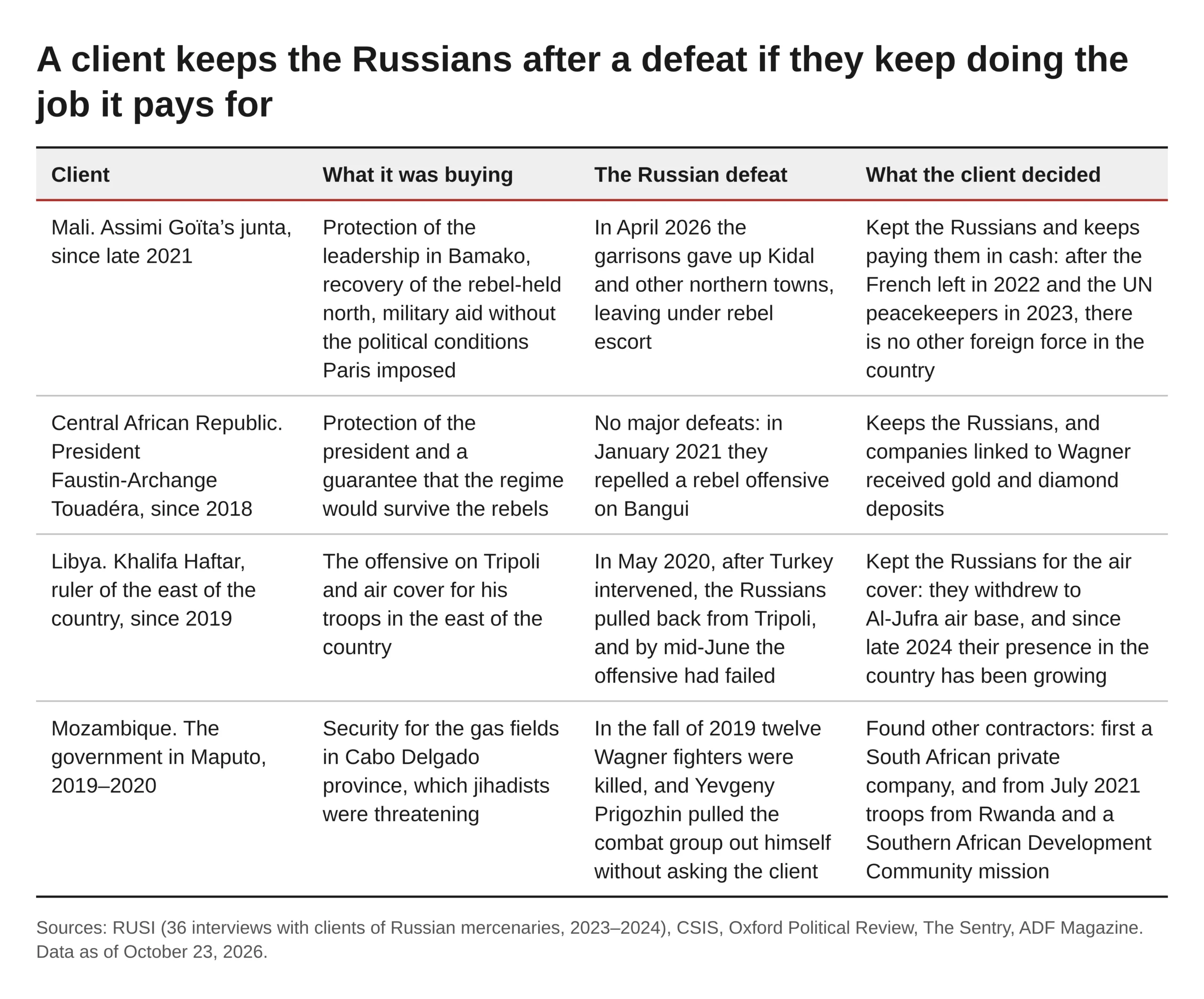
Two other African clients have already faced the same choice after a Russian defeat, and they decided in opposite ways. In Libya, Khalifa Haftar’s offensive on Tripoli, launched in April 2019, was supported in early 2020 by up to 1,200 Wagner fighters. Then Turkey intervened, and by May 24, 2020, the Russians had pulled back from the front lines, and by mid-June the forces of the government in Tripoli had retaken almost all the territory Haftar had seized on the approaches to the capital. The offensive failed, but the client did not change bodyguards. The Russians withdrew to Al-Jufra air base in central Libya, and since the end of 2024 their presence in the country has only grown; part of the supply for the Africa Corps in Mali now runs through Haftar’s Libyan airfields. Tripoli was never Haftar’s only goal, since he also has to hold power in the east of the country, and there the Russians and their aircraft give his troops air cover, a need that no defeat outside the capital can cancel.
In Mozambique, by contrast, cooperation with the Russians broke off almost as soon as it began. In the fall of 2019 about 200 Wagner fighters with helicopters and drones arrived in the northern province of Cabo Delgado to fight local jihadists who were threatening the gas fields on the coast. Within a few months twelve of them had been killed, and by November 2019 Wagner’s owner, Yevgeny Prigozhin, had begun pulling out the combat contingent without asking either the government in Maputo, Mozambique’s capital, or the Russian Defense Ministry. The combat contract was frozen, the instructors and advisers stayed, and each side accused the other of incompetence. By March 2020 the combat group had left the country, after which Maputo gave the fighting to a South African private company and, in July 2021, to troops from Rwanda and a mission of the Southern African Development Community. Mozambique was buying security for a gas field rather than protection for a palace, and when Wagner, the Africa Corps’s predecessor, failed to provide it and then pulled its own people out as well, the client quickly found other contractors.
In both cases everything after the defeat hinged on whether the Russians could keep doing the job they had been hired for. By that measure, Mali after April 2026 is closer to Libya than to Mozambique, because the Malian authorities, like Haftar, pay the Russians to protect their own position, the Russians are so far managing that job, and Bamako has no one to replace them with. The loss of Kidal therefore undermines Moscow’s bargain with Bamako less than the loss of a gas field would have undermined Maputo’s bargain with Wagner.
The Price of a Bodyguard
What is more, Bamako pays the bill for this protection out of its own budget. Mali pays for every Russian fighter in cash, and from the end of 2021 to May 2026 Moscow collected about $900 million that way. For Mali that is serious money: with 2026 budget revenues of about $5.3 billion, keeping the Russian contingent takes 3 to 6 percent of the country’s annual income. By comparison, the member states of the European Union spent 2.7 percent of all government expenditure on defense in 2023, and for that money they maintain entire national armies, whereas Mali pays a comparable or larger share of its budget for 1,500 to 2,500 foreign mercenaries. Moscow hoped to collect part of this bill in gold, and in June 2025 the cornerstone was laid for a gold refinery at Senou outside Bamako that was supposed to give Russia a share of the processing, but as of the fall of 2026 it had yet to start operating. Meanwhile, in February 2026 Washington lifted sanctions on three Malian officials, so the sanctions pressure on Bamako was not merely failing to grow but in places easing.
Moscow has so far failed to make its presence in Mali pay for itself in gold. In the Central African Republic, companies linked to Wagner got access to mining, whereas in Mali such attempts failed, and the cash from the Malian budget is not enough to cover the upkeep of the whole Russian contingent, so Moscow itself makes up the rest, paying for a place beside the government that lets it pursue its strategic goals in the Sahel. Bamako, meanwhile, bargains with foreign mining companies on its own, and after its dispute with Canada’s Barrick, a November 2025 agreement returned to the company the management of Loulo-Gounkoto, the country’s largest gold mine, so the quarrel with a Western company ended in revised terms rather than in the mine being handed to the Russians.
Hence the main difficulty for anyone who wants to push Moscow out of Mali. The retreat from Kidal damages the Russians’ reputation, but a government whose position has worsened needs their protection near the capital even more, so anyone urging Bamako to drop Moscow first has to explain who will do that job in the Russians’ place, and do it without the political conditions that usually make Western aid a deeply unequal relationship with the donor. Any promise to teach the Malian army to fight within a few years loses to help that is needed this month, or this week. So Ukraine will have to work along two lines in Africa at once. Military pressure on the Russian contingent and its logistics ties the hands of the Russian commander, while diplomatic work on the African front has to change the decisions of governments, which are what let Moscow keep its place even after its losses, and both lines lead far beyond Mali, to the ports and capitals along the path of Russian cargo.
The Links Russia Cannot Replace
Russian supply to Mali is arranged so that almost every link in it can be replaced. The port has already been changed, with Lomé following Conakry, and the sanctioned ro-ro ship Patria has for six months been shuttling between Owendo in Gabon and Douala in Cameroon with an unknown cargo, which means Russian ships are already calling at other piers in the Gulf of Guinea as well. Airlines are just as easy to replace, and American sanctions on at least three carriers in 2023 and 2024 did not stop flights to Mali. The same goes for equipment: Russian infantry fighting vehicles ride in the same convoy as Chinese armored cars, and since the winter of 2025 the Malian army has been buying in bulk from Norinco, taking armored personnel carriers and an air defense system. The Russian chain also withstands pauses of a full month, since flight tracking showed not a single flight in three months of 2025 and in February 2026, and although some of those gaps may be explained by switched-off transponders, supply resumed after every such pause.
Only two nodes cannot be replaced: the consent of the state that owns the pier, and Haftar’s Libyan airfields. The other links the Russians can replace, though not quickly, because a new route does not open in a day, and while on paper a port is changed with a single decision, in practice the first convoy from Lomé traveled to Bamako on a road twice as long as the convoys from Conakry.
Both of these nodes have been targeted in other wars, and the result almost always depended on whether the expeditionary contingent had another way through. In 1975, when Cuba was moving troops to Angola to help the government there in its civil war, the United States pressed the states where Cuban aircraft refueled on their way across the Atlantic, Barbados above all, to deny them landing rights. Havana responded by flying its aircraft out of Holguín, a city in the east of the island closer to Africa, with extra fuel tanks fitted in the cabins, while the bulk of its men went to Angola by sea. Pressure on the airfields, without closing the sea, only made the transport more expensive. Things went very differently in Chad, where Libya had held the north for years. In 1987 the troops of Chadian president Hissène Habré, riding light Toyota pickups, took Ouadi Doum, the main Libyan air base in the country, with a garrison of about 5,000, after which the Libyan garrisons in northern Chad were left without air cover and Tripoli had to abandon Faya-Largeau, the main town of the Chadian north, which it had held for four years. The Chadian scenario threatens the Russians only in the air, where there is no substitute for Haftar’s Libyan airfields, and the Africa Corps has in any case already lost Tessalit and its Il-76 runway. At sea, their supply is closer to the Cuban case, because the Russians have already found a way around once, when after Conakry they began unloading in Lomé.
Ukrainians in the Desert
As of the fall of 2026, Ukrainian weapons do not reach Lomé. After the Ukrainian strikes in the Mediterranean, Russia began sailing its ships under the protection of warships, and that caution is no accident, since in 2025 alone at least 11 shadow-fleet tankers were damaged and insurance rates in the Black Sea tripled, but there are still no Ukrainian drones off Lomé or Conakry, and the Conakry–Bamako road is under JNIM attack with or without Ukraine.
On land, however, in Mali itself, Ukrainians are already taking part in the war against the Russians, though as advisers to the Tuareg rebels. On September 12, 2026, it emerged that about 15 Ukrainian specialists working with the Tuareg Front were remotely coordinating drone strikes and, by their own account, had helped take Kidal, and Ukrainian military intelligence openly calls this turning combat experience into an instrument of foreign policy. Back in April the Africa Corps had blamed its defeats on Western intelligence services and “Ukrainian mercenaries”, so that explanation suits Moscow regardless of how many Ukrainians are actually in the desert.
Such involvement has a price for Ukraine, legal and political. JNIM has been on the UN Security Council’s al-Qaeda sanctions list since 2018. The Tuareg Azawad Liberation Front is not on that list, but it fights alongside JNIM in an alliance sturdier than the Tuareg rebels’ alliance with the jihadists in 2012, which fell apart within months. The Front has also accepted sharia norms, so from the outside it is easy to mistake for part of the al-Qaeda network. After the April offensive, when JNIM and the Front drove the Russians out of Kidal and Mali’s defense minister died in Kati, the states of West Africa condemned the attackers, not Russia, and Ukrainian help to the rebels runs against that common position and complicates Ukraine’s future strategic and mutually beneficial partnerships with African states. And if the Russian contingent really is the regime’s last prop, then wearing down its supply brings JNIM’s entry into the capital closer rather than the West’s return, and whoever cuts the road to Bamako has to weigh soberly what he gains himself and for whom he is clearing the way.
What Ukraine’s African Campaign Is Worth
Whether Ukraine’s whole campaign in Africa is worth what it costs is a matter of dispute. In November 2025 the Carnegie Endowment reduced the campaign to little more than one more way of reminding the world about Ukraine, one that brings it no closer to winning the war with Russia, and noted that the number of African states voting for anti-Russian resolutions in the UN General Assembly had fallen from 25 in 2023 to 13 in 2025. The authors at CEPA, the Washington-based Center for European Policy Analysis, saw in that same campaign in April 2026 a limited but precise pressure on a Russian supply network on the African continent that was never built for sustained resistance. What matters more for Kyiv is how many men and how much equipment Moscow has had to do without on the front in Ukraine because of the Sahel, and that figure has yet to be calculated. Moscow is willing to keep paying to rebuild its forces in Mali, so the contest with it in the Sahel may drag on for years, and the forces and money it spends there weaken it on the Ukrainian front only in part, since a large share of the bill for the Russian contingent is paid by Bamako itself. The real price of the African campaign for Ukraine should therefore be measured by what the same specialists and the same money would have achieved in the war for its own territory.
Until that calculation exists, the only thing known for certain is that Moscow keeps few people in Africa. Ukrainian intelligence estimates the entire Africa Corps across nine countries at about 8,000 fighters, less than one Russian division for the whole continent, and it is replenished from the same pool that supplies men for the front in Ukraine. The same goes for equipment: Bamako gets what Moscow can tear away from this war, and that is plain from the composition of the convoys, which often carry more trucks than fighting vehicles. Such supply can be made more expensive and slower from the outside, but in the end only a state that closes its pier or its airfield to the Russians can stop it, and that is exactly where the offer from the West and from Kyiv is weakest.
Bamako’s Neighbors
Togo, which owns the pier in Lomé, has no reason to close it, because handling Russian cargo is just one of many services Togo sells to all comers. Togo behaves the same way in regional politics. Mali, Burkina Faso, and Niger formed the Alliance of Sahel States and in January 2025 left ECOWAS, the Economic Community of West African States, for good, while Lomé in April 2026 hosted a meeting of both blocs and on April 18 announced its own Sahel strategy for 2026–2028. At the same time Togo holds naval exercises with France, discusses with the United States whether American companies would find it worthwhile to work in its port, and receives Russian armor in that very port. A demand to close the pier to one customer asks Lomé to pay for someone else’s victory out of its own revenue.
ECOWAS itself also prefers negotiating with Bamako to pressuring it: after the three states left on January 29, 2025, it provisionally kept the rules of free movement for their citizens, and the Institute for Security Studies in Pretoria rightly warns the community against becoming an instrument in the standoff between the West and Russia. Even the removal of foreign bases does not always sever relations with a former partner, and over the course of 2025 Senegal took back all the French military installations on its soil while keeping its partnership with Paris. But Dakar got there through its own negotiations with the French, and whether Bamako goes the same way with Moscow is for Bamako alone to decide. The West in the Sahel, as anywhere in the world, is also made up of different capitals with different interests. French troops left Niger at the end of 2023 at the new government’s demand, while the Americans stayed for several more months, negotiated their departure separately from Paris, and later, on August 5, 2024, handed their drone base at Agadez over to the Nigeriens. So Kyiv too has to negotiate separately with the European capitals and with Washington, just as it does with non-Western states.
Sanctions are no substitute for this diplomatic work, since economic damage does not turn into political concession by itself, in theory or in practice, and there has not yet been a single case of sanctions changing a decision in Bamako. A mistake in work this delicate hurts above all the one who makes it. After the destruction of a Wagner convoy near Tinzaouaten, a town on Mali’s border with Algeria, in July 2024, Ukrainian intelligence hinted at having helped the Russians’ enemies, whereupon Mali and Niger broke off relations with Kyiv and Senegal summoned Ukraine’s ambassador to protest a video the Ukrainian embassy in Dakar had posted online with an approving comment on the attack. A government that does not want a Russian garrison on its own soil is still not ready to support a war against one in its neighbor’s.
And when foreign troops leave, someone has to decide who will protect the population if the country’s own army is not trained to fight an enemy like the jihadists. During the UN peacekeepers’ withdrawal in 2023, Malian political debate already carried the warning that bases abandoned by the peacekeepers could set off new fighting among local rivals. A future Russian departure will likewise require deciding who takes over protecting the population and whether that can be agreed on inside the country, because without such an agreement Bamako will simply go looking for a new foreign bodyguard.
What Happens When the Instructors Go Home
Even Ghana, which talks readily with Kyiv about drones, does not shun Russian support. On February 25, 2026, its foreign minister, Samuel Okudzeto Ablakwa, held talks in Kyiv on defense cooperation and drones, and in August in Moscow he welcomed Russia’s support in the fight against the jihadist groups of the Sahel. Accra, the capital of Ghana, works with both sides, whereas Kyiv would like to push Moscow out of the region, and selling Ukrainian drones will not keep the Ghanaian minister from going to Moscow again, so with governments like these the Russian presence in the region has to be discussed separately from the sale of military equipment. Kyiv has no shortage of competitors in Ghana even without the Russians. It is home to the Kofi Annan International Peacekeeping Training Centre, named for the Ghanaian diplomat and former UN secretary-general, and on March 24, 2026, Accra signed a partnership with the EU on defense. So when in May the Ukrainian foreign ministry offered Africa its experience in using drones and defending against them, Kyiv was stepping onto a field where the Europeans and the Ghanaians themselves were already at work.
Help from several partners at once, though, sometimes unsettles a state instead of strengthening it. In Niger the mobile border companies trained and equipped by the European Union’s mission formally belonged to the police but received heavy weapons and military training, which sharpened the rivalry with the rest of the police, and when the National Guard also set up similar units with the same European money, the agencies began to argue over who should do what on Niger’s borders. When outside partners fund different agencies, each agency adapts to its own donor, and a government that receives more and more aid finds it harder and harder to manage its own agencies, because each pulls in its own direction.
To hold up in a direct comparison with Russian help, a Ukrainian offer has to leave the African government full control over training and equipment and let it carry on by itself even after the Ukrainian instructors go home. Accra, like any other African partner state, decides for itself which units to train. The first cycle is run together with local instructors, the next the Ghanaians run on their own, and maintenance of the imported equipment is assigned to a local workshop. Money for deliveries will of course have to be found separately, because under the March partnership with the EU, Ghana receives European equipment. The weak spot of such a program is obvious: Moscow offers governments protection for the head of state himself and his entourage, whereas training an army bears fruit slowly and may strengthen army and police officers whom the country’s leader may not trust. A Ukrainian program risks losing if it comes to a country where the Russians have already taken the place beside the government, or if within a year the drones it handed over are sitting idle for lack of spare parts. It can win by leaving behind a skill that outlives a change of leadership and at the same time poses no threat to the government in power, and may even strengthen it. Such a program, though, demands staying power from Kyiv itself, and consistency is precisely what Ukrainian policy in Africa lacks. German policy in Mali also showed how the reasons for coming to a country diverge from the reasons for staying in it, so the program should be built to keep working after the diplomats who launched it have scattered to new posts.
Five Ways to Squeeze the Africa Corps
Strikes on ships and convoys end up in bystanders’ phone videos and on satellite images, which makes them look like the main way of pressuring Russian supply to Mali. In fact there are at least five such ways: the port, the Libyan airfields, the Malian government’s money, kinetic action, and a precise accounting of how much strength Russia is spending in Africa. Ranked by power, kinetic action, meaning the destruction of enemy personnel and equipment, comes only fourth, and the stronger the lever, the less it depends on what Kyiv does. The pier in Lomé belongs to Togo, the Libyan airfields are controlled by Khalifa Haftar, the military ruler of eastern Libya, and sanctions on Malian officials and the terms of IMF loans are set in Washington and Brussels. In all three cases, then, the most Kyiv can do is persuade whoever holds the lever. Only the last two are fully in Ukraine’s hands: its own weapons and a precise count of Russian losses in Africa.
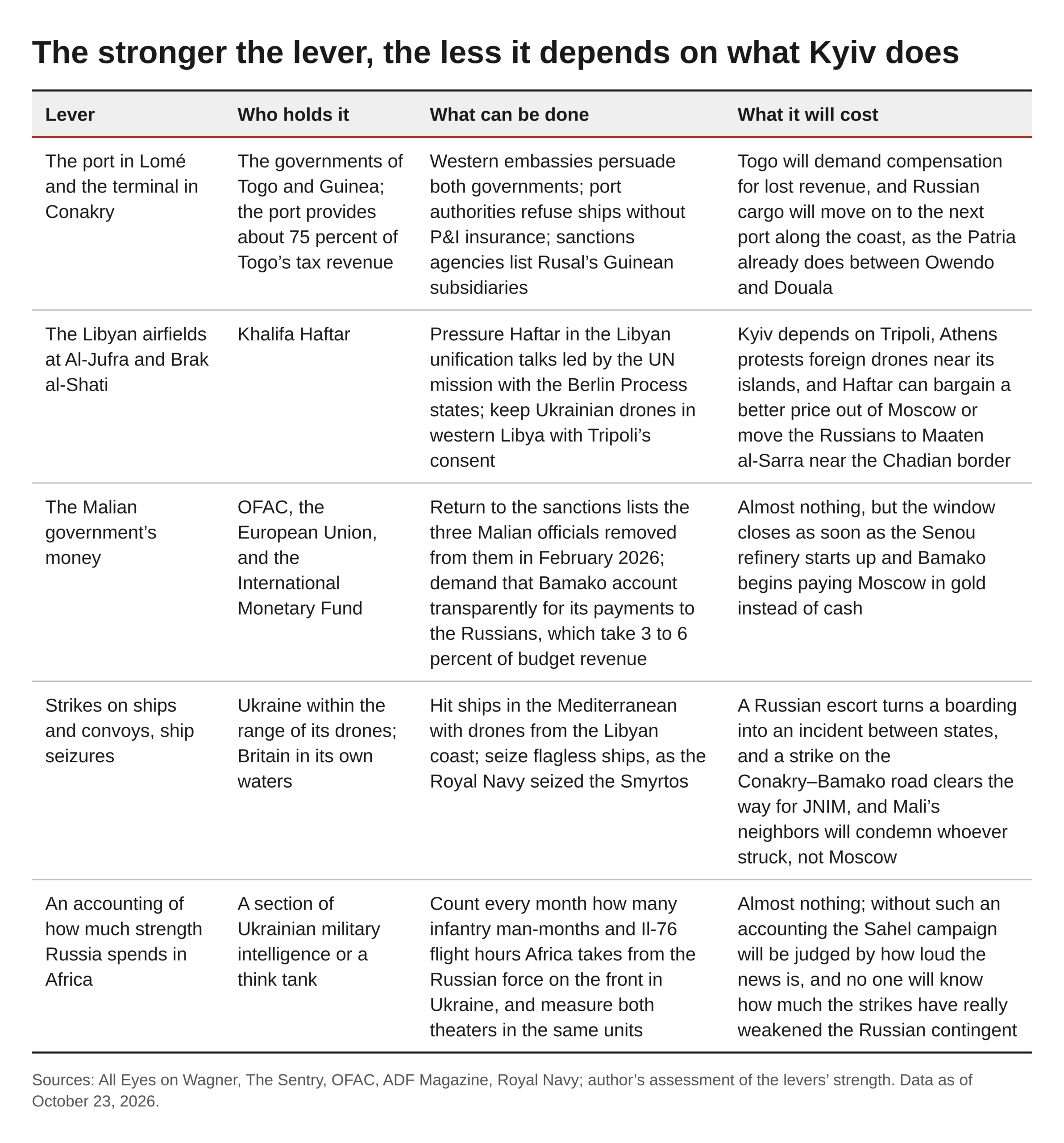
The place to start is the strongest lever, the port in Lomé, Togo’s capital. About 75 percent of the country’s tax revenue depends on it, so loud articles in the Western press will change little here; it is the Togolese government itself that has to be persuaded, and the persuading has to be done by Western embassies in Lomé and Conakry. There is an argument the port authorities will hear: a ship without P&I insurance, that is, without third-party liability cover, leaves behind losses that no one will pay for. Sanctions agencies, meanwhile, can list the Guinean subsidiaries of Rusal, the Russian aluminum group that works with the terminal in Conakry. Togo, of course, will demand compensation for lost revenue. And if the diplomatic pressure works too well, Russian military cargo will simply move farther down the coast, as the Patria already shuttles between Owendo and Douala, and then the next capital will have to be persuaded, while the Africa Corps’s supply falls behind schedule in the meantime.
The second node the Russians have no substitute for is the Libyan airfields at Al-Jufra and Brak al-Shati. Haftar holds them, and any deal with him will have to be made within the talks on reunifying Libya, which the UN mission leads and which the states of the Berlin Process have backed since 2020, among them the United States, the leading European capitals, Turkey, Egypt, and Russia itself, so Kyiv is not the main voice in that conversation. What Ukraine adds to the pressure is its presence in western Libya with Tripoli’s consent, because as long as Ukrainian drones can take off from that coast, Haftar has to reckon with the threat. The price of that presence for Kyiv is dependence on Tripoli, and for Greece it is foreign drones near its islands, over which Athens has already protested. On top of that, Haftar can simply bargain a better price out of Moscow, and if under Western pressure he does close Al-Jufra air base in the center of the country to the Russians, they will move to Maaten al-Sarra near the Chadian border, which they have already rebuilt.
The West’s third lever costs almost nothing yet hits the Malian government where it hurts. OFAC, the U.S. Treasury’s Office of Foreign Assets Control, and the European Union can return to their lists the three Malian officials removed from them in February 2026, and the International Monetary Fund can demand transparency about the payments to the Russians, which eat up 3 to 6 percent of budget revenue. But this has to be done quickly, because as soon as the Senou refinery starts up and Bamako begins settling with Moscow in gold instead of cash, spending on the Russians will vanish from the budget reports, and with it the formal grounds for the IMF to ask about it.
Kinetic action comes only fourth because Ukrainian weapons can reach only a few of the links in the Russian chain. Ukraine can act where its weapons reach, that is, over the Mediterranean, within range of drones from the Libyan coast, and the British Royal Navy can seize flagless ships in its own waters, as happened with the Smyrtos. But each such step carries a price. A Russian escort turns a boarding into an incident between states, and a strike on the Conakry–Bamako road clears the way for JNIM, which sits on the UN Security Council’s sanctions list, and Mali’s neighbors will condemn whoever struck, not Moscow.
The fifth lever is the cheapest, but without it Ukraine’s entire long-term strategy in the Sahel will operate blind. All it takes is one section of Ukrainian military intelligence, or a think tank, that counts and analyzes Russian losses. That section has to produce a single measure for both theaters of war: how many man-months of infantry and flight hours of Il-76s Africa takes from the Russian force on the front in Ukraine. Without such a count, the campaign in the Sahel will go on being judged by how loud the news is, as it was in November 2025, and no one will be able to say with confidence how much the strikes and the other levers have really weakened the Russian contingent in Africa.
The Gateway to the Sahel Closes Slowly
A weaker Russian contingent, though, does not yet mean the Russians will leave Mali. The Russian presence there will last as long as Bamako needs Russian protection and Moscow is willing to bear the human and financial costs for the sake of influence in the Sahel, which for Moscow is only part of a broader African strategy planned for years ahead. The Africa Corps no longer fights the way it fought in 2024, but it has not lost its place beside the Malian government. It has given up almost the entire north of the country, assigned its armor to escorting tankers, lost two of its roughly fifteen helicopters in ten weeks, and pulled its garrisons out under enemy escort, and the Malian government keeps paying, because what it is buying is its own survival, and that the Russians still provide even after their defeats. Pressure on supply can weaken the Russians further, but whether it pays for Ukraine depends on the price Ukraine pays for it, and that price Kyiv will have to calculate itself. The Africa Corps’s combat power and its presence in Mali also rest on different foundations: the first is set by supply, the second by the will of the government in Bamako, which this summer, for all the Russians’ defeats, decided to keep them. So the fate of the Russian presence in Mali will turn on two decisions. One has to be made by one of the coastal states, when it refuses to accept Russian cargo and bears the economic consequences of that refusal, and the other remains with Bamako, which may one day decide that it no longer needs Russian protection. These decisions are made by different governments, and neither is directly tied to the other. Until one or the other happens, the crane in Lomé will keep lifting Russian containers, and no single blow will close this gateway to the Sahel. It narrows only under pressure kept up for years, when the Russians are made to change ports again and again and to run every convoy through their enemies’ ambushes, and only under that kind of pressure will there come a day when a Russian convoy simply does not get through the gate.
Author – Kyrylo Pertsovsky, junior researcher in the “African Studies” programme at the ADASTRA Analytical Centre
Did you enjoy the article? Then support us on Patreon to help us to produce more original analysis!