The
term North Atlantic Treaty Organization gives a clear understanding of the
alliance’s fundamental core in geographical terms. However, the northernmost
part of the Earth has often been conspicuously absent from discussions in even
academic circles regarding the activities of the organization in question. This
frequently overlooked terrain is of course the Arctic – that is to say
the area within the Arctic Circle, a line of latitude about 66.5° north of the
Equator [1]. So, has the Arctic indeed been persistently pushed to the
periphery of NATO’s concerns, or is this unique land in fact gaining an
ever-increasing geopolitical significance? To answer these pressing questions,
an analysis of the evolution of the alliance’s presence in the High North is indispensable.
First
and foremost, it is vital to point out that since its inception NATO has
acknowledged the strategic value of Arctic in the bipolar period of
confrontation known as the Cold war. Such acknowledgement was largely
attributed to the fact that the alliance on the one hand, and the Soviet Union
on the other, did not exclude the possibility of conducting a nuclear exchange
over the territories of the High North, however apocalyptic such a prospect
seemed. Thus, within a few years of the alliance’s establishment, two prominent
members of NATO, namely the United States and Canada, started building Distant
Early Warning systems with 26 radar stations from Point Lay in Alaska to Cape
Dyer on Baffin Island in Canada [2].
Moreover, the USA needed to ensure the
capability of detecting intercontinental ballistic missiles which potentially
could have been launched by the Soviet Union and directed at North America.
With this hard security consideration in mind, the United States
initiated the construction of a new Early Warning Radar station at Thule in
Greenland, which is an autonomous country of the Kingdom of Denmark – one of
the founding states of NATO. As the Cold war unfolded, NATO members were
upgrading their military infrastructure in the Arctic region in order to guarantee
effective defence. The USSR totally reciprocated in the growing arms race in
the High North. It is worth mentioning that the Soviet Union conducted 130
nuclear tests in the Novaya Zemlya archipelago [3]. To put it in a nutshell,
although a direct clash between NATO and the Eastern Bloc did not take place in
the Arctic, this northern region witnessed a considerable militarization.
Learn more: The future of NATO in the context of European security
The
collapse of the USSR has substantially altered the geopolitical situation
throughout the entire world. The Arctic region was no exception to this
transformation of the world order. After decades of constant fears of
accidental or deliberate escalation resulting in a bitter warfare, the level of
militarization of the High North was significantly reduced. Headquarters Allied
Air Forces Northern Europe located in Norway was closed in 1994 and further
structural changes in NATO’s presence in northern Europe occurred, placing less
emphasis on the Arctic dimension. Soon afterwards NATO became absorbed in
conflicts in Yugoslavia and Afghanistan, which consumed virtually all of the
alliance’s energy. Meanwhile, the Russian Federation was preoccupied with
rebuilding its economy and did not possess enough resources to allocate them
for hitting ambitious foreign policy targets. As a direct outcome of these
processes, the strategic vitality of Arctic was enormously diminished.
Actually,
the major powers’ attention towards the Arctic after the Cold war has been
shifted from issues of hard security to the concept of soft
security. Such a pivot was particularly visible at the NATO Seminar on
Security Prospects in the High North held in Reykjavik in 2009. The
participants of this seminar recognized a number of new fundamental challenges
to security for circumpolar states in the 21st century. Chief among
those were the phenomenon of climate change and its profound impact on the
Arctic in terms of emerging sea lanes, as well as the implications of
discovered Arctic energy resources. The rationale for highlighting these issues
was unquestionably quite relevant. The
menace of nuclear confrontation over the Arctic has been replaced by the
simultaneous peril and opportunity of global warming in the High North.
According to the special report drawn up by the Economist, since 1951 Arctic
has warmed roughly twice as much as the global average [4]. With such
unprecedented rates of climate change and the ensuing acceleration in the melting
of ice, Arctic ocean is projected to become seasonally ice-free as early as 2030
[5].
Consequently, maritime routes through this ocean via the Northeast passage
and the Northwest passage may soon become better alternatives to the currently
dominant Suez and Panama canals by reducing the travelling distance between the
world’s major ports. Furthermore, according to findings of the US Geological
Survey in 2008, the Arctic holds approximately 13 percent of the world’s
undiscovered oil and nearly 30 percent of the world’s undiscovered natural gas
[6]. Given the abovementioned, the conclusion of the participants of Reykjavik
NATO Seminar appears logical that the alliance should henceforth deal primarily
with issues of soft security in the Arctic. Member-States decided not even to
make references to the challenges presented by the climate change in the High
North while drafting the alliance’s new strategic and defence concept at the
2010 Lisbon Summit. What is more, in 2013 NATO Secretary-General Anders Fogh
Rasmussen stated that NATO “had no
intention of raising its presence and activities in the High North” [7]. Allies
did not imagine that very soon hard security would dramatically return to the
top of the alliance’s agenda in the High North…
You may be interested in: NATO Space policy: Integrated response to incoming threats
The
years 2014 and 2015 have been characterized by a rapid deterioration in
relations between NATO and Russia following the annexation of Crimea, the
escalation of conflict in Syria, the imposition of sanctions and the return of
mutual hostility. The spillover effect of this “new old” geopolitical
competition has had a detrimental effect on the Arctic as well. Although the
provocative planting of the Russian flag on the seabed beneath the North Pole
in 2007 was a worrying signal, in general Russia’s relationship with NATO with
regard to the High North has been constructive for two decades after the breakdown
of the USSR. However, in recent years the Russian Federation maximized efforts
to turn Arctic into its sphere of influence. Not only has it rebuilt Soviet and
constructed new military bases and airfields, but also established an Arctic
command, secured the world’s largest fleet of icebreakers, including
nuclear-powered ones, and even threatened to unilaterally deploy force in order
to protect its sovereignty over the Northern Sea Route.
Quite naturally, NATO
had to swiftly adjust to such circumstances. Holding giant military exercises
in the High North was chosen by the alliance as the most appropriate response.
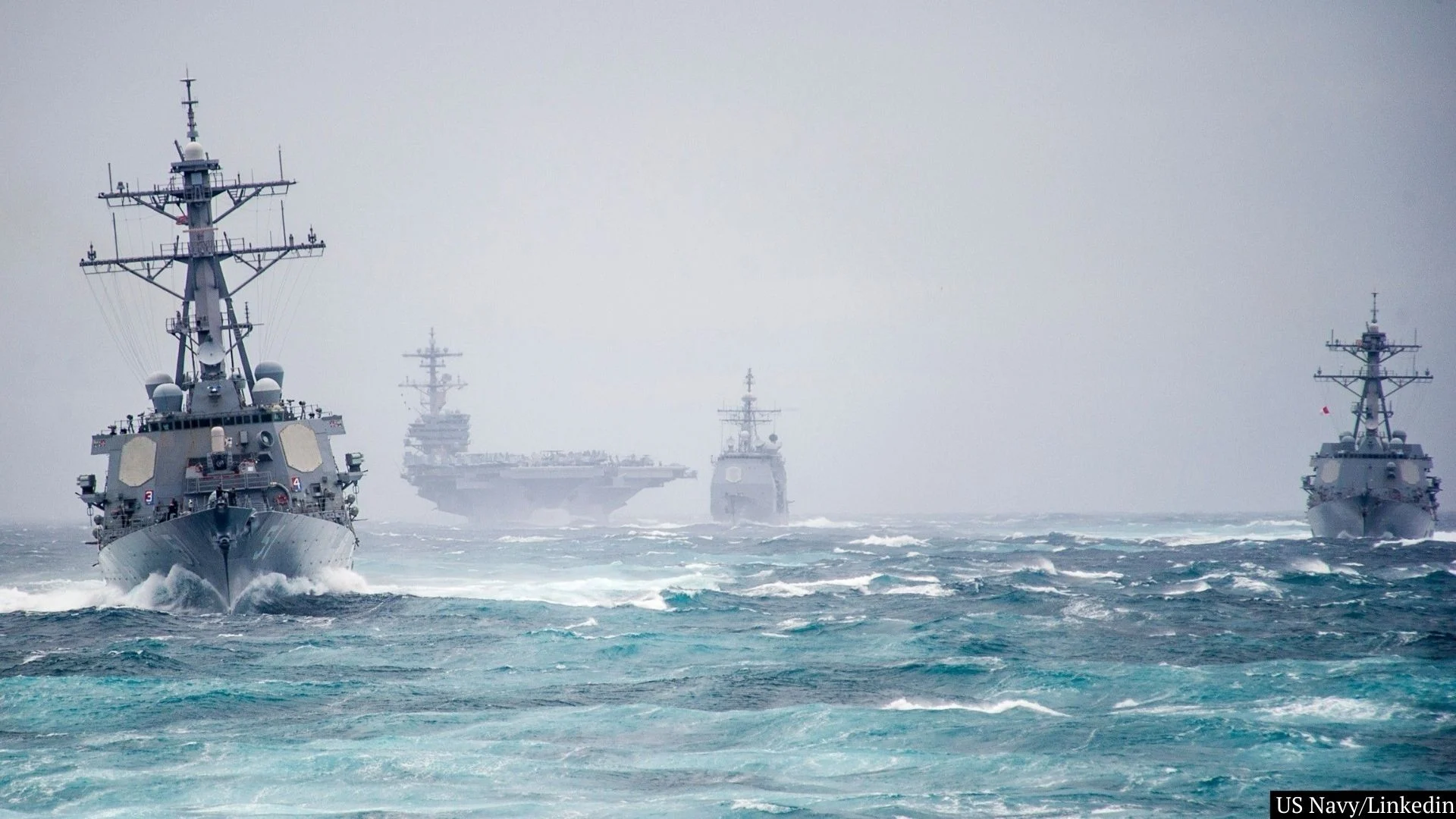
The previous year proved remarkable in this regard. From October 25 to November
7 NATO conducted Trident Juncture – the alliance’s most grandiose exercise
since the Cold war. Apart from all Member-States, Sweden and Finland also
participated in Trident Juncture as NATO’s enhanced opportunities partners. The
exercise, held in Norway, displayed an astonishing number of 50,000 personnel,
10,000 vehicles, 250 aircraft and 65 ships [8]. The United States of America
even contributed for the first time since the end of the Cold war the aircraft
carrier
USS Harry S. Truman specifically for this exercise. Undeniably, such a
formidable military drill demonstrated modern NATO’s strengthened deterrence in
the Arctic.
To
crown it all, NATO’s presence in the Arctic region has undergone a noticeable
evolution throughout seven decades. It looks reasonable to summarize it as a boomerang effect. Hard security matters in the High North were prevalent for the
alliance during the turbulent Cold war period. They were overshadowed by a
hopeful vision and predominance of soft
security concerns after the collapse of the Soviet Union. But nowadays hard security in the Arctic is once
again front and center, as evidenced by the latest huge NATO’s Trident Juncture
exercise aimed at solidifying the alliance’s credible deterrence in view of the
rising geopolitical tensions in the strategically significant High North.
Author: Oleksii Panchak, Senior Fellow for Korean
Studies and Polar Studies in Think Tank ADASTRA.
References
[1] National
Geographic Encyclopedia. Arctic, viewed 10 July 2019.
https://www.nationalgeographic.org/encyclopedia/arctic/
[2] Taagholt J., Hansen J.C., 2001. “Greenland Security Perspective”. Arctic Research Consortium of the United
States, p.36, viewed 10 July 2019.
https://www.arcus.org/files/publication/24792/greenland.pdf
[3] Connonly G.E. “NATO Parliamentary Assembly Report”. NATO and Security in
the Arctic, viewed 10 July 2019.
https://www.nato-pa.int/download-file?filename=sites/default/files/2017-11/2017%20-%20172%20PCTR%2017%20E%20rev.1%20fin%20-%20NATO%20AND%20SECURITY%20IN%20THE%20ARCTIC.pdf
[4] The Economist
Special Report. “Cold Comfort. The Melting North”, viewed 10 July 2019.
https://www.economist.com/special-report/2012/06/16/the-melting-north
[5] Wynn G., 2013. “Ice-free Arctic Ocean in 2030?” Reuters, viewed 10 July 2019. https://www.reuters.com/article/column-wynn-arctic-ice/column-ice-free-arctic-ocean-in-2030-wynn-idUSL5N0BE5PA20130215
[6] King H.M. “Oil and Natural Gas Resources of the Arctic”. Geology.com, viewed 10
July 2019
https://geology.com/articles/arctic-oil-and-gas/
[7] O’Dwyer G., 2013. “NATO Rejects Direct Arctic Presence”. Atlantic council, viewed 10 July 2019.
https://www.atlanticcouncil.org/blogs/natosource/nato-rejects-direct-arctic-presence
[8] Trident
Juncture 2018: Participation. NATO
International, viewed 10 July 2019.
https://www.nato.int/nato_static_fl2014/assets/pdf/pdf_2018_10/20181024_181024-TJ18-briefing-slides.pdf