
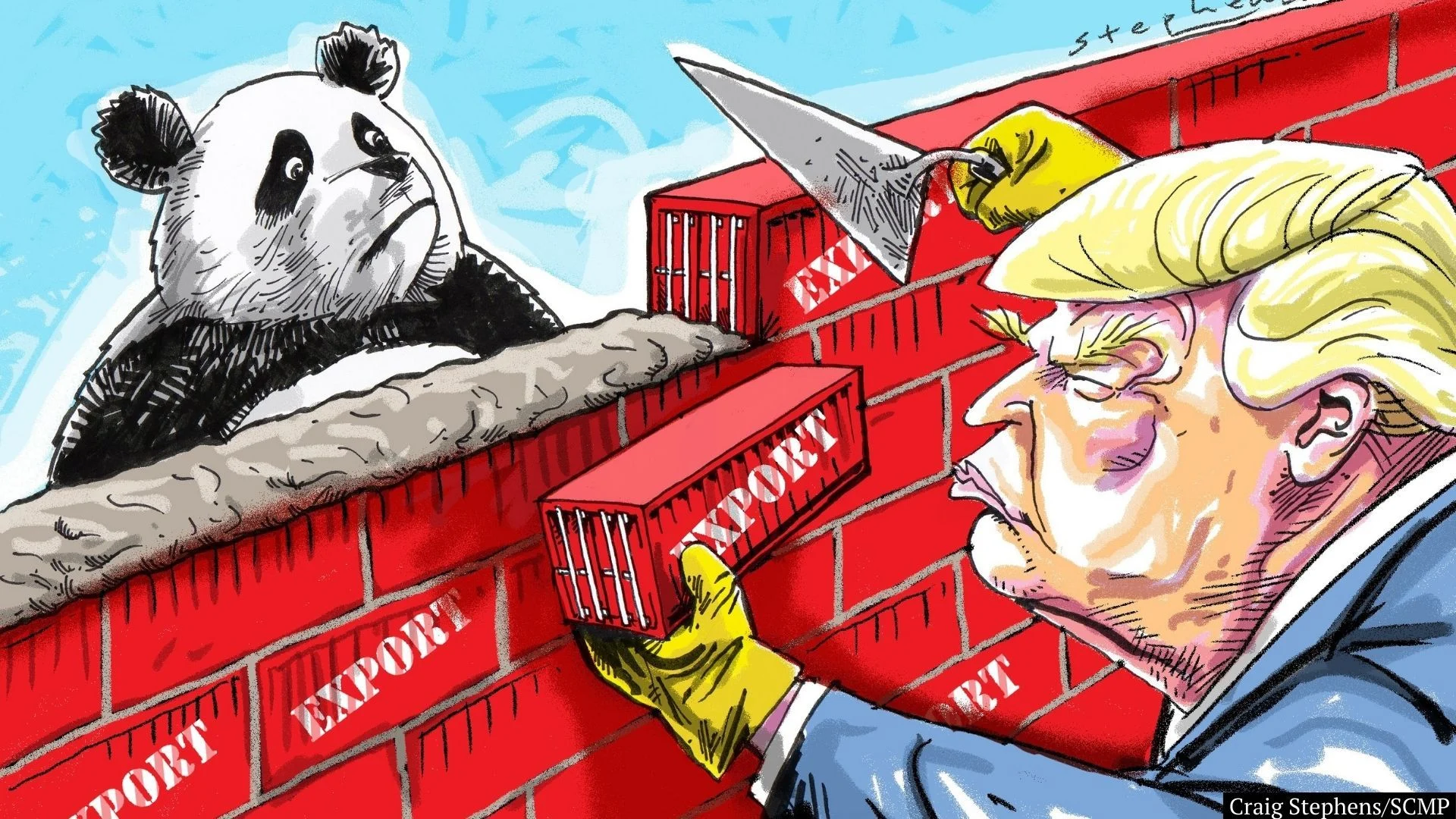
In 2001, China joined 159 other countries in the World
Trade Organization, which exists as an
organization where member governments try to sort out the trade problems they
face with each other (WTO). This seemed promising at the time for the United
States, as the two parties signed an agreement that would open each other’s
markets for one another, and perhaps now China would gain more of an influence
from American capitalism. However, this image of China’s future proved to be
far too optimistic. It would continue its poor economic practices even after
its admission into the World Trade Organization, namely their use of slave
labor, the security threat their companies pose to the United States, as well
as their currency manipulation, which in turn increases the United States’
trade deficit with China, as well as causing the loss of American jobs.
Therefore tariffs should be raised on Chinese imports.
Human Rights Abuses in
Production
As the typical American consumer browses the internet
on their new cell phone, pours coffee from their coffee machines, and wears a
face mask to protect themselves and others from the spread of disease, they
remain blissfully unaware of just how the product they use in their day to day
life has been manufactured. As a method of fighting so-called “religious
extremism,” the Chinese government persecutes Xinjiang’s Uyghur population, or Muslim
Turks native to Xinjiang. The Chinese Communist Party accomplishes this through
many cruel practices that violate human rights, which include detaining them in
prison labor camps, hundreds of thousands of miles away from their home, that is,
in turn, forcing them to work against their will, so that they can escape from
the so-called “poverty” that they were living in and become integrated within the rest of society. They do so while learning to
appreciate the Chinese Communist Party, are forced to abandon their religion
and cultural values, and partake in mandatory activities such as Mandarin and
ideological training, according to a New York Times Visual Investigation by Muyi Xiao and Christoph
Koettl.
Read more: Chinese Leadership: From ‘Soft Power’ to ‘Sharp Power’
Another account from International Cyber Policy Center
researcher Vicky Xiuzhong Xu states that even recently between the years
2017-2019, as many as 80,000 innocent Uyghurs from Xinjiang were being
transferred through labor markets, most likely from prisons and ‘re-education’
camps they are detained in beforehand. In these labor markets, they are forced
to produce goods that are not only consumed in China but internationally as well.
“Under conditions that strongly suggest forced labor, Uyghurs are working in factories that are in the
supply chains of at least 83 well-known global brands in the technology,
clothing, and automotive sectors, including Apple, BMW, Gap, Huawei, Nike,
Samsung, Sony, and Volkswagen.” The report, titled “Uyghurs for sale:
‘Re-education’, forced labor and surveillance beyond Xinjiang,” also went into
detail on the work environment minorities in China are presented with: Even
well-known factories for American brands imprison their workers with barbed
wire fences, watchtowers.
Such is the case with a Taekwong plant in Qingdao, a
company that makes materials for Nike shoes. By participating in free trade
with China, we are allowing them to manufacture the goods that we rely on under
these kinds of conditions. Given that the United States is a country that
strongly believes in human rights and free speech, the thought of partaking in
free trade with a country that denies its citizens the rights they are endowed
within the Chinese Constitution is deplorable. By imposing tariffs on Chinese
products, thus making Chinese products more expensive for the American consumer
than domestic products would be, American consumers would be discouraged from
purchasing imported products made by human rights abusers such as China, and
instead purchase domestic products made by more humane methods.
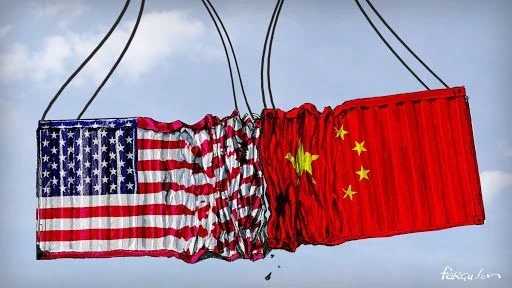
Source: Financial Times
A Threat to U.S. Security
However awful China’s human rights abuses in
manufacturing may be, the potential dangers Chinese manufacturing poses to our
security must also be considered. Technology firms such as Huawei have been
accused of being a security threat to the United States, which suspects the
cellphone company of taking orders from Beijing. The tech-firm has also signed
a deal with the Syrian Governments’ Communications and Technology Ministry.
Similarly, the second largest Chinese tech-firm, ZTE, was caught breaking
sanctions placed against them when they sold American components to Iran, and
283 shipments of servers, microprocessors, and routers to North Korea, in turn
violating embargoes set there by the United
States.
Some internal documents
exposed by the United States commerce department showed that ZTE even had plans
to distribute not only to countries that we hold a contestive relationship such
as Iran and North Korea, but also Cuba, Syria, and Sudan, all of which also
have embargos put in place by the United States. Thus, tariffs on Chinese
imports will cause China, in turn, to impose retaliatory tariffs on American
products, hence reducing the risk of those products ending up in the hands of
countries the United States considers adversaries.
Check out: The Resource Curse: Path toward Stagnation or
Development?
Along with their sanction violations, Huawei’s 5G
towers have proven to send messages in unencrypted form, which means “Anyone
with control of the masts can see what the user’s web browser is sending and
receiving when they browse unencrypted websites. That content includes cookies
and other data that could identify the user by name,” Huawei’s CEO has denied taking
orders from Beijing multiple times. Whether this is true or not, having
messages sent in unencrypted form means that anybody can see this at any time,
and anyone can request to see the messages, including the Chinese government.
“Michael Howard, senior research director at IHS Markit for carrier networks,
said the ‘biggest issue is that any and all equipment from any vendor can be
compromised by any knowledgeable rogue person.’ That means private actors hacking for money, as well as the
US’s fear — government-sponsored actors.”
This means that if the United
States were to allow any companies such as Huawei into the market, it could
potentially risk their Huawei users losing their privacy because their data is
not encrypted, allowing anyone to see what the contents of their messages are.
Thus, imposing tariffs on Chinese products could discourage American consumers
from purchasing them, by extent limiting companies such as Huawei’s foothold in
the American marketplace, making it impossible for them to construct their 5G
towers in the United States.
Damage to U.S. Economy &
Tariff Benefits
Finally, in discussing reasons as to why Tariffs on
Chinese goods should be considered, the damage dealt with the United States’
economy should be considered. “The U.S. merchandise trade deficit with China in
2018 was $419 billion (up from $376 billion in 2017), and is by far the largest U.S.
bilateral trade imbalance.” A trade deficit means that a country is importing
more than it is exporting, and is neither inherently good nor bad. However, if
a deficit is large and persisting, it can eventually lead to an entity
declaring bankruptcy. Especially since the Congressional Research Service has
stated that our deficit with China is the largest, then this should be cause
for alarm. Hence, by increasing tariffs on imported goods, consumers would
become more inclined to purchase domestic goods instead.
Part of the reason our trade deficit with China is so
large is that China has been a known manipulator of its currency. President of
the Peterson Institute of economics Fred Bergson explained how exactly this is done:
“China has intervened massively in the foreign exchange markets for at least
five years, buying at least $1 billion every day to keep the dollar strong and
its renminbi weak.” By undervaluing its renminbi to our dollar, China is
essentially lowering the price of its exports and eliminates its trade deficit.
This is how China discourages imports and encourages the
use of domestic products.
The manipulation of China’s currency has had drastic
effects on United States manufacturing jobs. As Edmund L. Andrews accounted in
his New York Times article “U.S. Adds Punitive Tariffs on Chinese Tires”:
“American imports of Chinese tires tripled between 2004 and 2008, and China’s
share of the American market grew to 16.7 percent, from 4.7 percent, according
to the United States Trade Representative. Four American tire factories closed
in 2006 and 2007, and several more are set to close this year.” This is just
one of many examples of how Chinese manufacturing has killed off manufacturing
in the United States. The reason many of the products Americans use in their
day to day lives are produced in China, although coming from American
companies, is partly because manufacturing there costs significantly less in
China thanks to their devaluing of the Renminbi to the Dollar. As a
consequence, 3.7 million United States jobs were lost, and manufacturing jobs
in the Steel and Aluminum industries continue to be threatened to this very
day.
So what kind of benefits can tariffs bring? By
increasing tariffs on foreign products, the United States is by extent
encouraging more spending towards their products rather than products imported
overseas, while also restoring American manufacturing jobs. In recent years,
this Trade War has shown success in bringing back American manufacturing jobs.
With these continuous tariffs on imports, this now also opens the possibility
of manufacturers relocating outside of China, to avoid paying tariffs. “Of the
$31 billion in U.S. imports that shifted away from China, some 46% was absorbed
by Vietnam, sometimes by the same Chinese suppliers who left the mainland.
Vietnam exported an additional $14 billion
worth of manufactured goods to the U.S. in 2019 versus 2018 as a result of that
shift.” By shifting manufacturing to Southeast Asian countries such as Vietnam,
importers now do not have to pay as much of a tariff on these goods, hence
creating less of a cost for our manufacturers importing goods.
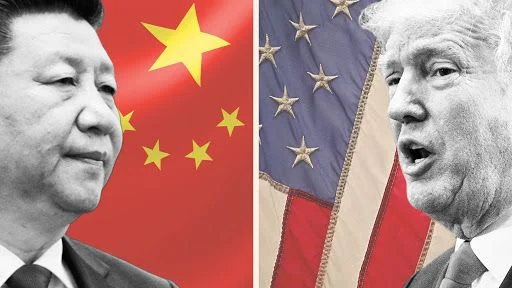
Source: Financial Times
Conclusion
Although it remains a controversial topic, raising
tariffs on Chinese goods will prove to be a better option for the United States
in the long run. This would mean that manufacturers would be pressured to move
out of China to export goods to the United States so then United States
consumers would not have to pay the tariff on imported products that they would
if the product was manufactured in China. Hence, these products would not be
made utilizing the same labor from enslaved minorities like they are in Chinese
factories, further aligning with our humanitarian values, and this would make
the American market less approachable for Chinese companies that are accused of
being security threats to the United States, such as Huawei and ZTE.
Written by Alexander Pepper, Grand Valley State
University (United States), Major in International Relations