
One of the most interesting political and economic phenomena that can
be observed in the international arena is the fact that many developing
countries that are rich in natural resources have lower economic growth rates
than countries without natural resources. At the same time, among the countries
with the largest oil reserves, only Canada and the U.S can be classified as
democratic while the rest are either Arab monarchies or countries with weak
democracies such as Venezuela and Russia. Nowadays, under the condition of low
oil prices, this issue is becoming even more relevant. So why the abundant
presence of natural resources slows down economic growth and political
development in some countries while becoming a source for better economic and
political outcomes for others?
Successful examples
The presence of natural resources has allowed several
countries to transform from relatively poor economies into leaders of economic
development. Because of its forest resources, Sweden transformed into an
industrial economy exporting technological goods around the world (Lindahl et
al. 2017). Similarly, Finland with company Nokia which for decades produced
paper and wood products (Schienstock, 2007). After the high income from its
initial business, it was able to create and develop a high-tech
telecommunication division which has later become the world leader in the
telecommunications industry. Furthermore, in several historical episodes,
countries like Australia and Botswana became richer not only due to the
diversification policy but due to the efficient technological use of their
resources (Lederman and Maloney 2007: 198-214). It
led to a more efficient search and extraction of raw
material.
In these countries, because of the efforts of the
well-trained geologists and engineers, new deposits of natural resources were
consequently discovered, mined, and exported. The discovery of natural
resources was so effective that the total stock of many types of minerals
continued to increase despite the continuous mining and exhaustion of
previously discovered deposits.
It is obvious that national companies can further
transform into international ones and operate all over the world. Consequently, the income from natural resources can
contribute to domestic investments which further lead to the accumulation of
physical capital, advanced technologies, and higher qualifications of workers.
This, in turn, creates a good environment for economic diversification.
However, even in the absence of diversification, income may increase due to the developed commodity market thus leading to a
higher level of consumption and savings.
Read more: Integration of Allies’ National Cyber Effects into NATO
Operations and Missions
Human capital
Unfortunately, some countries are not able to use
their resource wealth in such a manner where a systematic increase in income,
steady economic growth, and political stability occur. Among the main limits in
countries where natural wealth does not lead to constant economic growth is the
deficit of human capital. The most frequent manifestation of a shortage of
human capital is the low efficiency of its extractive industry.
The shortage of highly specialized geologists and
engineers leads to an increase in the extraction of natural resources in a way
where the constant discovery of such deposits is extremely unlikely and
therefore, leads to the exhaustion of natural resources in a relatively short
time (Zafar et al. 2019: 2-4).
For example, during the second half of the 19th
century, Chile’s “economic dynamism was
based on agricultural exports and mining resources”; however, around 82% of its
population was illiterate. This, in turn, led to the lack of diversification
policy and fast exploitation of natural resources which further resulted in a
few crises (Ducoing et al. 2018: 5-6). The Chilean economy was
historically facing significant impediments toward achieving economic stability
and constant political development. As the Chilean economy was mainly based on
mining resources such as tin and copper, it was extremely vulnerable during the
falls in mineral prices.
To put it in the modern context, for many developing
countries, the income from the export of natural resources still accounts for a
significant share of their GDP. For example, in 2017, the income from the
natural resources accounted for 42.5% of the GDP of the Republic of the Congo,
38.5% for Libya, and 37% for Kuwait (The World Bank 2017). Therefore, such
reliance on natural resources makes the economy extremely fragile during
periods of falls in mineral prices. To avoid this, the dependency on natural
resources has to be decreased. For instance, the government of Kuwait has
recently realized that most of its natural resources will not last forever.
Consequently, its government has implemented the “Vision
2035: New Kuwait” program to reduce its
dependency on oil and other natural resources. This, in turn, will be done
through reforming the land sector which will lead to more investments and
consequent economic diversification (Zakout, 2019).
Go to: Implications
of Russia`s A2/AD capabilities in Kaliningrad for NATO security
In other words, human capital plays a crucial role not
only for the natural resource sector itself but also for the diversification of
the economy. If the country has insufficient human capital, it becomes
challenging to get highly-specialized workers necessary to implement a
diversification policy even if financial support from the government is
provided for this. However, what if the country, for
example, will develop a great educational system? Would it be able to
accumulate human capital and implement successful economic diversification?
Institutional impact
The accumulation of human capital and further economic
and political development would be very challenging if the country lacks
transparent economic and political institutions. In other words, if the economy
is not endowed with transparent branches of power and a developed financial
sector, natural resources can hardly help its economic and political
development. In the case of insufficient development of the financial system,
well-educated and qualified individuals will experience problems with obtaining
loans and other financial help to build their businesses or to realize their
professional capabilities.
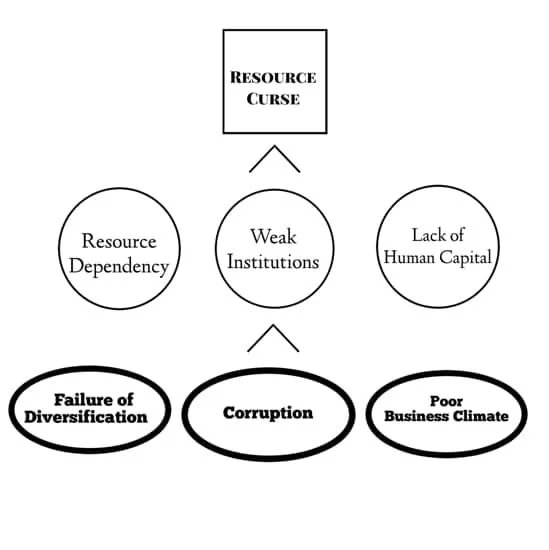
Figure
with the causes of the resource curse.
For example, in Russia, highly qualified individuals in the
«tech sector» experience significant challenges in getting sufficient
financing for their businesses. The recent «Skolkovo» project in
Russia was implemented to resolve the aforementioned issue. It was designed to
be a «Russian Silicon Valley» where Russian entrepreneurs would
receive large fundings for their innovative businesses. However, this project
resulted in a series of financial scandals related to corruption. Now, it could
hardly be called successful because of the weak return on investments. In other
words, the corrupted financial sector consequently led to a weak business
environment, low business activity, and the so-called human capital flight.
On the contrary, one may argue that weak institutions
do not significantly affect the economic and political development as the
countries with the abundant presence of natural resources can invest in human
capital and infrastructure alone and therefore, achieve economic and political
development without strong institutions. In other words, one may argue that
institutional issues can be ignored if the country has enough economic capital
to invest in education and infrastructure.
However, in this scenario, economic and political
development will again not be achieved. If the country lacks strong protection
of property rights and an attractive business environment, well-educated
individuals will have difficulties in finding jobs that match their qualifications
and therefore, will most likely find jobs outside the national labor market.
Even though the investment in infrastructure can help companies reduce costs,
it does not secure the ownership of earned profits. Consequently, if the
investment in infrastructure is not supplemented by an improvement in the
institutional environment, the potential outcome may be the appearance of
infrastructure alone without the expected increase in business activity.
Visit: The Evolution of NATO’s Strategy in the Arctic Region
In countries like Brazil, Russia, Nigeria, the
problems of corruption and insufficient protection of property rights are still
present. In their cases, due to corruption, a significant part of the natural
wealth is even hardly transformed into infrastructure; on the contrary, the
wealth from natural resources is accumulated and transformed into the personal
capital of corrupted officials. If we look at the corruption index measured
among 180 countries, Brazil, Russia, and Nigeria are being among the highest
corrupted countries that are rich in natural resources, ranking 105, 138, and
144 respectively (Transparency International 2019). If we look at the
infrastructure index measured among 160 countries, Brazil, Russia, and Nigeria
are not even in the top 50, ranking 56, 75, and 110 respectively (The World Bank 2019). Therefore, if the government
does not make sufficient efforts to improve the institutional environment,
fight corruption and violations by officials, then natural resources and
ensuing investments can hardly help economic and political development.

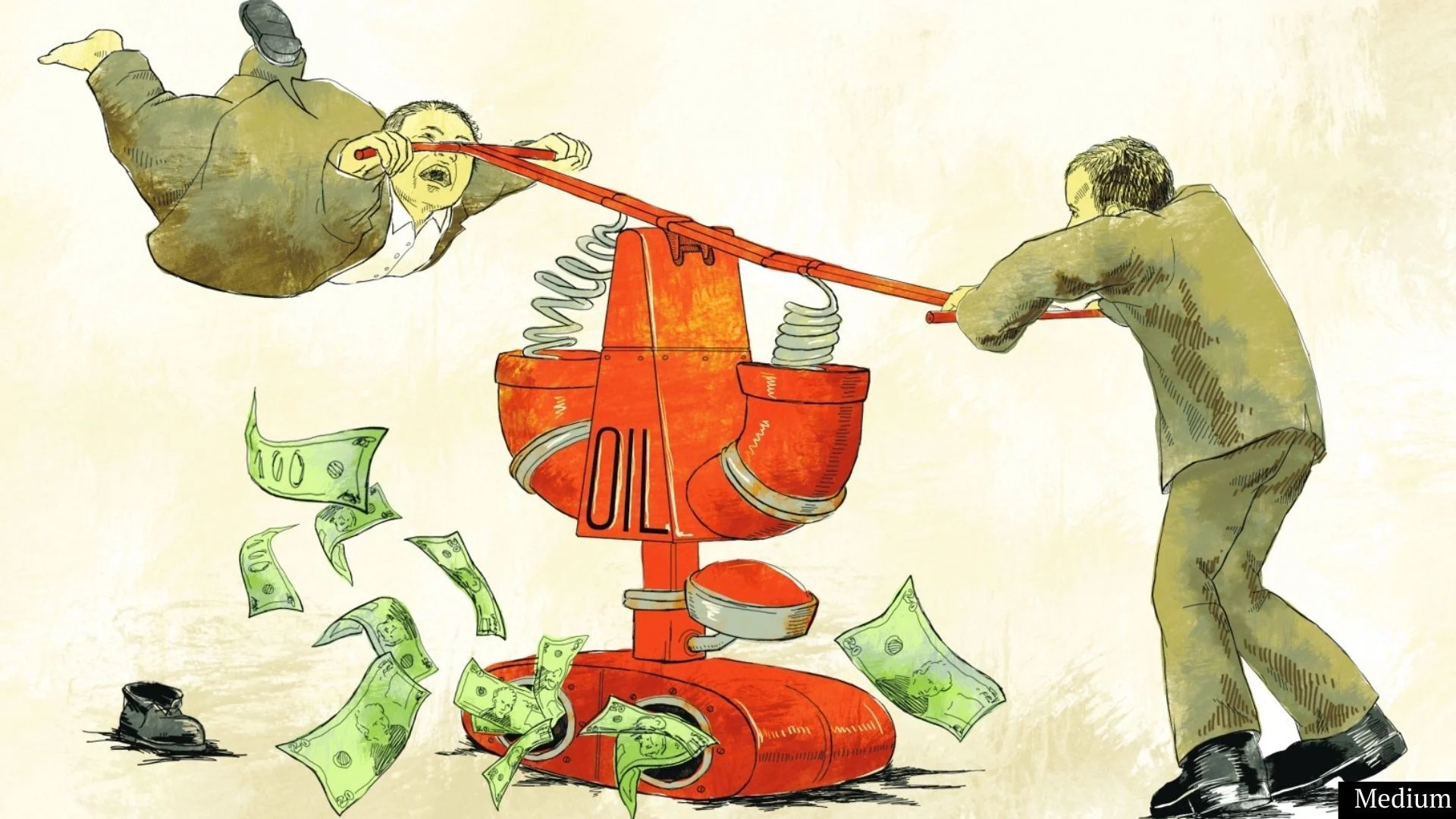
Drawing by Natalia
Mikhaylenko
Conclusion
Overall, to effectively use the income from natural
resources and achieve long-term economic and political development, it is
necessary to increase the level of human capital while ensuring the presence of
diverse and transparent institutions. The corruption and insufficient
protection of property rights, on the other hand, will only slow down economic
development leading to low business activity and the so-called human capital
flight. To put it simply, the abundance of natural resources alone does not
have a significant effect on economic and political development. It is rather a
great tool that has to be wisely used by the heads of state and the government
to achieve long-term political development and economic growth.
Written by
Vladyslav Konstantynivskyi, Major in Political Science, University of British
Columbia (Canada)
References
1. World Bank (2019. International LPI.
Retrieved from: https://lpi.worldbank.org/international/global?sort=asc&order=Infrastructure
2. Transparency International (2019).
Corruption Index 2019. Retrieved from: https://www.transparency.org/en/cpi/2019
3. Ducoing, C., Peres-Cajías, J.,
Badia-Miró, M., Bergquist, A., Contreras, C., Ranestad, K., & Torregrosa,
S. (2018). Natural resources curse in the long run? Bolivia, Chile and Peru
in the nordic countries’ mirror. Sustainability, 10(4), 965.
doi:10.3390/su10040965
4. Lederman, D., Maloney, W. F., Open
Knowledge Repository, & World Bank e-Library. (2007). Natural resources,
neither curse nor destiny. Washington, DC;Palo Alto, CA;: Stanford
Economics and Finance, an imprint of Stanford University Press.
5. Zafar, M. W., Zaidi, S. A. H., Khan,
N. R., Mirza, F. M., Hou, F., & Kirmani, S. A. A. (2019). The impact of
natural resources, human capital, and foreign direct investment on the
ecological footprint: The case of the united states. Resources Policy, 63,
101428. doi:10.1016/j.resourpol. 2019.101428
6. Zakout, W., Alkhoja, G., (2019)
Land sector reform is key to successful diversification of Kuwait’s economy.
Retrieved from: https://blogs.worldbank.org/arabvoices/land-sector-reform-key-successful-diversification-kuwait-economy#:~:text=The%20government%20has%20embarked%20on,is%20reforming%20the%20land%20sector.