
In 2019 we celebrated the
550th anniversary of the Union of Lublin that established the Polish-Lithuanian
Commonwealth, which included the territories of today’s Ukraine, Belarus,
Lithuania, and even Latvia. In reference to those events, which bound Poland to
those lands for the next two hundred years, the establishment of the Lublin
Triangle took place in July 2020. Of course, in this context, no one would name
Poland as an
authority. What is being said is that that body creates, in our opinion, successful
cooperation in many areas based on partnership. In that article, we will
research the current state of that project, the Polish take on that, and its
possible outcomes.
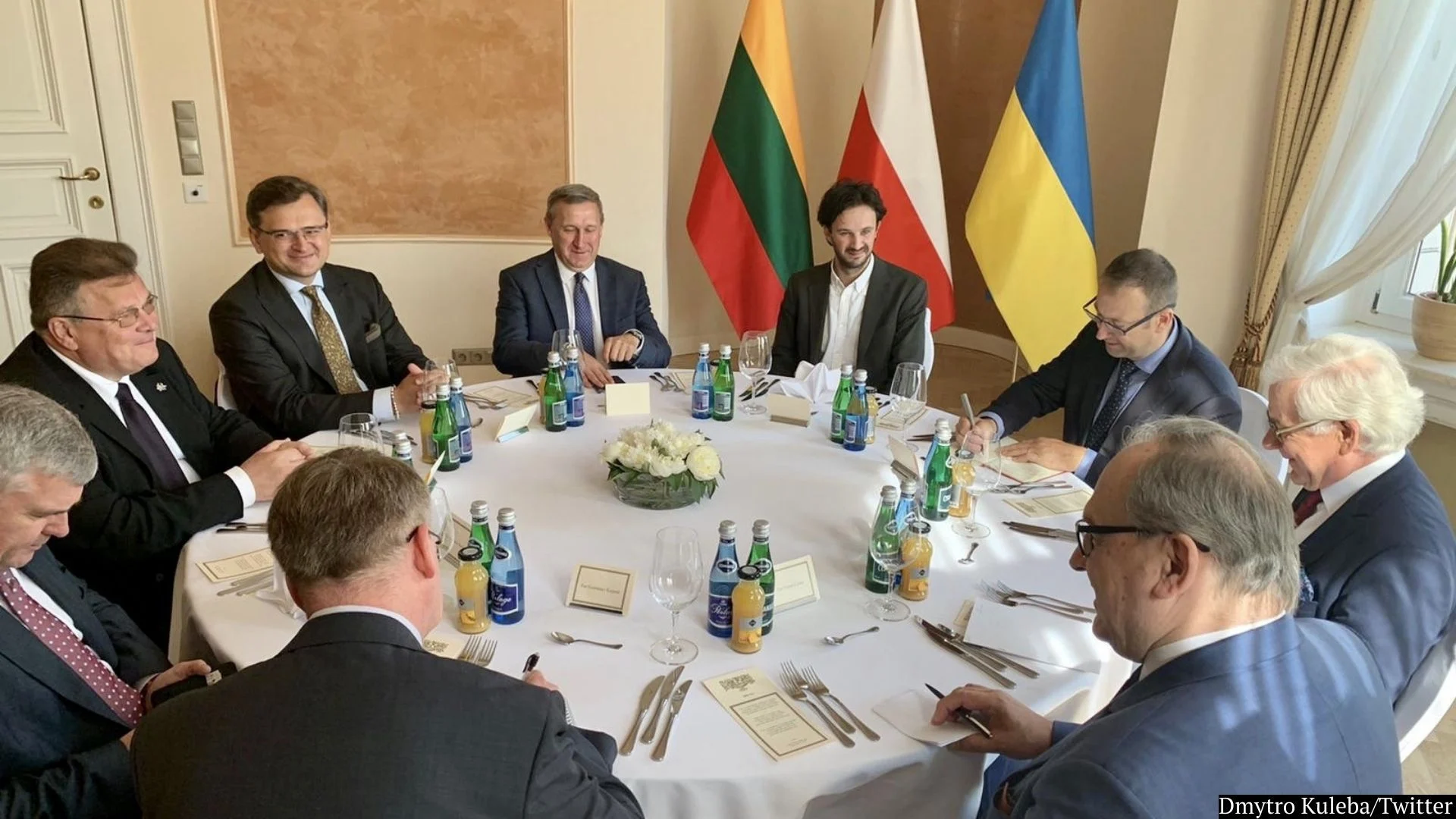
On July, 28th 2020, there was a working meeting of the Ministers of Foreign
Affairs of Poland, Lithuania, and Ukraine, respectively: Jacek Czaputowicz, Linas
Linkevičius, and Dmytro Kuleba. A day earlier, the representatives of Ukraine
and Poland took part in the ceremonial opening of the new building of the
Embassy of Ukraine in Warsaw, which currently houses also the consular
department. The three then met in Lublin. They visited the headquarters of the
multinational unit LITPOLUKRBRIG, which includes specialized military units
separated from the Polish 21st Highland Rifle Brigade, the Ukrainian 80th Air
Assault Brigade, and the Lithuanian Great Princess Biruta Lancer Battalion.
Check out: The Lublin Triangle: What is Included in This New Format of Cooperation?
(in Ukrainian) by Stanislav Kovalchuk
However, the most important result of the meeting
was the Joint Declaration of Foreign Ministers of the Republic of Poland, the
Republic of Lithuania, and Ukraine to establish Lublin Triangle. While analyzing this
document, the first thing that strikes one’s eye is recognizing the
centuries-old, historical ties between the nations and the benefits of closer
cooperation, among others: political, economic, or infrastructural. At this
point, it is necessary to mention the memorandum signed in August 2019 by
representatives of Poland, the US, and Ukraine, which provides for the supply
of 6 billion m3 of LNG from the US to Ukraine through the terminal
in Swinoujscie, as well as the development of gas infrastructure
connecting Poland and Ukraine precisely.
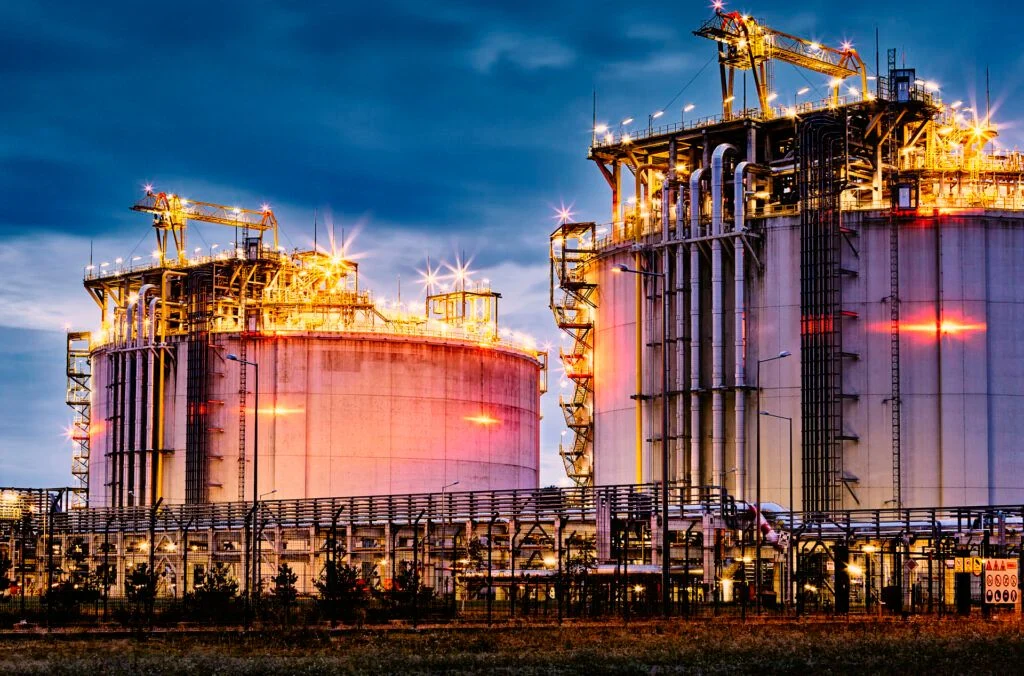
The LNG terminal in Swinoujscie (Poland). Polskie
LNG
This shows that specific cooperation in the
aforementioned fields is already underway, and there is a good chance that the
parties will not just stop at declarations. There was even an idea to include
Lithuania into this agreement, and then a part of the gas could flow to Klaipeda
and be further distributed from there, which would also require multimillion
infrastructural investments.
Recrafting the Ukrainian
path to West
As far as the political aspect is mentioned, the
document entails information about intensified cooperation within the European
Union, NATO, the Eastern Partnership program, and the Three Seas Initiative. It
seems that the Lublin Triangle will serve as a platform within which Ukraine
will strive to become even closer to the West. By joining this agreement, Poland
and Lithuania have agreed to take on the obligation to support Kyiv’s
pro-European aspirations, which, if successful, would be the best argument for
the creation of such regional agreements, as well as a great success for Poland
as a leader in EU eastern policy. Ukraine’s accession to the EU or NATO,
however, seems to be a very distant prospect. Some steps have already been
taken for years – for example, the already mentioned Eastern Partnership,
inaugurated in 2009 as a part of the European Neighborhood
Policy, as a result of the efforts of, among others, the Polish Minister of
Foreign Affairs, Radosław Sikorski.
Visit:
2020 in Latin America: a Political Roller Coaster
by Dulce
María Hernández Márquez (Mexico)
The rapprochement can also be seen in the field
of Euro-Atlantic relations. The most recent example happened last year in June
when Ukraine joined the Alliance’s Enhanced
Capabilities Programme. By doing so, it became an equal member among the group
of countries such as Australia, Finland, Georgia, Jordan, and Sweden, i.e., those which have made a
significant contribution to missions and operations conducted by the Alliance.
Participation in this program does not in any way prejudge Kyiv’s NATO
membership, but it does offer an opportunity to present itself as a reliable
partner. It will lead to deeper integration of the Ukrainian army with Western
armies, which will undoubtedly facilitate full-fledged accession in the future.
It is also worth noting that the text of the declaration establishing the
Lublin Triangle mentions the granting of the Membership Action Plan to Ukraine
as another desirable step on the part of the Alliance.
The Three Seas Initiative, which includes 12 EU
countries, also plays a vital role in the Central and Eastern European regions.
The first summit took place in 2016. Consequently, two years later, a fund was
established to finance mainly infrastructure projects that would better connect
the region’s countries. The United States, and in particular President Donald
Trump, played a significant role in setting up this initiative, treating it as
a counterbalance to the “old EU” countries with which he has not always had a
good relationship.
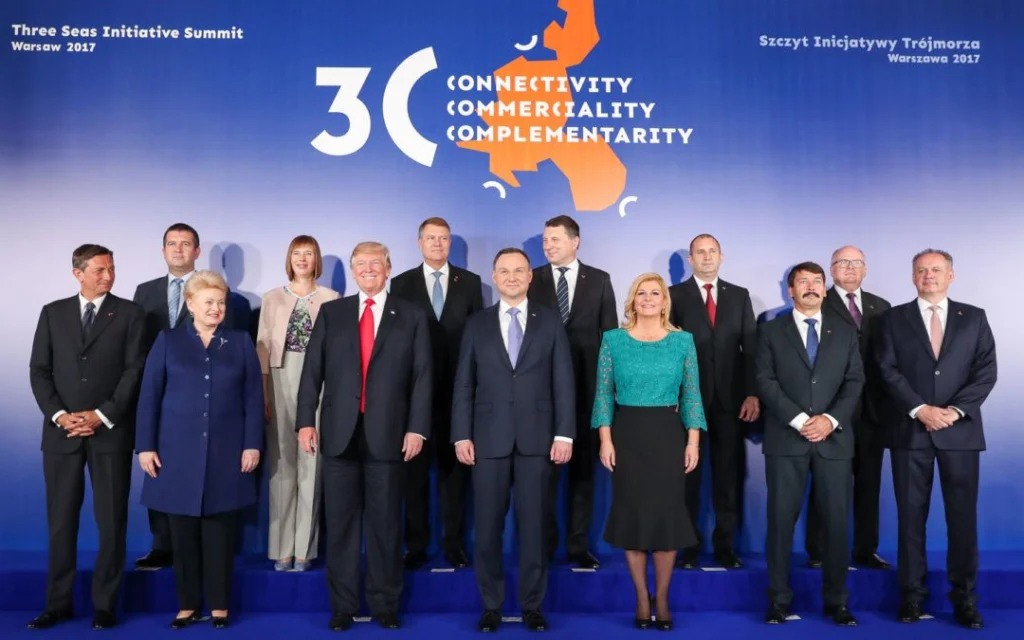
The 2017 Three Seas Initiative Summit in Warsaw
(Poland). Krzysztof Sitkowski, KPRP. President.pl
Therefore, it is difficult to predict what
approach to this project will be presented by the new American administration, relying
more on traditional alliances. Nevertheless, Ukraine does not give up its
desire to join this initiative. On 12 January this year, together with Moldovan
President Maia Sandu, Volodymyr Zelenskyi expressed official interest in
participating in the Three Seas Initiative. To exemplify, these countries can
join initially as observers; such a role is currently played by the US and
Germany.
Security issues as one of
the top priorities for the Lublin Triangle
The next point of the declaration concerns the
common security threat. There
is no doubt that the source of this common threat is the Russian Federation’s
actions, which is explicitly expressed in the passage referring to Russian
aggression against Ukraine. The signatories do not recognize the annexation of
Crimea and undertake never to do so and call on Russia to withdraw its troops
from the Donetsk and Luhansk regions. To resolve the conflict in Ukraine, in
addition to trilateral cooperation, the
declaration mentions cooperation within international organizations such as the
EU, NATO, the UN, the Council of Europe, and the OSCE. Let us focus our
attention on the latter for a moment. At the beginning of this year, Poland
became one of the three countries coordinating the Organization for Security
and Cooperation activities in Europe, and from 2022 it will
take over the chairmanship from Sweden. This offers the possibility of greater
OSCE involvement on the ground of the conflict, for example, by “establishing permanent monitoring
along the line of demarcation between areas occupied by Russian mercenaries
from the so-called “people’s republics« and regions controlled by the
Ukrainian government”, or introducing an international police mission, which
would allow for the implementation of hypothetical peace resolutions. Such use
of the OSCE chairmanship by Poland would undoubtedly strengthen its position as
a natural leader of the region, acting not only for its selfish purposes.
More on the topic: Viktor Karvatskyy and
Artur Koldomasov for KyivPost: Old problems, new patterns
While deliberating on the subject of security, it
seems reasonable to return to the LITPOLUKRBRIG international brigade. Thus, we
should consider whether it would not be beneficial to create additional units of this type to
be stationed in each of the countries forming the Triangle. In that scenario,
for example, a second brigade could have its headquarters in Lviv and a third
in Klaipeda or Kaunas. This would undoubtedly have a positive impact on the
meaning of equal engagement on all sides in this endeavor and would also be a
signal from Poland and Lithuania to show their complete confidence, especially
towards Ukraine, and support for its Western aspirations. The document also
includes support for Ukraine’s economic and political reforms, using the best
Polish and Lithuanian experience in this field and cooperation in combating the
coronavirus pandemic.
Meetings and discussions
for the future actions
Finally, the ministers decided to hold regular
meetings at the ministerial level and the participation of selected partners.
Therefore, the first meeting was to be hosted by Ukraine, and the special guest
was to be the Foreign Minister of Belarus, but another increase in infections
thwarted the plans. In addition, liaison officers were established at the ministries to enable ad hoc
contact and joint coordination of activities.
The subsequent meeting within the framework of
the Lublin Triangle formula, but this time
in a remote form, took place on 29.01.2021. In the meantime, there were changes
in the positions of the Ministers of Foreign Affairs of Poland and Lithuania. Jacek
Czaputowicz was replaced by Zbigniew Rau and Linas Linkevičius by Gabrielius
Landsbergis. They discussed mechanisms of joint fight against disinformation
and hybrid threats. The conversations also covered the problem of the difficult
accessibility of vaccines. Svetlana Tikhanouska also participated in part of
the meeting, so the subject of the situation in Belarus was also present and
discussed. Especially from the Ukrainian side, there
is a strong desire to include democratic Belarus in
the Triangle, but a change of authorities in Minsk would be necessary for this
to happen. Lithuania will host the next meeting.
Read more: Iryna Zaporizka for Baltic Security Foundation: Ukraine-Baltic Energy Cooperation in the Context of Russian Hybrid
Aggression
Discussions on further cooperation within the
Triangle were also held on other occasions. In early February, Lithuanian
Foreign Minister G. Landsbergis paid a visit to Poland, where he met, among others, with
Marshal of the Sejm Elżbieta Witek. Shortly afterward, in the second half of February, the Marshal of the
Senate Tomasz Grodzki took part in an online
conversation with the Speaker of the Lithuanian Seimas and the Chairman of the
Verkhovna Rada of Ukraine.
Conclusion
As the Lublin Triangle is an informal forum for
cooperation, its effective functioning and fulfillment of the tasks set before
would require the goodwill of all interested parties, especially foreign
ministers. Let us hope that despite the changes in the positions of the heads
of diplomacy, this project will not be abandoned. It would be desirable for the
Polish raison d’état if in several years we could be proud, together with the
Lithuanians, that it was with our support that Ukraine managed to overcome the
difficulties related to Russian aggression and permanently anchor itself in the
West, whether by joining NATO or the European Union.
Written by Piotr
Obszarski, a ‘Młodzi o polityce’ (‘Youngsters about politics’) project,
University of Warsaw, Poland