
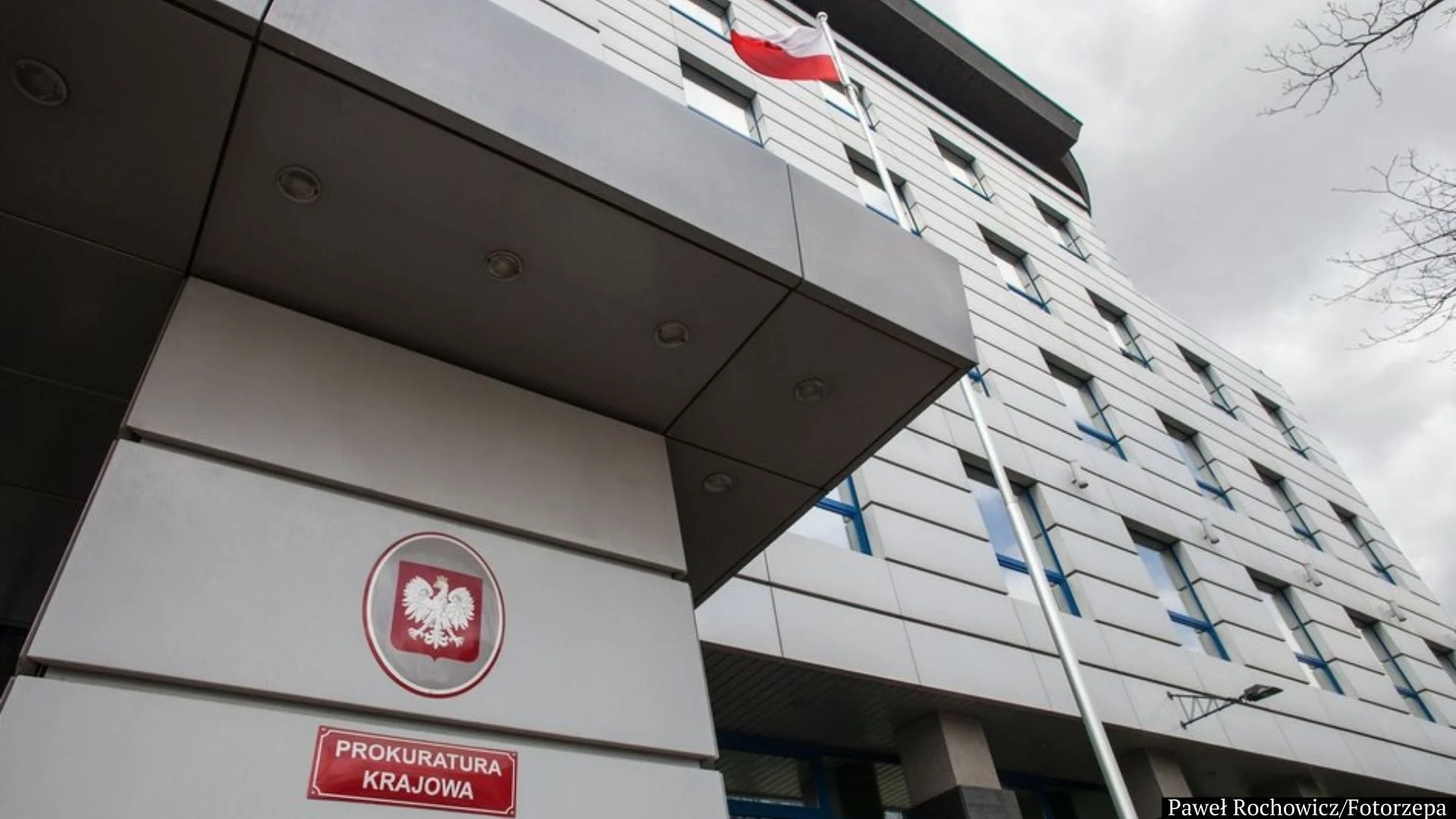
The general prosecutor’s
office is one of the institutions which activities still rise the most
controversy in the opinions of politicians, media, and citizens in Poland. At
the same time, it seems to be one of the least understood by the general
public. In public discourse, we often hear the question: Should the Minister of Justice ex officio act as Prosecutor General?;
more frequently than What should a
prosecutor’s office be? (D. Wysocki, Nowe usytuowanie prokuratury w
systemie organów państwowych, „Państwo i Prawo“ 2010, 5, p. 81)
Crucial in understanding its current place between law and politics
is the realization that the same institution serves to fight crime – among both
ordinary citizens and political figures – and thus can be used to fight
political opponents – when it is overly dependent on political actors. Which,
especially in recent years, is of deep concern to me.
Regrettably, the unfortunate lack of location of the prosecutor’s
office in any of the chapters of the Constitution, as well as the lack of
consensus among political parties as to the place of the prosecutor’s office in
the political system, prevents its constitutional legitimacy.
In my text, I shall attempt to answer the questions: What is the
prosecutor’s office? What are its weakest spots in our country? What does the
combination of the position of Prosecutor General with the role of Minister of
Justice entail? What do the abuses in temporary arrests lead to? And – is there
a recipe for healing the prosecutor’s office?
What is the public prosecutor’s office in Poland?
The public prosecutor’s office is one of the organs of legal
protection, and its most important task is to supervise the execution of the
law. It is an office with different competencies, which, together with the
police authorities, deals with the investigation and prosecution activities
necessary for the administration of justice by judicial authorities. The
ambiguous political-legal status and the way the prosecutor’s office functions
make it difficult to categorize this body under any rule. On the one hand, one
would like to assign it to judicial power. On the other though, “the primary
aim and task of the prosecutor’s office are to protect
the state and citizens in accordance with the norms of the law established in
the Republic of Poland”, and yet issues related to public order are the
domain of the executive power.
The prosecution service may be more closely linked with one of these
two authorities, depending on the systemic solutions adopted. In the case of
Poland – as I mentioned in the introduction – the Constitution does not define
the position of the prosecution service, the effects of which we have seen in
the allocation and re-combination of the role of the General Prosecutor with
the position of the Minister of Justice. It should also be mentioned at this
point that the prosecution service is only an institution consisting of
prosecutors, while the prosecutors themselves are a state body (with the
Prosecutor General at its head) (D. Wysocki, Nowe usytuowanie prokuratury w
systemie organów państwowych, „Państwo i Prawo“ 2010, 5, p. 81).
They participate in both civil and criminal proceedings. In the
latter, the main aim of the prosecution service is to uncover the crime and
bring about the conviction of the person who committed it. This is done using
pre-trial proceedings, public prosecutions in court proceedings, and, for
example, coordinating the activities of the police in the prosecution of
crimes. If the prosecutor’s allegations are not confirmed in the course of a
trial, they should drop the charges but should also, in the course of the
prosecution, raise motions in favor of the accused if there are objective
reasons for doing so.
But who is the General Prosecutor, and what are the characteristics
of this office, the highest in the hierarchy of institutions? The fundamental
right of the head of the prosecution service is to appoint and dismiss (under
certain conditions) all prosecutors in its standard organizational units, i.e.,
the Public Prosecutor’s Office, regional prosecution offices, district
prosecution offices, and regional prosecution offices. The General Prosecutor
is also the superior of military prosecutors and prosecutors of the Commission
for the Prosecution of Crimes against the Polish Nation at the Institute of
National Remembrance.
In addition, the General Prosecutor may submit a motion to the
relevant services to carry out operational and exploratory activities and lift
secrecy clauses imposed by various institutions (they must notify the head of
the institution needed and the Prime Minister). He has the right to initiate
cassation proceedings through an extraordinary cassation appeal and a cassation
complaint. He can also convene the Prosecutors’ Council to the General
Prosecutor, a consultative body that determines the number of members of the
disciplinary court.
Check out: The European Youth Capital 2023: Lublin is Ready and
Set by Julia Dziuba (Poland)
As I mentioned above, the positions of the General Prosecutor and
the Minister of Justice have been merged, and now again, as for most of the
history of the Third Republic of Poland, we have a situation in which the same
person performs these functions. However, to understand why these organs have
been merged for the more significant part of the last three decades, we must go
back to the beginning, back to the 1980s, and briefly describe the whole
sequence of cause and effect related to the position of the General Prosecutor.
A pinch of history
For most of the history of the Third Republic of Poland, the offices
of the General Prosecutor and the Minister of Justice were intertwined. This
was not a relic of the People’s Republic of Poland but a way to make the
prosecution system independent from the former state apparatus.
Before the systemic transformation, under the 1985 Act on the Public
Prosecution Service of the People’s Republic of Poland, the powers to appoint
and dismiss the Prosecutor General was vested in the Council of State. This was
due to the lack of political control that parliament could exercise over the
prosecution service and its total dependence on the all-powerful communist
party, which used the prosecution service to fight its political opponents. The
law amending the Constitution, introduced after the Round Table talks on 7
April 1989, transferred many of the competencies of the Council of State to the
created position of the President of the People’s Republic of Poland.
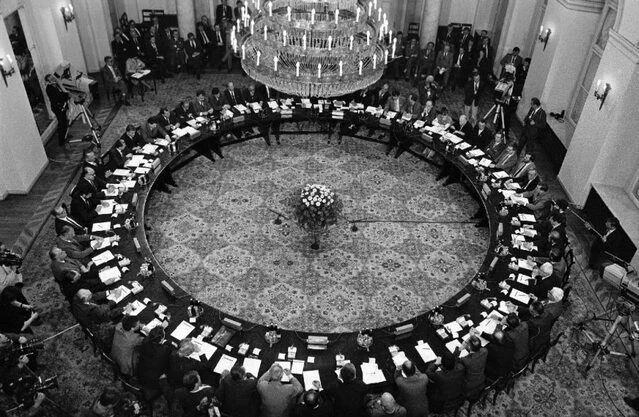
The picture from the Round
Table talks, 1989. Erazm Ciolek/FORUM
This included
the right to appoint and dismiss the General Prosecutor, who was obliged to
report on the activity of the Prosecutor’s Office to the President. This state
of affairs did not last long. In December of that year, Tadeusz Mazowiecki’s
government introduced a law amending
the Constitution of the People’s Republic of Poland, establishing a personal
union of the Minister of Justice and the General Prosecutor. Only this enabled
the supremacy of Solidarity politicians over the prosecution system. Aleksander
Bentkowski became the first ex officio, Minister of Justice, to control the
Prosecutor’s Office. The postulate of politicians’ supremacy over the
Prosecutor’s Office was not changed by the so-called Small Constitution of
1992, nor by the Constitution of the Republic of Poland of 1997.
This was due
to the prosecution model, in which – through a personal union of the General
Prosecutor and the Minister of Justice – it was subordinated to the government.
It has been argued that prosecution, being subordinate to the executive, could
not be regulated elsewhere in the Constitution than in the chapter devoted to
the executive because by placing the prosecution in a different branch, it was
not intended to remove the influence that the executive had over it. As a
result, the place and position of the General Prosecutor in the structure of
state bodies was not defined in the Constitution at all, which allowed for the
later separation of this office from the executive power.
This state of affairs lasted until 31 March 2010, when the functions
of the General Prosecutor and the Minister of Justice were divided, separating
the prosecution service from the executive power. Interesting fact: until that
time, Poland was the last country in the European Union where the Minister of
Justice ex officio exercised the function of the Prosecutor General. As a
result of amendments
to the Prosecution Act, the General Prosecutor was to be appointed by the
President of Poland – from two candidates proposed by the National Council of
the Judiciary and the National Council of the Prosecution – for a six-year
term, with no possibility of re-election.
Under these provisions, the General Prosecutor
was required to submit an annual report on the activities of the prosecution
service to the Prime Minister of Poland. This body was not immovable, as both
the President and the Sejm (the lower chamber of the Polish parliamentary
system [translator’s notice]) (with a 2/3 majority vote on the motion of the
Prime Minister if the report was rejected) could dismiss the General Prosecutor
before the end of their term. This independence of this body from executive
pressure seemed to be a step in the right direction, as, after 1989, we had a
situation where successive Ministers of Justice (regardless of their party
affiliation) introduced changes in personnel and organization to increase their
own political base in the prosecution service.
Check out: Vaccines: a Special Guest at the Coronavirus’ First
Birthday Party by Agnieszka Homańska (Poland)
The prosecution community itself was not unanimous in assessing the
changes introduced (the Polish Prosecutors’ Association supported the changes,
while the Prosecutors’ Ad Vocem Association opposed them). The solution
functioned for only six years. Today, the Public Prosecutor’s Office operates
under the new Law on the Public Prosecutor’s Office passed on 28 January 2016,
which came into force on 4 March 2016. Under this law, the Minister of Justice
again ex officio performs the duties of the General Prosecutor.
When the new
law on prosecution was introduced in 2016, reference was made to the provision
of Article 146(4)(7) of the Constitution
of the Republic of Poland, which speaks of ensuring the internal security of
the state and public order by the Council of Ministers, apparently forgetting
that the prosecutor’s office performs tasks only in the field of prosecution of
crimes and upholding the rule of law (impartial and reliable). One of the basic
conditions for fulfilling this role is that prosecutors are prohibited from
belonging to a political party or participating in any political activity while
in office. In contrast, the Prosecutor General in the person of the Minister of
Justice may even be the head of a political party (which indeed the current
Minister is).
Given the powers and concentration of power in the position of
Prosecutor General, and the opportunities this situation creates for abuse of
power in political struggle, and the way Zbigniew Ziobro directs the activities
of the prosecution service, we can speak of a real politicization of the
prosecution service.
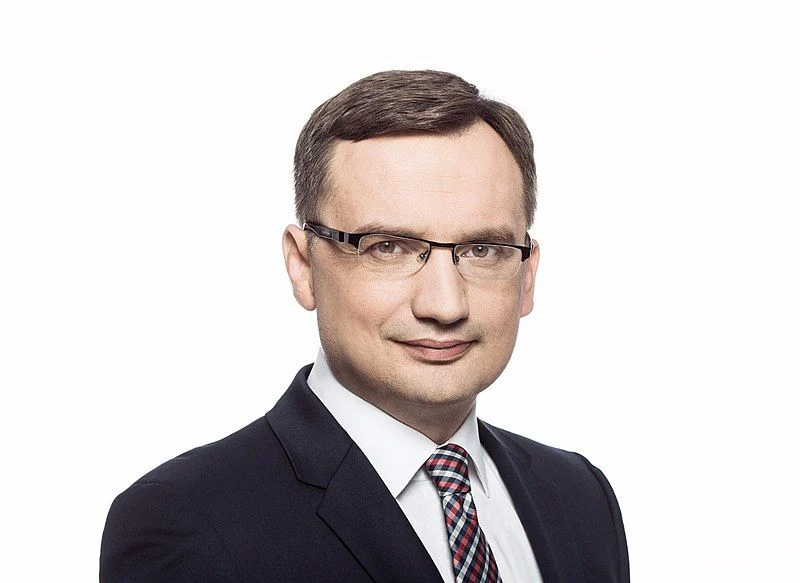
The Polish Minister of
Justice Zbigniew Ziobro. Wikipedia
Selectivity and bad practice
Recently, the prosecution has provided the public with very striking
examples of selective handling of cases. Its actions are either too dilatory or
too overzealous. This can be perfectly seen in the case of proceedings against
political figures, which is why I have chosen three situations to serve as such
examples.
At the end of September 2019, opposition MPs filed a notice to the Warszawa
– Śródmieście District Prosecutor’s Office about tax evasion by the newly
elected head of the Supreme Audit Office. Later, Minister Mariusz Kamiński
(Minister of Interior and Administration of Poland and Coordinator of Polish
Intelligence Services) referred the notification on Marian Banaś (President of
the Supreme Audit Office) to the Regional Prosecutor’s Office in Białystok. The
prosecutor’s office launched an investigation into the irregularities in the
asset declaration. Still, there has been no visible progress since then, and
the public is reminded of the ongoing investigation every time the NIK (pl.
Najwyższa Izba Kontroli – The Supreme Audit Office).
Chairman does a disservice
to the ruling camp. When in May the media reported on NIK’s findings in the
matter of notifying the prosecutor’s office of a possible crime committed by
the highest persons in the state during the organization of envelope elections,
officers of the Central Anti-Corruption Bureau appeared at the home of the NIK
head’s son (on the morning of the conference at which he was to inform the
public). The search was conducted on the recommendation of the Regional
Prosecutor’s Office in Białystok.
It is impossible to be indifferent about the coincidence of the
dates of these two events. Unfortunately, they bring to mind the puppet
treatment of such an important institution and probably leave no illusions
about its objectivity.
Another glaring example of the prosecution’s selective treatment of
cases was provided by its failure to initiate proceedings against Jarosław
Kaczyński in connection with the suspicion of a crime raised by the Austrian
businessman Gerald Birgfellner.
Let me remind you that this famous case concerned payment for an
order related to preparations for the construction of two high-rise buildings
in Warsaw by the Srebrna company. The company is owned by Lech Kaczyński
Institute, which is a foundation with Jarosław Kaczyński on its board. The
Austrian businessman testified to the prosecution that he was persuaded to pay
a bribe of 50 thousand zlotys to another member of the foundation’s council.
In this whole situation, the most important issue seems to be who
these accusations were directed against. We are not dealing here with a
businessman who is not widely known to the public (although in the case of
every business person, the proceeding should be initiated in the circumstances
of such accusations and evidence in the form of recordings), but with the head
of the political group that governs the country!
The prosecution justifies its decision not to initiate proceedings because,
in its opinion, no criminal offenses were committed in this situation. One can
only wonder whether the prosecution under the authority of an independent body,
such as a person who is not a member of the government, whose existence depends
on the political background headed by Jarosław Kaczyński, would apply the same
interpretation of this case.
However, there are situations in which the prosecution can handle
the case of a politician accused of corruption efficiently and vigorously. This
is quite evident in the case of the former Minister of Transport Sławomir
Nowak.
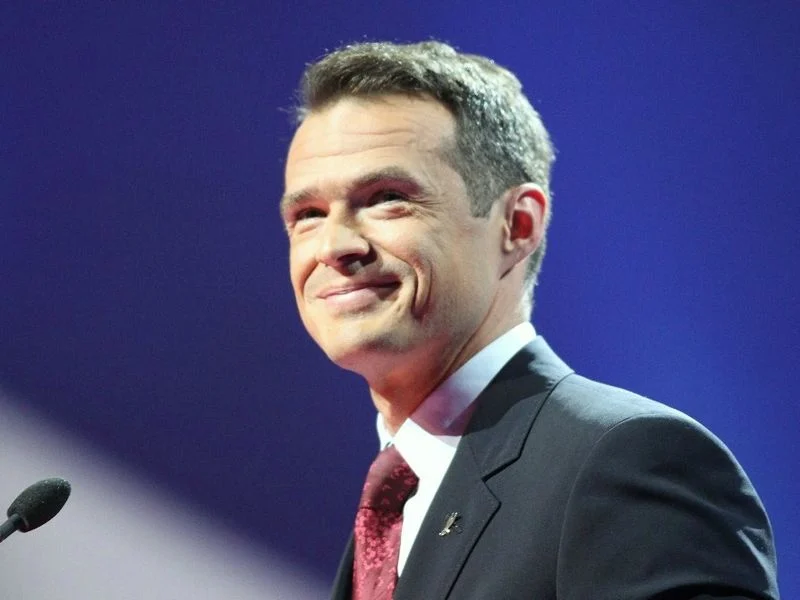
The Minister of Transport,
Construction, and Marine Economy of Poland Sławomir Nowak. Platforma
Obywatelska RP
In July last year, the former politician was detained by the CBA in
connection with corruption charges. So far, he has been charged
with a dozen or so offenses, including “setting up and leading an organized criminal
group operating in Warsaw, Gdańsk, and Ukraine, accepting multi-million
financial benefits and paid protection in connection with the position of the
head of Ukravtodor, demanding and accepting economic benefits in the years
2012-2013 in exchange for roles in state-owned companies, money laundering and
paid protection in connection with the position of the Head of the Political
Office of the Prime Minister and the Minister of Transport, Construction and
Maritime Economy”.
The case became notorious again in April this
year when the District Court in Warsaw did not agree to extend the defendant’s
stay in custody. The prosecutor demanded an extension of the detention period
due to the fear of the suspect’s departure from the country and due to the
amount of punishment he faced (15 years). The court apparently found
the prosecution’s irrefutable evidence insufficient, arguing that the witness
testimonies collected by the CBA instead proved the suspect’s innocence.
Sławomir Nowak was released from custody, but the court granted him police supervision,
a ban on leaving the country, and a surety of 1 million zlotys. The time for
payment was to have passed on 18 June, and the money was received, which was
confirmed by the Warsaw prosecutor’s office, but the prosecutor refused to draw
up a protocol of acceptance of the funds into the deposit, citing objections
and a complaint, as reported by attorney Wojciech Glanc (attorney for Nowak’s
daughter, who paid the surety).
The prosecutor motivated his decision by the Warsaw
Court of Appeals ruling, which stated that the former minister is to be
returned to custody if he fails to pay the designated amount. A spokeswoman for
the prosecutor’s office said that once the decision of the Court of Appeal
becomes final and an appeal is filed, the amount will be returned to the
defendant’s family, and if the prosecutor’s appeal against the decision is not
accepted, the prosecutor will draw
up a protocol of acceptance of the financial guarantee.
Sławomir Nowak was held in custody for nine months without a court
sentence. The case is still pending. This example prompted me to take a closer
look at the very subject of temporary arrests and their use. Then I saw that in
recent years this practice had been used more and more often. How often? Since
2015, the recorded number of pre-trial detentions has almost doubled, despite
the number of incarcerated people and crime in Poland decreasing
(graph 1) every year.
The report of the Court Watch Poland Foundation finds not only an
increase in the number of pre-trial detentions (at the end of 2018 – 487
people, compared to 151 people in 2016) but also their extension: an average of
439 days in cases heard by a district court and 223 days for cases heard by a
district court. As an interesting fact, I will add that in the course of
writing the report,
the authors came across a case of arrest for 43 months (more than three
years!).
Visit: The Odebrecht Corruption Scandal: the End of the World
Plea Deal by Dulce María Hernández Márquez (Mexico)
I want to stress that pre-trial detention is a wait in custody for a
final sentence, so we are talking about staying in the custody of people who
have not been convicted. Without underestimating the nature of the provisions
allowing pre-trial detention, I do not have to strain my mind too much to
notice that something that should be a last resort – permissible and entirely
acceptable in some instances – has in recent years taken on a preventive
character, and the effectiveness of prosecutors with irrefutable evidence has
led to an absurd.
How does the prosecutor’s office look like?
This begs the question: What should our prosecution system look
like? In recent years, there have been many reports on how the prosecution
service is performing and how the offices of the General Prosecutor and the
Minister of Justice have been merged. While one cannot disagree that the merger
of these two positions has resulted in the politicization of the prosecution
system, it must be remembered that the mere separation of these offices is not
sufficient to heal this body. There are also indirect factors that affect the
independence of this institution, such as clientelism and links to specific
politicians.
As I have tried to show above, one of the cardinal sins of the
prosecutor’s office is its far-reaching subservience to the politicians who
supervise them. It is also necessary to have democratic control over an
institution that can interfere in
the realm of human rights. It seems that the most durable solution to these
problems would be to enshrine the status of the prosecutor’s office in the
already extensive Constitution. This would strengthen and clarify its position
in relations with the executive and judiciary.
Of course, there are proponents of taking the prosecutor’s office
out of the executive branch’s oversight and retaining it. The latter argue
their position because the government is responsible for the fight against
crime and that public control over this institution is needed. Lech Kaczyński,
among others, used these arguments in arguing his veto of a 2009 law separating
the personal union between the General Prosecutor and the Minister of Justice.
The Court Watch Poland Foundation report authors emphasize the need
for an in-depth analysis of the prosecution’s motions and the justification for
initiating proceedings. They also state that it is advisable to change the name
of temporary arrest to preventive isolation. This is to differentiate this
action from the punishment of detention. The issue of ex officio payment of compensation to wrongfully convicted persons
who have been acquitted
of charges should also be legally established.
It is also worth considering the recommendations formulated by
Jarosław Onyszczuk and Katarzyna Kwiatkowska from the Stefan Batory Foundation
(an independent non-governmental organization working for the development of
democracy and civil society in Poland). In their publication on the role and
place of the prosecutor’s office, the authors emphasize that in the context of
healing the prosecutor’s office, it is crucial to draft a new law on the
prosecutor’s office that separates the functions of the prosecutor’s general
and the minister of justice. They also recommend clarifying the necessary
qualifications that a candidate for the General Prosecutor should have,
including length of service. They add that it should be a person with the
highest professional, intellectual and moral qualifications and agree that the
term of office of the Attorney General should be six years and that an
independent body of the prosecutors’ self-government should be involved
in the apolitical process of filling this position.
Read: Media Without Choice: What is Going On With the Polish
Media System? by Julia Smogorzewska (Poland)
Beyond any doubt, the following should be reiterated by T.P.Marguery
as the four most important principles on which the functioning of the
Prosecutor’s Office should be based: independence from any influence;
democratic control over the activities of the institution; effectiveness in
protecting the rule of law and combating crime; and protection and respect for
human rights.
Conclusion
In conclusion, an independent and fully autonomous prosecution
service is a necessary condition for the independent operation of the justice
system (and, by extension, the judiciary as a whole). The activities of
prosecutors shall not be limited or directed in any way by the Minister of
Justice or the prosecutors to whom they report. This means that executive
influence over the prosecution system, the hierarchical nature of this body,
and the lack of transparency that this entails, are not compatible with a
democratic state under the rule of law.
In my opinion, to heal our prosecutor’s office and bring quality to
our justice system, we must detach this structure from the executive and draft
a law that will counteract attempts by any of the powers to influence the
prosecutor’s office.
After reading this text, I want to ask the reader to answer this
question: Do I accept how one of the most critical institutions whose goal is
to uphold the rule of law functions? I don’t, not even a little. Hence this
article.
Written by Adam August Michalik, the project “Youth About Politics”,
University of Warsaw (Poland)