
After the great
exhaustion brought by the waiting for the first vaccine, as soon as the
information about Pfizer’s product hit the media, the world, full of hope but
also uncertainty, began to ask itself dozens of questions. Questions that, even
though now we have not one, but many vaccine options (and new ones are still
under research), do not disappear but multiply. Additionally, the virus is not
giving up – not only is it mutating, but it is still striking, in varying
frequencies and magnitudes, with no chance of meaningfully bringing economies
out of lockdown.
All in all, this and the coming quarter will celebrate the
first anniversary of global lockdowns and restrictions. And the public, clearly
tired, no longer wants to sit at home, especially since they often do not know
what the next day will bring. The example of Polish governmental covidian
roulette – removal of restrictions, New Year’s Eve recommendations and threats
of fines, lack of police patrols, the opening of slopes and hotels, the closing
of slopes and hotels, the return of red zones, shows best how uncertain and
unstable times we are in (and probably, unfortunately, will remain for the next
several months). This article gives us a global analysis of the SARS-COV-2
virus vaccination procedure with a closer study of several international cases.
Ready, set,
g…
The process of waiting for vaccines and then for
the start of vaccination programs can be compared to the New Year’s countdown.
With one difference – it lacks a colorful firework show because what is
happening in the world cannot be called a happy
end. Corona party decided to
organize a new event but invites the countries that will provide their citizens
with access to vaccines. Unfortunately, this event is only for VIPs – rich
countries, the ones that do not have to look back.
If I were to describe each of the 108 vaccinating
countries here, I would either reach novella format, or the reader would
abandon my text in favor of interactive graphics. I’ll start with what’s going
on in Poland as it is my fatherland, then I will focus on the whole European continent.
Later, I will leave Europe and look at what’s happening overseas. Then,
consistently, I couldn’t help but mention the situation over the Pacific to end
with African struggles and forward-looking reflections.
Although we were all starting from the same
position, we did not commence together. The U.K. is the first country to
authorize the vaccine created by Pfizer
and BioNTech and launched the
vaccination program on Dec. 8, 2020. “I
feel honored to be the first person to be vaccinated against COVID-19. It’s the
best birthday present I could have wished for as it means I can finally enjoy
spending time with family and friends in the new year, after being alone for
most of the time”, – said just after
getting the vaccine Margaret Keenan,
a 90-year-old British woman who proudly holds the
title of the world’s first person vaccinated against coronavirus.
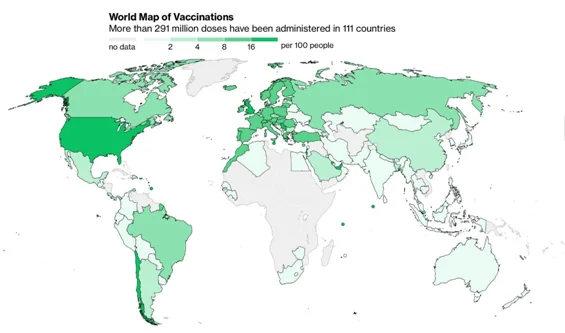
World Map of Vaccinations (March 2021). Bloomberg
Polish ‘polishing’
of the procedure
Poland started vaccinating on Dec. 27, 2020. In
the so-called zero stage, employees of the health care sector, social
assistance homes, municipal social assistance centers, and the personnel of
medical facilities will be vaccinated (about 1 million people). Then, residents
of nursing homes and other care facilities, senior citizens, employees of the
uniformed services, and teachers (about 10 million people). Vaccinations are –
as Prime Minister Mateusz Morawiecki emphasized – our “common responsibility”.
Thus, he appealed to register for vaccinations. Ironically, Poles listened to
the appeal, and therefore, within seven hours after opening the registration
for the age group 80+, on 14.01.2021, over 100 thousand people called the
hotline. At the same time, the process of registration of people from groups II
and III of the vaccination program was launched. – “The interest is impressive.
We have 130 thousand applications by 8:30 a.m., of which 70 thousand have been
confirmed. We had technical problems during the night, but now the e-mails are
being sent regularly”, – announced by the Ministry of Health,
Andrzej Niedzielski.
In the beginning, however, everything looked
(relatively) organized. People from non-priority groups were boasting on social
media about their declaration to get vaccinated (when? That is a different
matter, but everyone knows that in this country you always have to be armed
with patience). However, the following weeks started bringing more and more
problems, and the stairs that were, and still are, built in the orders and
deliveries of subsequent doses began to make other countries breathless. From
the very beginning of this year, Polish hospitals were turning into call
centers that were canceling appointments for this week on the one hand and
signing up seniors on the other. This created complete chaos, says Krzysztof
Strzałkowski, chairman of the Health Committee of the Mazovian Voivodeship
Assembly. Moreover, it was a problem for most institutions because, in the
following week, vaccinations were to be carried out by employees of other
clinics, which were more challenging to reach than their own staff.
Here the mess begins…
When the
union poses problems to the Union – how to order and not go crazy
Globally, more than 249 million doses have been
administered so far (data as of early March 2021), most in China and the United
States. The leader in the number of doses per capita is Gibraltar, although
until recently, Israel scored first in the ranking. Among European countries,
the U.K. leads the way and faces a significant increase in COVID-19 cases.
Within E.U. countries, Malta has the highest number of vaccinations and
Bulgaria, the lowest. This raises questions about how the process is working
and why we are dealing with a new-old type of inequality: vaccine inequality. Frankly speaking, following the European Commission’s
clashes with the U.K. and the medical corporations, the ups and downs of COVAX
(to which I will return at the end of the article), Joe Biden’s race against
time and Trump fans was a process only for people with nerves of steel.
The
amount of data, press articles quoting legal articles, voices of experts and
politicians, constantly changing numbers, and a veritable cacophony of news
from social media or news portals (not infrequently dotted with fake news,
probably forever ingrained in the culture of homo videns) could lead to dizziness, complete confusion, and loss
of faith in any anti-covid vaccination (the Internet is teeming with memes
about their deadlines. Perhaps, however, it is the jokes about this situation
that are the best defense of society so inactive in the face of any
international action).
Check out: The
European Youth Capital 2023: Lublin is Ready and Set by Julia Dziuba
(Poland)
In the EU-27 countries, preparations for the
vaccination procedure were already in full swing at Christmas time. The
beginning of 2021 was hot and full of hope. After all, the European Commission
announced that the schedules of the expected deliveries of vaccines show that
there will be enough doses to vaccinate in all E.U. countries by the end of
March 80 percent of the population aged at least 80 years and health care
workers, and by the end of August – at least 70 percent of all adults. Faith in
achieving national resilience till the end of summer has not left Ursula von
der Leyen. Union orders 8.01.2021r. have doubled – at that time, the E.C.
ordered 600 million doses from BioNTech/Pfizer
(from which, after an appeal by specialists, not 5 but 6 vaccines could be
obtained), 320 million from Moderna,
and after the admission of other concerns – 100 million doses from AstraZeneca, 400 million from Johnson&Johnson and 405 million from
the German company CureVac, which for production purposes has started
cooperation with Bayer. In total, the E.C. ordered 2.3 billion doses from six
manufacturers between August and January. To calm tempers, the president argued “we are only negotiating
together in 27 countries. This is a legally binding agreement”.
And these joint negotiations can be treated as
the nail in the coffin. February greeted Brussels with an alarm – «Union,
we have a problem,» wrote Łukasz Wójcik in Polish
magazine Polityka. What caused the E.U.
to get only 25 percent of the order of AstraZeneca
doses in the first quarter of this year? The British-Swedish company argued
that this was due to technical problems. However, Pfizer’s deliveries also slowed down considerably. Other E.U.
countries suspended procedures, changed schedules, prolonged stages of
vaccination (it is worth looking at Portugal struggling with a significant
impact of the third wave, France, which is completely failing in terms of
vaccines, or Germany expecting at least ten weeks of vaccine shortage). Even a
conspiracy by Big Pharma, the largest
pharmaceutical companies, was once suggested. E.U. Health Commissioner Sella
Kyriakides, backed by the heads of state, said that “pharmaceutical companies
had moral, social, and contractual obligations to meet and send prosecutors to
the AstraZeneca factory.” It made
things uncertain and unpleasant. Could it be that E.U. tensions are helping the
ones nearby the Thames or from overseas?
The London-based Airfinity institute reported that by the end of 2020, these
countries were spending about seven times more each than the E.U.,
respectively, on various vaccine prepayments such as research or manufacturing.
Thomas J. Bollyky, a health expert at the Council on Foreign Affairs, believes
that it is precisely some manufacturers that may have been guided by the amount
of these prepayments when prioritizing orders. Going further, when countries
such as the U.K., USA, Canada, and Japan, immediately after the positive
results of the Pfizer/BioNTech
vaccine tests increased their orders, the European Union waited to hear from Sanofi and AstraZeneca, which then faced technical problems. Pascal Soriot, in
response to a question about the delays from an Italian newspaper La Repubblica, replied “The facts are simply that we
signed the contract with the U.K. three months earlier than with the E.U.” And
since the arrangement of assurances contains only the usual “best efforts”, any
discussion may end there.
The result of all this mess is that the member
states have had enough and have started to look for help independently. It is
worth noting that on paper, the Commission has ordered more doses than are
actually needed. However, while Moderna
was prepared to provide the E.U. with 300 million doses that – for political
reasons – decided on 80 because it could not order more than that from a French
concern. Here comes another staircase, which B.Johnson uses like a pedestal –
the inability to act independently alongside the intricate web of E.U.
arrangements and obligations from which Brexit has liberated the islands. The E.U.’s
predicament, after all, primarily stems from the very essence of a procedural
community based on mediation and equality.
According to Wolfgang Munach, head
of the think tank EuroIntelligence, the eurozone debt crisis may turn out to be
a pittance in the face of vaccine shortages. Besides, it is becoming
increasingly clear that leaving member states free to buy would lead to the wealthiest
countries buying up vaccines. However, this process has begun and is unlikely
to stop. Other countries have decided to build new alliances. And so, as
reported by politico.eu in late February and early March, Denmark, Austria,
Poland, Slovakia, and the Czech Republic joined Orbán’s earlier move and began
looking for a vaccine strategy outside the E.U.
What did the commission say about this? It
appealed for forbearance and trust. Well, it seems that these reservoirs of
member countries are depleting almost at the rate of disappearing vacant beds
in European hospitals. Committee spokesman Stefan De Keersmaecker argued that
the process of producing and delivering vaccines is a project that faces many
obstacles along the way. The leaders of the member states allow themselves to
disagree, to say the least, as evidenced by the strong words of German Finance
Minister Olaf Scholz, who called the European vaccination program “a total shitshow”.
Andrzej Duda spoke with Xi Jinping, expressing interest in China’s Sinopharm.
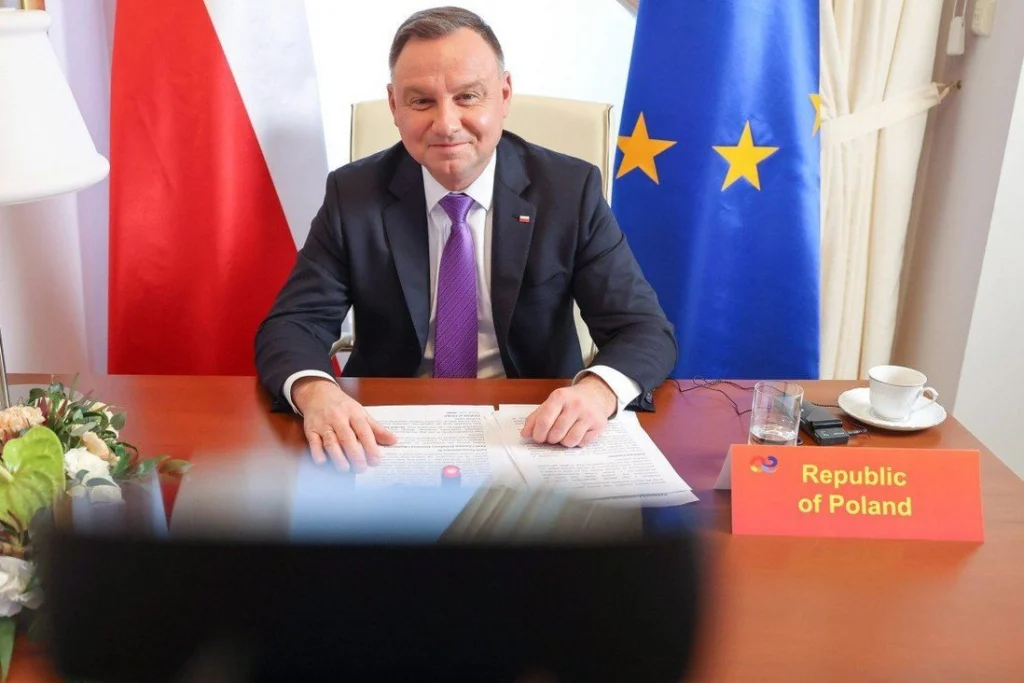
The Polish president Andrzej Duda during a video
call with Xi Jinping, March 2021. EPA-EFE
It may not have been a bad idea, given that the
delivery of 62,000 AstraZeneca
vaccines was canceled on 4.03.2021, the president of the Strategic Reserve
Agency Michał Kuczmierowski announced one morning. Although the desire is
considerable in Germany, almost 70 percent of German citizens believe that they
vaccinate too slowly. This is an increase of nearly 20 percentage points within
a month. In addition, in February, as much as 63 percent believed that the
transfer of the coordination of this project to the E.C. was a mistake (data from the
Infratest Institute survey). The Germans are doing what they can, and the
federal government is looking beyond the Rhine and is making a real commitment
to helping countries worldwide by supporting the COVAX program (more on that
later).
How are our Hungarian friends doing? Orbán, while
criticizing the slow Western vaccination campaign, declared on his Facebook
profile that he is already vaccinated, agreeing to use not only Chinese but
also Russian supplies of Sputnik V.
And at this point, Hungary is the closest of the E.U. countries to achieve 70%
vaccination of the adult population if the vaccination rate remains unchanged
by the end of the summer. Malta, Cyprus, and Denmark are next. So, who has
enough nerve for this wait?
Read: Media Without Choice: What is
Going On With the Polish Media System? by Julia Smogorzewska (Poland)
However, it should be remembered that the
European Commission cannot be blamed solely (or even mainly) for the confusion
surrounding vaccines. The problem lies in the structure of the E.U., which
should be rethought and reformed after the pandemic so that situations such as
the one I have described do not occur again. The Union seems to be beginning to
feel the tension between its members, as evidenced by the fact that the new
Prime Minister of Italy, Mario Draghi (the former head of the European Central
Bank, which not so long ago rescued the Euro from the crisis), listened to the
appeal and blocked the transport of 250 thousand doses of AstraZeneca’s product to Australia in the first days of March.
This is the first such intervention since new vaccine shipment regulations were
imposed. And that is indeed a
very good thing – it was not introduced for not being later in use.
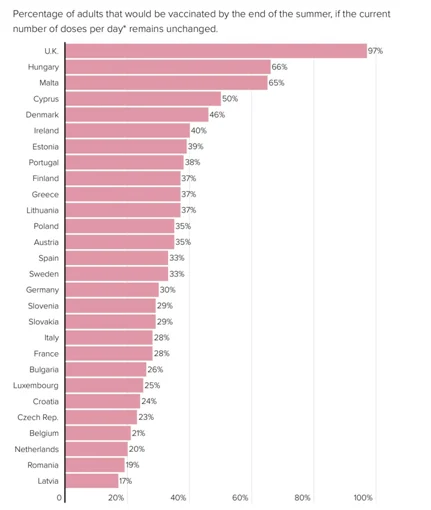
Percentage of vaccinated citizens in each country by summer. politico.eu
The rest of the Old Continent
And what is the vaccination issue outside of the
twenty-seven U.E. member states? Ukraine is facing many problems. As a Polish
newspaper Rzeczpospolita reported, “Ukrainian medical
facilities threw away some unused vaccines against coronavirus after doctors
failed to show up for their own vaccinations.” Nearly half of the population
does not want to be vaccinated at all, with a record low of only 3,141 vaccines
administered by Feb.28. This distrust is, unfortunately, a common denominator
of most post-Soviet republics. The government takes the jabs, the president
takes the jabs, the fight against throwing away doses continues.
The Swiss are vaccinating, but as recently as
February, the country was the only European country where the Agency for
Therapeutic Products (Swissmedic), responsible for authorizing the marketing of
drugs in Switzerland, refused to approve AstraZeneca’s
vaccine and ordered a series of further tests. So far, only 6% of the
population has received both doses. Bloomberg reported back in January that
even “the wealthy and punctual Swiss are falling behind.”
Great
Britain on its way to the podium
All signs point to the Kingdom deciding to end
its bad streak and learn from its mistakes. B. Johnson, who a year ago was in
no hurry with lockdown or further restrictions, is already chilling the
champagne. Is his enthusiasm premature? This can only be shown in the upcoming
months. The U.K. has struggled not only with massive pandemic hits but also
with the final implementation of Brexit. This all took place unfortunate
against the backdrop of a new – British – variant of the
coronavirus, which proved to be more dangerous and harder to detect, as well as
raising questions about the efficacy of vaccines against potential future
mutations of the disease and the vast number of fatalities – the islands
occupying the long-neglected first place in this classification.
However, there is also a need to look at the
other side of that matter. Great Britain was the first to get vaccinated,
quickly and effectively invested in production and research, and without waiting
for E.U. accreditation, recognized and purchased subsequent doses. In this way,
the goals clearly set for themselves brought success. As Ch.Gallardo writes for the politico.eu
website, these quick decisions sought by the government were possible because
the U.K. amended its national health regulations in the fall to allow the MHRA
to temporarily release a vaccine that meets safety and efficacy standards but
has not yet fully completed the licensing process. Interestingly, this brings
us back to the issue of the E.C.’s solution, as it too could have used such a
mechanism, but opted for a more stringent licensing procedure where companies,
rather than taxpayers, take responsibility if problems arise. So, by deciding
on its own, the U.K. has bypassed the inevitable extra bureaucracy of working
with 27 other countries.
Check out: The Lublin Triangle: A Polish Look at the
Establishment of the Initiative by Piotr Obszarski (Poland)
The latest statistics show a marked drop in
mortality after effective vaccination uptake. Dr. David Speigelhalter,
Professor of Statistics at the University of Cambridge comments on the results using the
word “extraordinary – in terms of hospital admissions and casualties, a gap
appears between those under and over 65. For those over 75, the daily mortality
rate halves each week. Extraordinary.”
The government has announced that if the current
vaccination rate does not slow down, every adult Briton will be vaccinated not
by autumn, as promised at the beginning, but by the end of July this year. The
public is holding its breath and believing in the announced date of Jul. 21 as
the moment when the restrictions will be lifted and the fight for the economy
(and tourists, after all, the islands are a very popular and popular
destination, and the vacations are just around the corner) will fully commence.
What the eyes and ears of the whole country are now turned towards are the
reports of the first news of the Brazilian variant arriving there.
Israel
leads in the general classification
Israel can definitely declare success in the
fight against the pandemic pride itself on an incredibly well-run vaccination
process. This is due to the fact that from the very beginning it worked
brilliantly. The country ends the first quarter of this year with these results: 54.6 percent of the
country’s population has already received at least one dose of the vaccine,
while 38.9 percent – both doses.
However, as we mentioned at the beginning, it is
difficult to compare the vaccination rate in Israel with other countries. There
are several reasons for this. First, Israel has received more doses of vaccine,
which is due in part to an agreement with Pfizer
for a project to determine the true nature of herd immunity. Israel committed
to provide anonymized, aggregated epidemiological data on its citizens.
Secondly, the demographic structure of the country seems to be extremely
important. Israel has a population of 9.3 million and a relatively young
population structure (people over the age of 64 make up about 12 percent of the
population), which reduces the amount of vaccine needed to vaccinate the most
vulnerable group. In addition, from the very beginning, the vaccines were
strongly promoted. Not only the government is responsible for good PR and
fighting fake news, but also the clear involvement of citizens, sportsmen, and
celebrities is visible.
A question about Palestine seems very
controversial though the Israeli authorities have only given a few thousand
vaccines to the Palestinians. “We want everyone in our region to be vaccinated.
But the health of the Palestinians is the responsibility of the Palestinian
Authority”, – explained Yoav Kish, the Israeli Health Minister. The Israeli
government has been criticized for not making its significant vaccine reserves
available to Palestinians living in the occupied territories. Human rights
organizations such as Amnesty International and Human Rights Watch say that
Israel, occupying power over approx. 60 percent of that territory, has an
obligation to vaccinate Palestinians living there. Israel rejects these claims and argues
that under the Oslo Accords, the Palestinian Authority is responsible for
vaccinating Palestinians.
Beyond the
Great Water and 100 first days
As usual, the whole world is watching America.
The USA, back during Donald Trump’s administration, abandoned the ideas of
treatment with bleach and decided to invest in vaccine development, as we
already mentioned. After being sworn in in January, J. Biden announced an
ambitious plan for the beginning of his term, in which, in addition to
rejoining the Paris Convention or the WHO, he set a goal of launching 100
million doses in the first 100 days of his presidency. In February, Pfizer expected to deliver more than 13
million a week to the U.S. by mid-March, more than double what it had
previously delivered, while Moderna
hopes to deliver up to April 40 million doses per month, which was assured by the
company’s chief executive, Dr. Stephen Hoge.
Although the first phase of
vaccination was fairly uneven across all states, there was a focus on
hospitals, pharmacies, and other medical facilities, which greatly aided the
process. According to Bloomberg, in an effort to speed up the process, the U.S.
government began encouraging states to begin vaccinating all residents 65 and
older, as well as those 16 and older with certain diseases. This directive made
vaccinations available to more than one-third of the U.S. population. Orders
were also significantly increased. March charts already indicated
administration of more than 2 million doses per day, which, at this rate, would
bring the nation to national immunity within the next six months.
However, the Johnson&Johnson
vaccine was approved in late February and early March that could significantly
impact the entire process. This substance differs significantly from the
vaccines available on the market so far. Although its efficacy is estimated not
at over 90, but about 65%, it is a single-dose vaccine that can be stored in a
regular freezer. Although these factors may even revolutionize the procedure, I
would take a rather relaxed approach to the experts’ enthusiastic talk of
achieving American immunity as early as March. Vaccination is one thing and a
pandemic is another, as some seem to forget, such as Republican Texas Governor
Greg Abbott, who gleefully announced the imminent return to 100 percent store
openings and the easing of restrictions by removing the requirement to wear a
mask as, thanks to medical advances in vaccines and antibody treatments, Texas
now has the means to protect Texans from the virus. Unfortunately, his ideas
are, well, unconvincing.
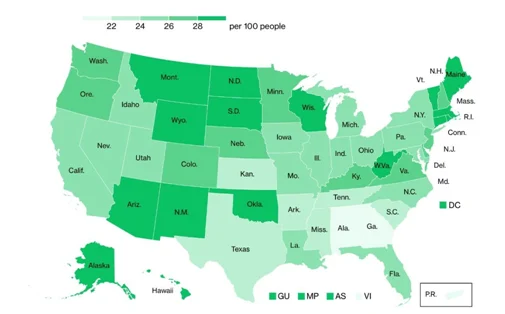
Doses administered by state, January, 20, 2021. Bloomberg
It is worth noticing that COVID and vaccines have
also become an arena for exposing further inequalities. This is evident not
only between regions or continents but also between U.S. states. The U.S.
medical website Stat analyzed the relationship between Covid-19 vaccination and
the wealth of individual cities. It turned out that wealth inequalities are essential
in the case of vaccination because, in affluent places, access to the vaccine
is easier. For example, in Woodbridge, Connecticut, whose residents earn an
average of nearly $139,000 a year, almost 20% of the population was vaccinated
on Feb. 4. By contrast, in neighboring Ansonia, whose population is half that of
Woodbridge and whose average per capita income is $46,000, 7.1% of residents
got the shot. Moreover, if we look at the capital, the number of inoculations
in the two wealthiest districts was twice as high as in the two poorest. What
we are seeing is that the privileged have access to vaccines and are crowding
out those at a lower standard of living, said Tekisha Dwan Everette,
executive director of Health Equity Solutions in Connecticut, also a member of
the governor’s Covid-19 advisory task force in that state. This means that
Barack Obama was thinking about social inequalities while falling asleep for a
reason.
But the numbers don’t stop there, as vaccine vacations are becoming more and
more popular and are already turning into the first phase of vaccine
commercialization. On the Internet, it is easy to find a whole range of travel
ads, including, among others, Indian operators offering trips to New York or
London to be vaccinated against coronavirus for as little as $2,500. Everything
covered. However, let me not go into that, as this is a topic for a separate
article. One question that arises here is how far can ethical boundaries be
pushed in an age of, supposedly in crisis, commercialism?
And what
about the rest of the world? The other side of the Pacific
Since the U.S. has just been mentioned, we have
to focus on China before moving to the south. The vaccination process here looks
a little different – there are no groups dedicated to the elderly, and the
appeal has been addressed to people between the ages of 18 and 59. Of course,
priority is given to people working in high-risk areas, which applies not only
to health care personnel but also to workers in markets, transport, contact
with frozen food, and customs officials. Interestingly, international experts
are still questioning China’s claim, which insists that the virus was imported
from abroad in the form of imported frozen food. Of course, on national television,
the official line of the authorities is not disputed by anyone. They vaccinate,
of course, with their preparations – Sinopharm
and Sinovac, which began to be
administered even before the official approval of the authorities. However,
even there, the vaccination process did not proceed without obstacles, and its
beginning was quite laborious. Above all, the leaders were anxious to vaccinate
up to 50 million people by the Chinese New Year holiday, which, like our Easter
or All Saints’ Day, is conducive to travel, celebrations, family gatherings,
and gatherings.
Moreover, it should be added that indigenous
vaccines were administered to representatives of certain professional groups as
early as July 2020 as part of an emergency vaccination program. What else
distinguishes China is implementing ideas straight out of Orwell, which,
unfortunately, we have already become accustomed to. The fact that vaccinations
in Beijing, although not obligatory, are used for electronic public monitoring.
As Gao Xiaojun of the Beijing Health Commission explains, “we link our
vaccination platforms with the official coronavirus tracking app to enable data
sharing. A person who has received the first dose of vaccine is recorded as
vaccinated in their app. The second dose will also be recorded there with the
notation «vaccinations completed.” Interestingly,
the coronavirus tracking app already acts as a form of sorting – you have to
show it in many places – going to restaurants, shopping, or traveling. The
solution is reminiscent of the debated ideas of coronapassport (or any other
form of vaccine tracking) but raises questions about the boundaries between
individual anonymity and public safety. Questions that multiply day by day,
leaving no answers behind.
Of course, we must remember that China really has
many doses to administer – after all, it must vaccinate around one billion
people to achieve national immunity. Theoretically, this is doable by the end
of this year.
However, the aid they are sending abroad may or
may not prolong the process. This is because the country already has orders for
all four types of preparations. According to the state press, the Sinovac practice has already been sent to Turkey, Mexico,
Thailand, Malaysia, and the Philippines, and the specifics of the Beijing unit
of Sinopharm – to Hungary, Serbia,
Peru, Indonesia, and Zimbabwe. In addition, despite the announced production
volume, it was already apparent in February that supply was not meeting demand.
China also has to fight reluctance among the public. “People believe that there is now little chance of contracting
coronavirus. Hence few people feel the need to be vaccinated immediately”, – explained Yanzhong Huang, a public
health expert at Seton Hall University. Interestingly, in an August 2020 online
survey, the vast majority of Chinese citizens (up 70%) said they would be
interested in getting vaccinated. By November, it was up to 61% (almost 20
percentage points higher than Americans).
The next few months will show how the Chinese
game will turn. The truth is that with relatively few new cases, the country
can focus on vaccine diplomacy, production of new doses, and conducting the
vaccination campaign.
Keep calm
and organize
Australia seemed to adopt the tactic of starting
slowly and accelerating on the second lap to run to the finish line, perhaps
not first, but certainly not in the last place. The idea, maybe, would have
worked if the E.C. Authorities had not stopped the planned March delivery of AstraZeneca doses, insisted that the
pace would soon be stressed and thus looked to October as the month to achieve
immunity. Australians want to vaccinate. And they do. A survey conducted just
before the trial began and on Jan. 21, 2021. by Vox Pop Labs for the ABC showed that the vast majority
(over 70%) is in favor and that they perceive vaccinations as not only safe but
needed.
As we all remember very well, New Zealand coped
with the pandemic brilliantly, and this can undoubtedly be attributed to the
smiling and competent Prime Minister – Jacinda Ardern has a different way to
administer the jabs. Interestingly, when the whole world is already in the
race, New Zealand leaves its borders closed and announces that it will start
the vaccination process in the middle of the year. Well, yes, the geographical
location and incidence rates make this situation not comparable to other
countries.
What is more, the government of New Zealand has
signed vaccine contracts with AstraZeneca
and Novavax, according to Business
Insider. As a result, citizens of the 5-million-strong country will receive as
many as 18.3 excess doses at their disposal, and these, in turn, will go to
residents of nearby areas – Tokelau, Cook Islands, Niue, Samoa, Tonga, and
Tuvalu. And this is not the end of the assistance offered by this government to
residents of neighboring countries. Nanaia Mahuta, Minister of Foreign Affairs,
announced that they would also
receive $65 million to support their development.
Our reality
– African dream
Sad projections about vaccination procedures in
Africa echoed ominously at the beginning of the year. It turned out that some
countries have no chance to carry out vaccinations effectively or even to start
them within the next two or even four years. Analysts of The Economist stressed on their graphics that vaccine poverty really exists in
that region. Charlie Hebdo at the
beginning of February scared with its cover graphic showing an African child
with a mouth full of vaccine leftovers and the caption We will still get leftovers!
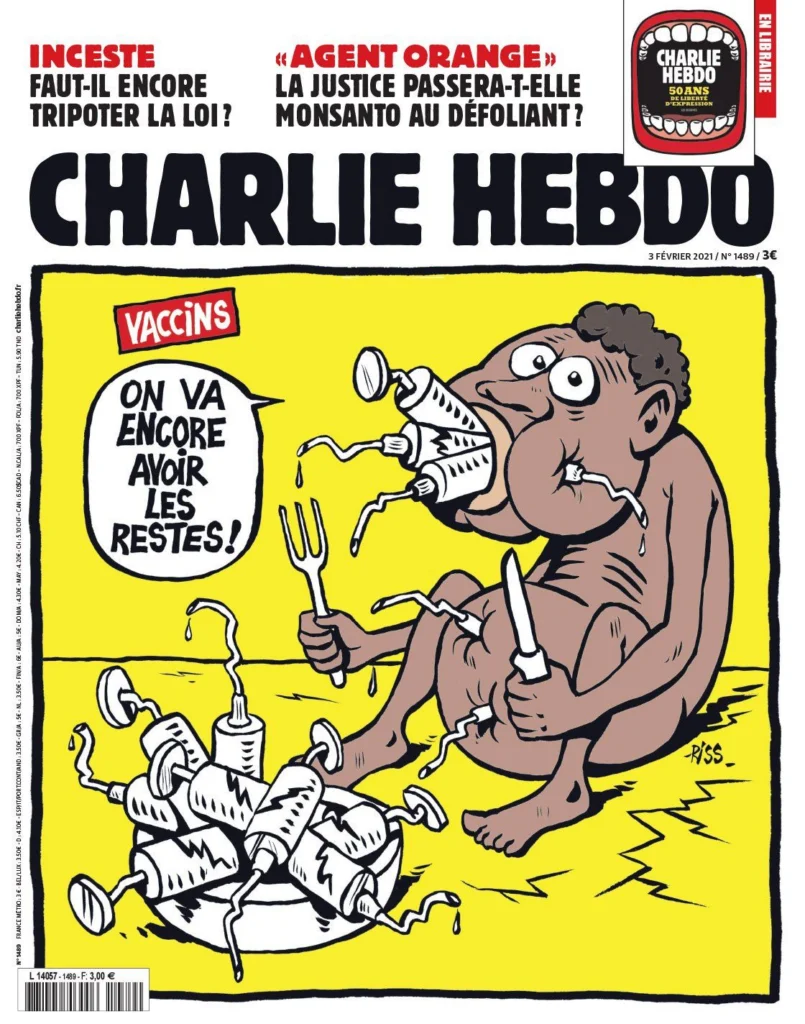
The mentioned ‘Charlie Hebdo’ cover
This essentially macabre vision was reconstructed
by the effective operation of the COVAX program.
COVAX, or COVID-19 Vaccines Global Access
Facility, is a global collaboration to accelerate the development, production,
and equitable distribution of new vaccines. Countries that join the COVAX
program will gain access to a wide range of new vaccines and are jointly led by
Gavi, the Vaccine Alliance, the Epidemic Preparedness Innovation Coalition, and
the World Health Organization. Participation in COVAX can be seen as an
insurance plan even for the wealthiest countries, such as the U.S., which have
bilateral agreements with several drug manufacturers to get priority access to
certain vaccines. The idea, therefore, seems to address satisfactorily the
problems that arise almost constantly today. In January, Kate O’Brien, WHO
chief vaccine expert, indicated that COVAX’s goals were to secure 2 billion
doses for the world’s poorest countries and begin the process within the next
few weeks. Additionally, the plan was to ensure doses for 20 percent of
the population from each participating country, with 92 lower- and
middle-income countries receiving funding.
Truth to be told, the success of a campaign to
distribute vaccines to the poorest regions is tied to the production and
distribution of contracted doses. This interdependence once again points to the
fact that, in reality, the fate of all aid measures is in the hands of those
who wield both power and money. The tensions I have described in the European
Union, the nationalistic and egoistic attitudes of some countries, competition,
and irresponsibility may have an extremely negative effect on those who have
little or no influence. Reuters warned as early as December 2020 that the COVAX plan,
while necessary, could prove highly ineffective and leave Africa waiting for
vaccines until 2024.
Along with the singing of the first spring birds,
March also brought good news – Ghana and Côte d’Ivoire launched government
campaigns to popularize vaccination, Nigeria, Kenya, Angola, and the Democratic
Republic of Congo received their first shipments of vaccines, which, according to Marie-Pierre Poirier,
UNICEF Regional Director for West and Central Africa, was “a huge first step
towards equality and a demonstration of global solidarity.” The program’s
activities have, therefore, significantly accelerated, bringing hope for the
entire continent. The plan is to deliver as many as two billion vaccines by the
end of the year. Achievable? Absolutely. Will it be achieved? We will find out
soon enough. The key again will be international cooperation, and it is clear,
after all, that shortening the pandemic period is a global goal, so getting
Africa’s economy working again should also be on the international agenda.
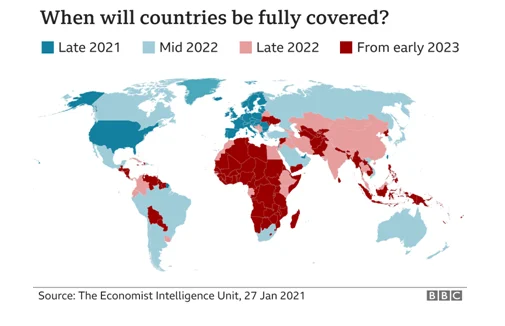
The global gap in the vaccines’ distribution in a map. BBC
Big unknown
The fact that the
Covid-19 pandemic will change our lives irrevocably was already known in its
early beginnings. In April 2020, analyses of the future appeared, universities
and companies were massively moving to remote working, and doctors’ online
visits ceased to be a concept straight out of the science-fiction classics.
Everyone was waiting for I.T. – THE vaccine. Now, as we enter the second
quarter of 2021, we have learned to live with the pandemic, what we know – and
yet what we don’t know. The process of vaccination, shrouded in so many myths and
hopes, continues, and when it ends – paraphrase Bogusław Mec, a Polish
well-known artist – the future, “really what you are, nobody knows”. What we do
know is that it is worth persuading people to get vaccinated, that scientific
researches and discoveries should be continued, and that governments should
understand that in this post-pandemic world, they have to focus most of all on
the development of science, education, health care, and regional integration,
which will significantly improve all activities on many levels and simply or
perhaps -above all – make our lives easier.
This article was written
at the beginning of March 2021. The situation is developing dynamically. In
fact, every day, new issues are raised, further questions, doubts, and problems
arise. Some countries are recovering. Others are entering a lockdown.
Tanzania’s president, who did not believe in the virus, died due to heart
problems (as reported in the press), but it is widely known that his condition
due to covid infection was very severe. Israel opened most of its economy,
celebrating the vaccination of nearly half the population. It allowed for a
slow easing of restrictions, one of the critical demands of Netanyahu, who is
seeking re-election. The United Arab Emirates (22.1 percent) and Bahrain (12.5
percent), as well as the United States (11 percent), are at the top of the
ranking but not even close to Israel’s position. The U.S. President’s @POTUS Instagram
account shows a graphic of 100 M shots in (crossed out 100) 58 days. It
signifies presidential success. Also in the top 10, is South America’s leader,
Chile, where 9.3 percent of the population is fully vaccinated.
Visit: 2020 in Latin America: a
Political Roller Coaster by Dulce María Hernández Márquez
(Mexico)
Allegations against the AstraZeneca vaccine regarding
complications and/or side effects of taking it (the risk of blood clots seemed
to be particularly dangerous) became an important topic. However, in the middle
of the month, the EMA announced that this product was safe. The head of the commission
insisted that the benefits of the vaccine outweighed any possible risks. After
its use was temporarily suspended, re-vaccination began in Germany, Italy,
France, Latvia, Lithuania, Portugal, Spain, the Netherlands, and Cyprus and
Slovenia. The Swedes still needed a few days to decide.
The European Union is
working on the idea of covid passports and vaccinations. According to the
latest estimates, member countries should get a total of 66 million doses of BioNTech/Pfizer, 10 million of Moderna, 30 million of AstraZeneca in the first quarter, 200
million, 35 million, 70 million, and also 55 million of Johnson&Johnson’s single-dose formulation in the second
quarter, respectively. Officially reported data shows that in Poland, 4.2% of
the population has been fully vaccinated. In the E.U. community, we are
preceded only by Malta (8.7%), and in Europe – Serbia (10.9%), Norway (4.6%; as
of Mar. 11), and Switzerland (4.3% by Mar. 10).
It is important to emphasize
here the intensive work of the E.C. and the fact that the E.U. vaccine problem
is the responsibility of the member countries themselves, not individuals or
the organization itself. Data from the end of February shows that most of them
have not yet used up all available vaccines. Poor management and planning of
the vaccination rollout have resulted in many doses simply remaining
unused. Harmonization and structuring of
work and cooperation and reduction of nationalism in the twenty-seven countries
will undoubtedly be post-pandemic topics on the E.C. agenda. After all, E.U.
bodies work effectively, but only as much as they can – thus within the limits
of their competencies.
Every day brings
something new. And let’s hope that behind this new one, there is progress and development. The fight for a return
to (albeit different) reality, for the protection of human life and health –
continues!
Written by Agnieszka Homańska, a ‘Mlodzi o
polityce’ (Youth about Politics) project, University of Warsaw, Poland