
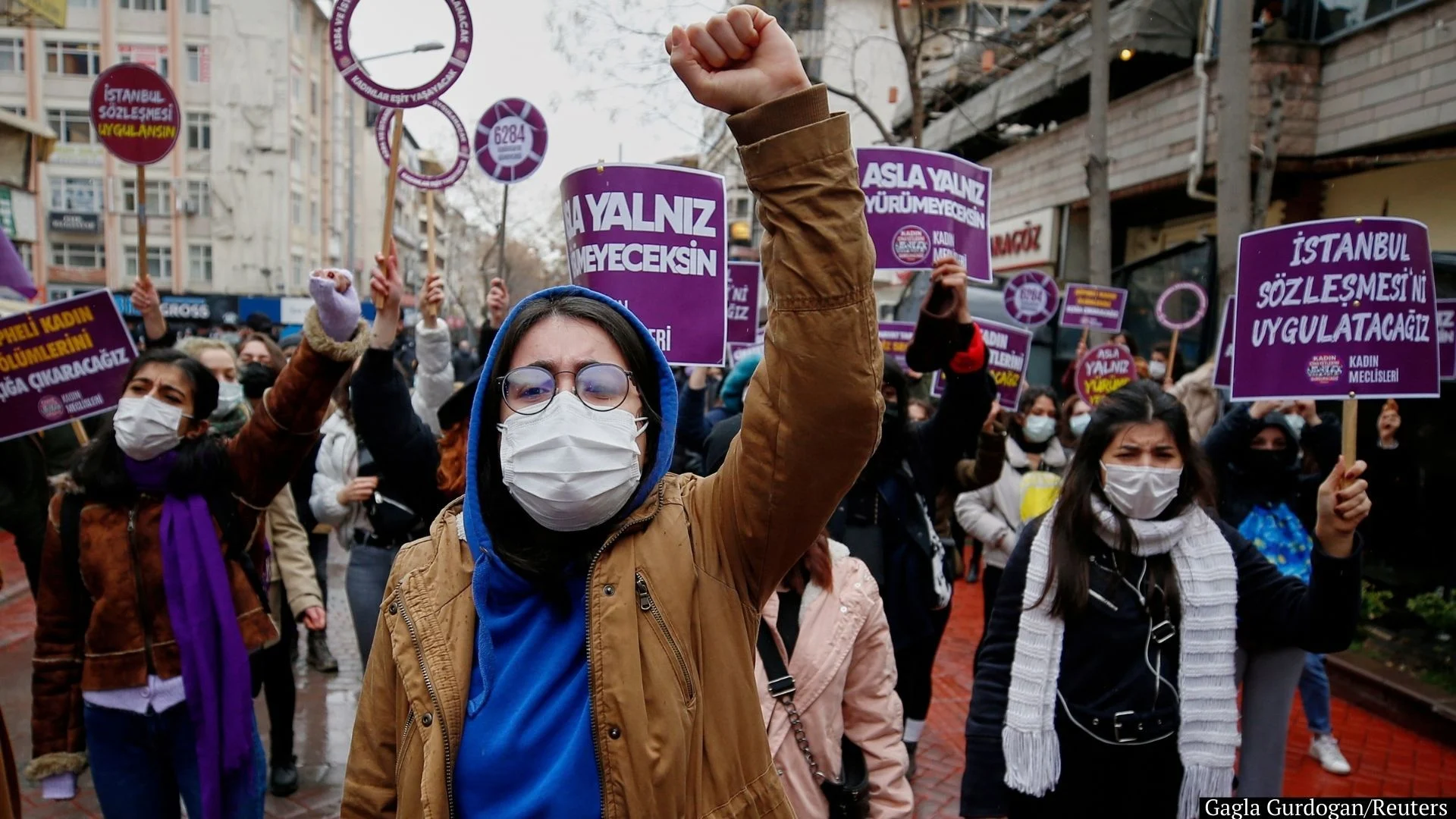
This year marks the tenth anniversary of the signing of the
Convention on preventing and combating violence against women and domestic
violence, commonly called the Istanbul Convention (after the place where it was
signed). The Council of Europe drafted the document. Its primary goals are to
«protect women from violence and prevent domestic violence, eliminate all
forms of discrimination against women, promote equality between men and women,
establish a comprehensive policy framework to support and protect victims of
violence, and establish international cooperation among states, as well as
support organizations and law enforcement agencies to eliminate domestic
violence and violence against women.” However, the Turkish government does not
see it as a solution, or the women rights as an issue. What is the matter? Read
in this article.
Convention. What does it really mean?
This is a landmark international act that recognized violence
against women as a form of discrimination and, more importantly, a violation of
human rights. It also introduced several new criminal acts, thus classifying
sterilization, forced abortion, genital mutilation, forced marriage, or
harassment as crimes.
The document has been signed by all EU countries and all Council of
Europe member states except Russia and Azerbaijan. Turkey was the first to
ratify it in 2012, and over the years, 35 countries have done the same,
including 21 EU member states. However, the Convention has not been ratified by the EU as an organization, nor by the UK, Czech Republic, Slovakia, Lithuania, Latvia, Ukraine, or
Bulgaria. It took effect on August 1, 2014, when the first ten countries,
including eight members of the Council of Europe, agreed to make it binding on
their territories.
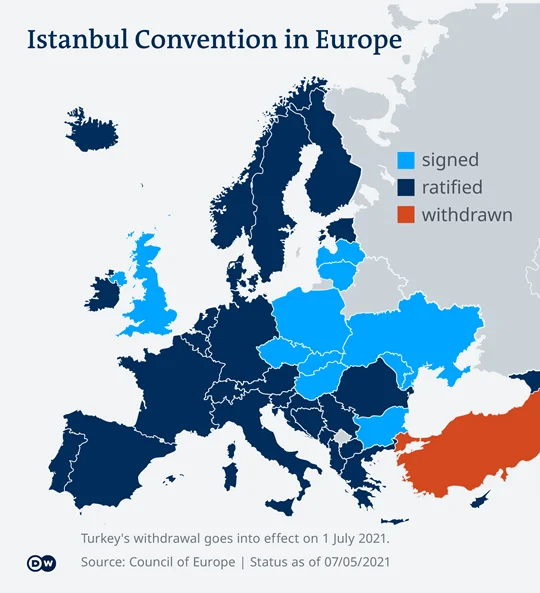
Istanbul Convention status in European countries. DW
The year 2021 brought surprising news from Turkey, which decided to
invalidate the document on its territory. The decision of the Turkish
government caused a massive stir among the society. It remains to be seen whether the
denunciation of the Convention was foreseeable…
A multi-million society
One area in which analysis could try to help understand the Turkish
situation is a brief analysis of the country’s socio-demographic data. Over 80
million people live in Turkey, and women make up almost 50% of the total population. Additionally, the number of
Turkish citizens is steadily growing. It is estimated that by 2030 the country could have up to 89 million citizens.
Thus, in such a vast society, there may be disparities in different areas of
life, and withdrawal from the Istanbul Convention means a potential threat for
half of the citizens to respect their rights.
It was mentioned about the possible disparities occurring due to the
multi-million population. The first of these is access to education. Despite
the optimistic data on the low level of illiteracy, which among both men and
women remains below 10%, a large percentage of people who, after completing
their compulsory schooling, stop receiving further education may be observed. It encompasses 30% of people aged 18-24 who stop studying and have no employment. The
average in the European Union countries for the same indicator in 2019 was 10%.
Read: The Polish Prosecutor’s Office’s Sickness by Adam August Michalik (Poland)
But that’s not all. A national survey on violence against women
conducted in 2014 found that as many as one in three women in Turkey are
married off by the age of 18. Additionally, a third of girls are not allowed to attend school due to bans
issued by their families, and the families of 11% of women forbid them from
working. From this data, it can be seen
that a large portion of those who do not work or continue their education are
women who start taking care of children and housekeeping after they get
married.
The need for Turkish feminism
The country’s history has greatly influenced the women’s
emancipation movement. The first pedagogical college for women was established as early
as the 1860s. Two women’s magazines, «Terakki» and «The
World of Women,» were also founded
then. When at the beginning of the 20th century, the country returned to
the system of constitutional monarchy, women started forming organizations and
associations.
As a result of World War I, women could work in offices, hospitals, or banks. In February 1923, Atatürk commented on the situation of women as follows: «Turkish women fought
bravely for the independence of the nation. Today they should be free, should
enjoy education and have the same position as men; they deserve it». The
year 1926 can be called a
watershed year for Turkish women. It was then that the Turkish authorities
adopted the Swiss Civil Code, resulting in the westernization of national law.
However, there was a critical difference in the adapted Turkish
Civil Code. In marriage, the status of a woman was still to remain lower than
that of a man. Nevertheless, the possibility of separation and divorce was
introduced, and marriages performed in a religious institution began to be
recognized only after the union was concluded in a civil registry office. Only
a few years later, in 1934, Turkey became the following country in which women gained the right to vote and
to run for political office.
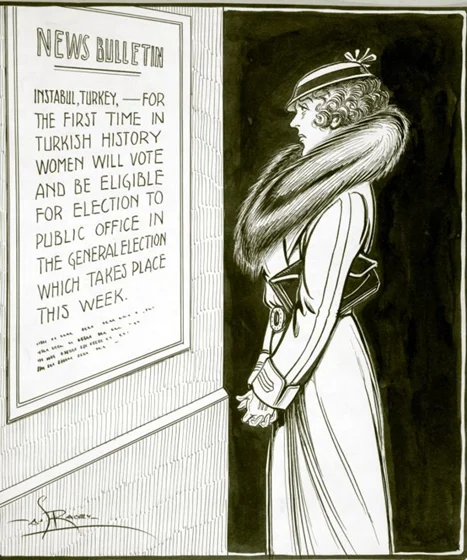
Canadian political cartoon.
Racey Arthur G./The Montreal Star
In the 1950s, internal and external migration increased, which contributed to changes
in the status of women. The urban population grew slowly at first, rising
nearly five percentage points between the early 1940s and the late 1960s. By
the early 1970s, however, the number of people living in cities was already as high as 30 million, accounting for 75 percent of the
total population. In 1985, the country joined the Convention on the Elimination of All Forms of Discrimination
against Women (OHCRH), which is also known as the International Women’s
Charter. Turkey could thus be counted as a country moving with the times, which
was to be confirmed by the signing and ratification of the Istanbul Convention
in 2012.
NGOs are the support for women
In 2014, however, after a national survey, it was found that four out of ten women were exposed to physical or sexual
violence, and 48% of Turkish women who married at age 18 had experienced sexual
or physical violence. To monitor and prevent such incidents, women’s
organizations, including the Women’s branch of the United Nations, are still
active in the country today. Moreover, over the past few years, on the
initiative of women’s organizations, the government has enacted several
programs to protect women from violence and discrimination.
In 2019, the Eleventh National Development Plan for 2019-2023 was approved, with the objectives, among others, of preventing discrimination
and ensuring that women have the same access to rights and opportunities as
men. A strategic plan to empower women, a national plan to combat violence
against women, and a national plan to improve the working conditions of Turkish
women were created as well. Also, on the initiative of the United Nations Women’s
Organization, a program funded by the European Union, «Implementing Norms,
Changing Minds,» was created in 2017. It aimed at reducing violence in Turkey and in parts of the Balkan
countries, despite the introduction of the Istanbul Convention in these
countries.
Visit: The Odebrecht Corruption
Scandal: the End of the World Plea Deal by Dulce María Hernández Márquez (Mexico)
Unfortunately, despite all the regulations introduced, the position
of women in Turkey still differs significantly from that of men. According to
the 2021 report conducted by the World Economic Forum, Turkey is ranked 133rd
in terms of gender equality and 101st in terms of
educational opportunities for women. Moreover, only 38.5% of
women exist in the labor market, and 22% of them are in managerial positions.
The female labor market situation is so bad that the wage gap between women and men in the same places is 15%.
With such alarming statistics, the decision of Recep Tayyip Erdogan’s
government to terminate the Istanbul Convention by Turkey may therefore come as
a surprise.
What happened in March 2021
When President Erdogan announced Turkey’s withdrawal from the
Istanbul Convention, Turkish society got heated. Thousands of women went on the
streets of Turkish cities to express their opposition to the government’s
decision. Opposition party MP Gokce Gokcen expressed extreme outrage on her
Twitter account over the decision and said it would lead to the marginalization
of women into second-class citizens.
The Women’s United Nations almost immediately issued a statement that also criticized the president’s move and recommended a
rethinking of the matter. On the Internet, accounts appeared under the hashtag
#IstanbulSozlesmesiYasatir, which can be translated as «the Istanbul
Convention lets women stay alive.»
The Turkish organization We Will Stop Femicide stressed that the
Turkish government’s decision would increase murders resulting from domestic
violence, with only a recorded number of about 300 in 2020.
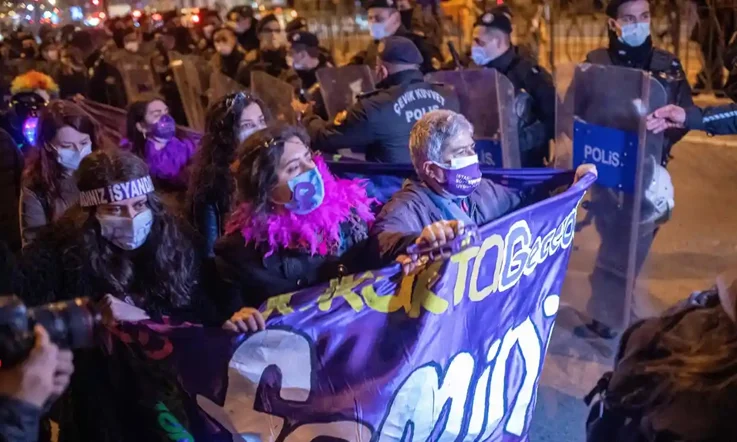
Protests against the Turkish withdrawal from the
Convention. Bülent Kılıç/AFP
On March 20, an abrogation of the ratification of the convention was
signed. As of July 1, it officially ceased to be in force, and Turkey joined
the group of Council of Europe countries that have decided not to fall under
the document. However, the Turkish Minister of Family, Labor, and Social
Services said that the country’s laws, including the Constitution, sufficiently
protect women from potential acts of violence.
Still, in the eyes of international opinion and NGOs, President
Erdogan’s move was a purely political ploy that could have dire consequences.
Amnesty International suggested that the new situation could also negatively affect the LGBT+ community, which the Convention also protected.
As we can read in an article published by the aforementioned
organization, the Turkish authorities on this issue have suggested that the
LGBT+ minority does not go along with Turkish social and family values and maybe
socially harmful. The use of similar rhetoric can be seen in the case of the
Polish government, which in 2020 also considered removing itself from the ranks
of the Convention. The Polish Ministry of Justice sent a letter to several
countries in the region outlining proposals for a new convention.
Check out: The European Youth Capital 2023: Lublin
is Ready and Set by
Julia Dziuba (Poland)
The Ordo Iuris Institute prepared its draft for Legal Culture. The
reason for the willingness to sign the recent way and withdraw from the
previous one was also one of the arguments put forward by Turkey – the Istanbul
Convention will lead to the destruction of the traditional family model. The Ordo Iuris project has so far
attracted the interest of Hungary and Slovakia. It should be remembered that
both these countries have not ratified the Istanbul Convention.
Controversies around the Convention
As I mentioned before, both Hungary and Slovakia have not put the
Convention into force. They have only signed it. The same move was made by the
Czech Republic and, perhaps surprisingly, the UK. However, this is because
national law is not adapted to the assumptions of the document. In the UK,
psychological violence is not considered a crime. There is also no stipulation
to help victims of violence who have refugee status. However, the country
is on the right track, as the Domestic Abuse Act that meets some of the
criteria of the Istanbul Convention was passed this year. Nevertheless, the
British government is not yet able to estimate when the Convention can be
signed.
The Czech Republic was one of the last countries to decide to sign
the Istanbul Convention. Its ratification was scheduled for 2018, but the event
never happened. The reason was the controversy over the provision on
non-stereotypical gender treatment, the same condition that Ordo Iuris and
Turkey objected to when denouncing the Convention. The main opposition to the
ratification of the document in the Czech Republic is the Church. Priest Petr
Piťha stated that its ratification would lead to the break-up of families, so
the same populist argument was used as in the case of Turkey.
Conclusions
The decision of the Turkish government was most probably motivated
by political motives, disregarding the will of the citizens. Nevertheless, I
can state that the Convention itself arouses great emotions not only in Turkey.
The document evokes controversies, especially in religious circles. I think
that in the nearest future, its topic will appear in the media more than once.
Turkey may be followed by other countries, especially those interested in an
alternative to this document.
If other countries decided to withdraw from respecting the
Convention, it could lead to a permanent violation of women’s rights, as well
as children’s and LGBT+ minorities’ rights. However, this is only a theoretical
scenario for now. For the time being, we can only observe how the situation in
Turkey will look like in the nearest future and whether Turkish law will indeed
be a sufficient mechanism of protection against domestic violence.
Written by Hanna Janasik, the project ‘Youth About Politics’,
University of Warsaw (Poland)
If this article was useful for you, support us on Patreon to get more high-quality articles on the issues of international politics.