
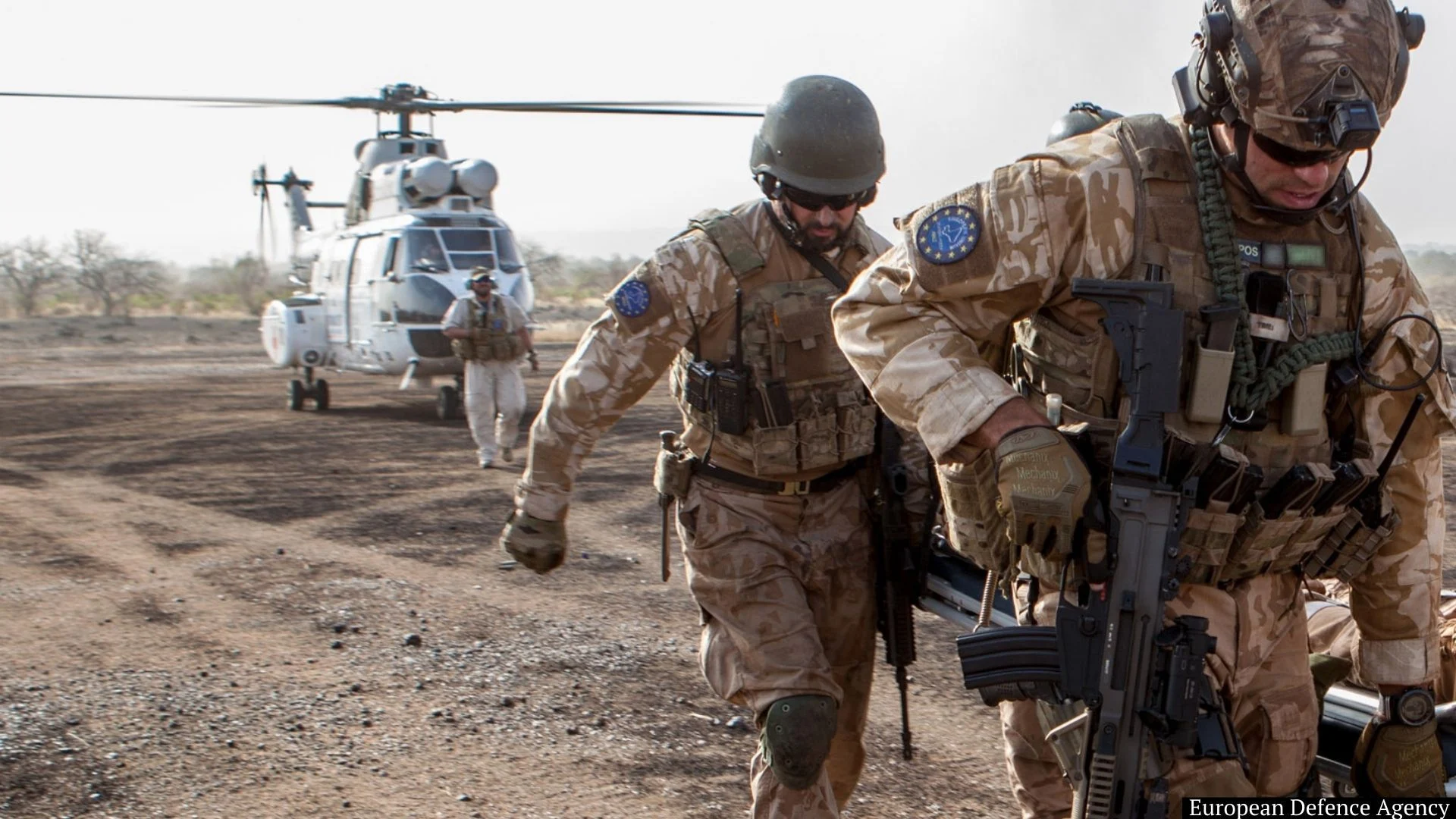
Strategic autonomy, a European army, a Europe without NATO,
President Macron’s ideas, Central and Eastern European concerns, and dozens of
articles trying to answer the question of whether the EU should become
independent of NATO and the US. These buzzwords, enigmatic slogans, and deep,
unanswered questions seem to be inherent in the EU’s defence policy. Much is
written about it, but at the same time, we know little about it. What is it,
what does it involve, and, consequently, what future does it have?
To answer
these questions, we need to know the genesis of that idea, the formal framework
that shapes it, and the instruments available to it. Explaining what the
European defence policy is is a difficult task. However, it is now also a
necessity, because as members of both the EU and NATO, we have a duty and a
vested interest not only to know what is going on but also to look for
opportunities to defend our interests in a changing reality. The following text
aims to guide us through the meanders of the EU defence policy and indicate
what it is and what it is not and what – from the Polish perspective – it
should not be.
Wind of change
If one’s interests focus on transatlantic relations, then
undoubtedly one of the most prominent bones of contention between the U.S. and
the EU is the EU defence policy. The latter is developing dynamically, and
recent months have brought a rash of information and announcements. First, we
saw a change in the narrative of the White House, whose previous
confrontational rhetoric had led many Euro-enthusiasts to think about building
a European defence system independently of the US. It was then that threats
were made that some countries were not worth defending against aggression or that NATO was undergoing «brain death» and needed to be replaced with something
else. A calming of mood came with Joe Biden’s assumption of power but once
aroused, ideas and doubts did not go away. One could follow them all in the
speeches of Angela Merkel, Emmanuel Macron, or Jens Stoltenberg at the Munich
Security Conference of February 19 this year.
After a wave of words and comments, the time for the details has
come. For example, the final shape of the European Defence Fund (EDF) for
2021-2027 was adopted, the first (for the time being secret) versions of the EU
Strategic Compass were presented, and it was announced that the United States would
participate in one of the PESCO projects (Permanent Structured Cooperation,
about which more later). All this is happening at a time when experts are
talking about changes in the global balance of power, anticipating the
development of tensions between Washington and Beijing, or counting the days
until the announcement of a new NATO strategy.
Read:
The Polish Prosecutor’s Office’s Sickness by Adam August Michalik (Poland)
All these events and processes point to an obvious conclusion – the
contemporary international situation forces the European Union to build its own
security. The Community tries to respond to it. What is less apparent is how
this is done. Therefore, without further ado, it is time for us to get to know
it better. Let us start with history to understand better the context of what
exists today.
The roots of EU defence policy
The first attempt by European states to form a military alliance
took place a year before NATO came into being, in 1948, when France, the United
Kingdom, Belgium, the Netherlands, and Luxembourg formed the Western Union
under the Treaty of Brussels. Its origins were straightforward and classic:
these countries feared the remilitarisation of Germany and another war that
would follow the same course as the two previous ones. To protect themselves
against this, they wanted to create an alliance and commit themselves to stopping the rearmament of Germany. There was no question of building a
separate army, joint structures, or European integration, instead of forging an
alliance like so many other alliances in history, without a European army or
autonomy.
In the early 1950s, however, it seemed that some qualitative change
was coming. It was then that the Korean War broke out, and for Western
countries, the sense of threat from the Communist world became more accurate
than ever before. Such atmosphere quickly influenced the emergence of an idea
in Washington and among its European allies about the need to remilitarize West
Germany to increase NATO’s defence capabilities in Europe. Under such
conditions, the Western Union, which was a traditional alliance focused on
defence against Germany, was quickly losing its raison d’etre. Therefore, between
1950 and 1952, a new entity was to be created – the European Defence Community (EDC).
In its conception, the EDC was to bring together the Benelux
countries, France, Italy, and West Germany, and concentrate its efforts not
only on an alliance but also, and more importantly, on the creation of a
standard military. The creation of such an army, independent of any single
state, was intended, on the one hand, to respond to the growing threat of war
in Europe and, on the other, to reassure the French that the accompanying
military buildup in Germany would be under the control of a separate organisation,
the EWO.
What is noteworthy from today’s perspective, the United States
«signed on» to this idea. The Americans felt that increasing Europe’s
independent military capabilities would relieve Washington’s burden and allow
it to focus on the global fight against communism. The plans of the founders of
the EDC were ambitious – they wanted to create 40 divisions, each with 13,000
soldiers, under its own command, which would be dependent on the authorities of
the EDC and in cooperation with the North Atlantic Council. This new organisation,
creating a de facto separate European army, gained rapid momentum from 1950,
and just two years later, in 1952, the treaty was signed by all the countries
mentioned above.
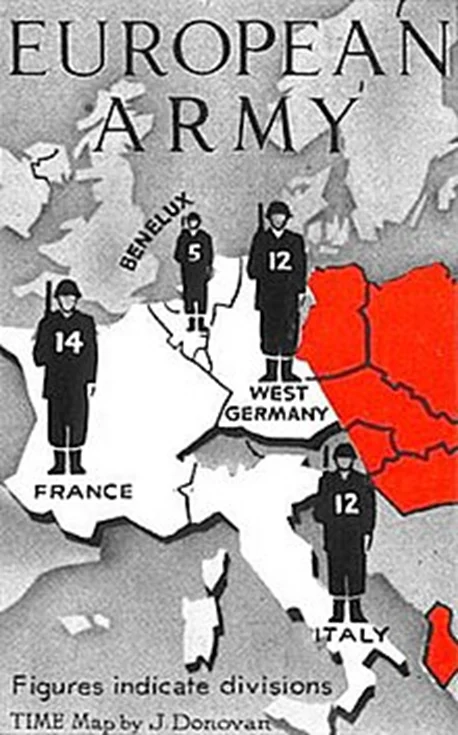
The map for the EDC creation.
TIME/J.Jonovan
The organisation itself and the army, however, never came into
being. This was because the international situation was changing faster than
work on the treaty and its ratification. The fastest to ratify the treaty was
Belgium and Germany, but it all came down to a veto by… France. Even though
it was French politicians themselves who invented the concept of the EDC, it
was Paris itself that rejected the ratification of the Treaty constituting it. Among the reasons for this refusal and the general loss of
interest in the whole initiative on the part of Western European states is the
lowering of the threat of a global conflict.
The relaxation came after Joseph Stalin died in March 1953 (in the
month of the first ratifications of the EDC Treaty), and the Korean War was
just coming to its end (which came after three years of conflict in July 1953).
Therefore, in 1954, when it came to voting in the French Parliament, the Treaty
was rejected, and thus the short history of the EWO ended. Nevertheless, it
teaches us the first fundamental truth about the role of European defence
policy today: it is more dependent on the international situation than on the
will of European politicians.
The gap created by the failure of the EDC had been filled since 1954
by the concept of a Western European Union. This organisation was a
continuation of the Western European Union, which above all, was to lose its explicitly anti-German character. Despite the defeat of the
EDC, the fact remained that, above all, the USA and the United Kingdom were
keen to win over a militarized Germany in their military rivalry with the USSR.
In addition to this process, which was inevitable at the time, the Western
European Union was to guarantee mutual military assistance in case of attack
and cooperation in peacetime. It cannot be ignored that this Union did not bring
about any revolution in the independent defence of Europe, and its main effect
was to facilitate Germany’s entry into NATO as early as 1955. The organisation
itself, undisturbed, drifted into lethargy until 2011, when it was dissolved as
no one saw any point in its continued existence.
Visit: The Odebrecht Corruption Scandal: the End
of the World Plea Deal by
Dulce María Hernández Márquez (Mexico)
The last chord of this historical outline was the European Corps
(Eurocorps), established in 1993. It is not, however, subordinate to the EU, NATO, nor any
other international organisation. Today, the Eurocorps numbers around 1000
soldiers and, according to statements (which cannot be confirmed), could
command a force of up to 60 000 soldiers. Since its inception, Eurocorps forces
have taken part in missions, e.g., in Kosovo, Bosnia, Afghanistan. This
involvement consisted of fielding symbolic forces (sometimes no more than 100
soldiers) to support more extensive NATO or EU operations.
These were historical, unsuccessful attempts by Western European countries
to create a common defence. They give some idea of nature, but also of the
difficulty and complexity of the subject and highlight features that also
accompany the European Union today. It is time to look at how it looks today.
Modern times – CSDP
The first, perhaps enigmatic acronym we necessarily learn in this
text is CSDP – Common Security and Defense Policy. It is under this policy that
the European Union currently wants to pursue its military and defence
ambitions. The CSDP itself has undergone its evolutions and changes since the
landmark Maastricht Treaty of 1991/1992. What also distinguishes it from the
historical organisations mentioned earlier is that it is not a separate
creation. The EU institutions are responsible for it and – together with the
member states – shape it. As we read in Article 42 of the Treaty on European
Union (TEU) – The common security and defence policy is an integral part of the
standard foreign and security policy. Consequently, when looking for an answer
to the question of what the EU defence policy is, we are asking what the CSDP
is. On a formal basis, analysing what the TEU tells us about it, we can
establish its several characteristics:
1. it is based on both civilian and military means to be used
outside the EU for peace-keeping, conflict prevention purposes in the framework
of military, humanitarian, rescue missions – Article 42(1) and Article 43(1).
2. CSDP must be consistent with EU Member States’ commitments to
NATO.
The EU must respect those potential divergences in the objectives of
the two organisations that will be resolved in favour of NATO by the member
states. The commitments to NATO de facto take precedence over the CSDP –
Article 42(2) and (7).
3. The CSDP will have only such civilian and military capabilities
as are made available to it by the Member States – Article 42(1) and (3).
4. In addition to the missions themselves, the CSDP is supported by
special agencies and instruments. They appear in the TEU: European Defence
Agency (EDA – the agency’s acronym) and Permanent Structured Cooperation (since
2018 known as PESCO) – Article 42(3) and Article 45 refer to EDA, while Article
42(6) and Article 46 refer to Permanent Structured Cooperation.
To these four frameworks shaping the CSDP, one can add a fifth,
which becomes apparent after reading this part of the treaty. This policy is by
definition dynamic and focused on constant development rather than on achieving
a specific final shape. This is because military issues are always so crucial
for states that they are very reluctant to share competencies in this sphere
with other actors. Therefore, setting too ambitious goals risks the failure of
any international military alliance or further military cooperation. The
European Communities have learned this lesson in the course of the 20th
century, and now the EU itself is cautious and sensitive not to provoke too
much tension or resistance among the member states. One could say that the CSDP
would like to take as its motto the principle of «go slowly but never
retreat». On the one hand, such an approach allows for stable development.
Still, it also exposes the sometimes-justified accusation that the policy is
aimless, obscure, and baroque in the sense that it multiplies institutions,
declarations, and documents and offers little in return.
You may be interested in: The future of NATO in the context of European
security
That is precisely what it is. Documents, institutions and
declarations. Let’s start by listing what instruments the CSDP has. An
inevitable renaissance, a flourishing of these came after the EU slowly but
inevitably learned lessons from the migration crisis and Russia’s annexation of
Crimea. Before these events, defence policy constantly had to give way to
almost all other Community policies. In the second half of 2016, the then EU
High Representative – Federica Mogherini, announced the so-called EU Global Strategy (EUGS). It was this that, even if
not always in an exhaustive way, made it possible to define what goals CSDP
should achieve in the first place. Since then, by 2020, it can be said that the
EU has achieved three types of defence policy instruments: military, industrial,
civil. To each of them, we can qualify the following tools of different nature
(from missions to planning and evaluation):
● Military dimension: Military Planning and
Conduct Capability Cell (MPCC, operates within the EU Military Staff EUMS),
Permanent Structured Cooperation (PESCO), Coordinated Annual Defense Review
(CARD), Capability Development Plan (CDP)
● Industrial dimension: Preparatory action in
the field of defence research (only until 2021), European Defense Industrial
Development Programme (only until 2021), European Defense Fund (EDF)
● Civilian dimension:
Civilian Crisis Response Concept (CCC), Civilian Planning and Conduct
Capability (CPCC)
Among them, one can point to instruments of a programmatic or
strategic nature such as the Capability Development Plan (CDP), the Coordinated
Annual Defense Review (CARD), and the Civilian Crisis Response Concept (CCC).
The CARD is worth special attention. It is supposed to play a vital role – to
assess to what extent the Member States’ actions in the field of CSDP are
implemented and to what time they translate into the increase of the EU defence
potential. The first edition of the CARD report, prepared by the European
Defence Agency, took place in 2020 and, unfortunately, did not provide positive
conclusions. Similarly, it is worth paying attention to what is written in the
CDP because it is on the basis that priorities are to be set within PESCO
(Permanent Structured Cooperation) and EDF (European Defence Fund).
Of the above instruments, the EU-led civilian and military missions
should undoubtedly be the ones that fire the imagination the most. Currently,
there are 11 civilian missions in total – three in Europe (Kosovo, Ukraine, Georgia), four in the
Middle East (two missions in Palestine, Iraq, Libya) and four in Africa (Niger, Central African Republic, Somalia, Mali). During
these missions, EU experts support local authorities and monitor the situation
in those countries. There are almost half as many military missions (six), and
five of them take place in Africa – in Mali, Niger and Somalia. The
effectiveness and evaluation of these missions are difficult to judge, but it
can indeed be said of them that they are not stunning in scale. All of the 17
civilian and military missions involve about 5 000 people who constantly point
to the fact that the level of funding for these undertakings is too low.
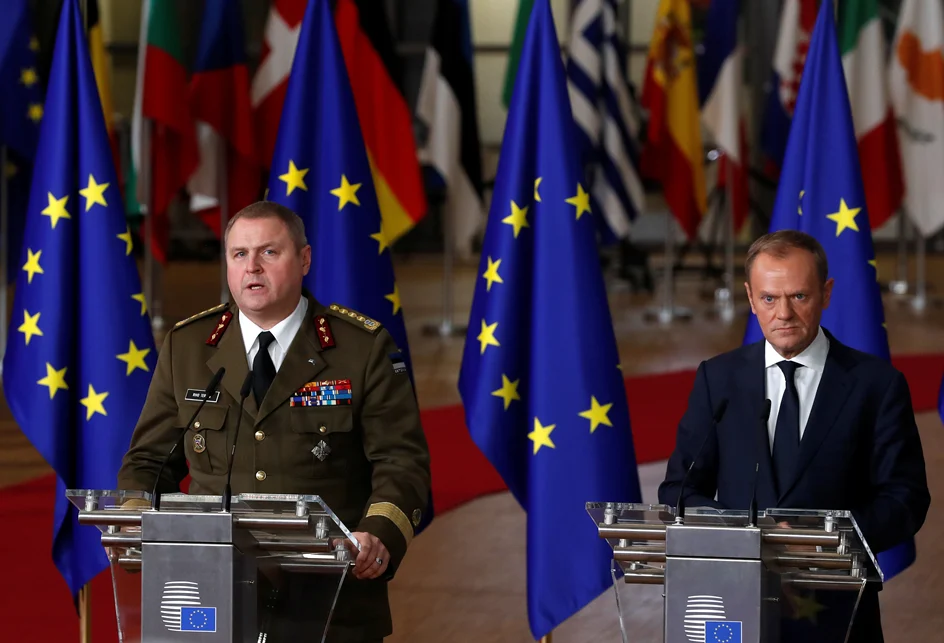
Estonian Army
general Riho Terras and European Council President Donald Tusk address a speech
on the launch of the PESCO during the EU summit in Brussels, Belgium, December
14, 2017. Yves Herman/Reuters
The last of the instruments that are particularly worth mentioning
in this text is the European Defence Fund (EDF) and PESCO. The first of them,
the EDF, existed in a caducratic form in 2018-2020, and since this year is
already in its complete form spread over the years 2021-2027. Initially, it was
to amount to 13 billion euros, which considering that it was supposed to
finance innovations in military technology, was relatively low. Unfortunately,
the pandemic only worsened the situation, and the final amount is less than 8 billion euros.
The situation in PESCO seems to be slightly better. Under this
instrument, member states jointly submit the projects they want to implement to
provide the EU with its resources to conduct missions and crisis response. In
the beginning, in 2018, there were 17, now – 46. Among them are projects to build equipment for the navy, air force and many others. It is worth
mentioning that non-EU countries can join PESCO, which in 2021 will benefit the
US, Canada and Norway, who will join the project to build military mobility in the EU.
Check out: The European Youth Capital 2023: Lublin
is Ready and Set by
Julia Dziuba (Poland)
At the end of this part of the text, relatively dry and undoubtedly
full of data, it is worth explaining another truth about the current shape of
CSDP. If anyone fears that it is moving in a direction independent of NATO,
then at least by the time I am writing these words – they are wrong. This CDP,
by the EU’s Global Strategy, must be compatible with the NATO Defense Planning
Process (NDPP). Moreover, as I also pointed out earlier, the TEU itself
indicates the need to subordinate CSDP ambitions to NATO’s obligations on most
of its member states.
A European army far over the horizon
Having gone through the last parts of the text, it is only now that
we are ready to get serious about discussing whether the European Union is
capable of being an independent player in the field of defence. Undoubtedly,
every Euro-enthusiast at least once in his life would like the answer to this
dilemma to be yes. French President Emmanuel Macron also strikes these
tones. However, even a cursory analysis of the tools available to the EU in the
defence sphere shows that its ambitions in the military sphere are focused on
the industrial globe rather than on the creation of an army.
The most developed instruments are, after all, the above-described
PESCO and EDF, i.e., formats that actively support the development of EU
armaments industries, which in the first initiative can co-create new solutions
and in the second obtain funds for innovative research and development of new
technologies. Although not all member states are yet convinced of the
effectiveness of cooperation within the framework of PESCO, its development is
certainly much less controversial than creating EU troops and starting an
aggressive policy towards NATO and the US. Indeed, this focus on industry can
bring very tangible benefits instead of vague visions of a European Army that
is unclear as to where it would operate, and which conflicts it would resolve
and which it would not.
For example, in the European Commission’s 2016 Communication.
(European Defense Action Plan) emphasised that armaments are an essential
branch of the economy that everyone would benefit from developing. The announcement noted that every euro invested in defence could
return up to 1.6 euros of profit. The market itself is vast – it includes about
1.4 million employees and generated 100 billion euros in 2016, so stimulating
it can only increase these numbers. The same statement points out that the EU
can be more active in supporting smaller and medium-sized producers. Under normal
circumstances, they have significant difficulties in competing with large arms
companies, including those from the United States.
Other topics: The Evolution of NATO’s Strategy in the Arctic Region
Creating a more competitive common arms market can stimulate
innovation and growth of the arms industry in Europe. Such priorities are not
inconsistent with the interests of NATO and the U.S., which supports all
European countries’ attempts to build a solid industrial, logistical, and
technological base for their armies without trying to stand in opposition to
Washington. It remains, indeed, a key ally for many European countries (not
only those on the Eastern Flank), and it is crucial for them that the EU does
not do anything that could undermine American guarantees.
This apparent twist towards developing the arms industry and
military capabilities (logistical and technological), rather than towards
missions, interventions and army building, certainly disappointed Paris, at
least initially, in 2017. France has traditionally sought independence from the
U.S. in the defence sphere and to convince Europe to intervene where its
interests lie, namely in the Sahel, but also in North Africa and, in part, in
the Levant. In part, Paris has succeeded because these are the regions with the
most CSDP missions.
The good spirits are only spoiled by the low interest of Member
States in missions in countries and the negligible number of personnel
deployed. As a unique analysis of the European Parliament points out, the discrepancy
in the perception of the objectives of these missions is so significant among
the EU countries that they are unable to clearly define mission priorities
allocate sufficient funds for the implementation of the current tasks. Their
proper evaluation is consequently complicated. The aforementioned document states explicitly that France, for
example, through the objectives of EU military missions, wants to implement its
historical colonisation ambitions. This is not only morally reprehensible
(although valid), but above all, for natural reasons, unacceptable to other
Community countries.
Check it out: Implications
of Russia`s A2/AD capabilities in Kaliningrad for NATO security
Moreover, it is pointed out that in the case of military missions,
no state wants to take responsibility for them. Arms made available as part of such missions, which
should be delivered to unstable regions in Africa and the Middle East, could quickly
end up in the hands of local warlords. Moreover, it is difficult to say what
would happen if the forces of an EU military mission were to commit, even
accidentally, attacks on civilian targets. Who would take responsibility for
that? The Commission, the EDA, the EU Military Staff? Even if, how would they
be punished? Imposing financial penalties would not make sense since their
budgets are de facto contributions and money coming from the Member States. These
dilemmas are precisely why the development of the EU’s intervention capacity is
growing pains, and it is hard to expect anything to change soon.
Some attempt for change was made in 2018 by Paris, creating the
European Intervention Initiative (EII) already outside the EU framework. The
proposal addressed to the countries of Europe was initially accepted by nine
countries, and now the circle has expanded by another four members.
Nevertheless, it can hardly be said to be a dynamic environment and one that
changes the strategic realities on the continent. Only one non-NATO country
(Finland) has been admitted to the initiative. Its attention is focused on
monitoring the situation primarily in the Sahel, which is difficult to
interest, for example, the countries of Central and Eastern Europe. Even worse
for the assessment of the EII is the fact that it is difficult to say how its
ambitions and methods differ from those of NATO and the CSDP. Also, so far, no significant
mission has taken place within its framework. Taking all this into account, it
should not surprise us that all the announcements of a European army, which we
hear time and again in the media, are received by decision-makers with great scepticism
and do not inspire either hope or enthusiasm.
Conclusions
The EU’s defence policy is an area that has been experiencing
intense change over the past few years and whose stature is increasing. It is a
response to an increasingly unstable international situation, which is making
European countries think about whether they are ready for numerous crises in
their neighbourhood and wars. Nevertheless, it is still a policy that raises
many objections and emotions. The interests of nation-states, especially the
largest ones, prevent the development of some branches of this policy, such as
military missions. Despite that, we can count on the development of the EU
armaments industry in the coming years if it increases its profits thanks to
the Community policy.
NATO is currently preparing to develop a new strategy, which may
appear as early as the beginning of 2022. Similarly, the EU, under the French
Presidency of the Council of the EU, will issue the successor to the EU Global
Strategy, the Strategic Compass. Its content will tell us what ambitions the
Community has for the coming years in the sphere of defence and external
policy. Only a comparison of its content, the reaction of the member states to
the new NATO strategy, will give us an idea of whether Europe is staying on the
old, known paths or whether it will try for something more. So far, the facts
indicate that there will be no revolution, and the development of CSDP will remain complementary primarily to NATO’s ambitions.
Written by Maciej Sobieraj, the project ‘Youth About Politics’,
University of Warsaw (Poland)
If this article was useful for you, support us on Patreon to get more high-quality articles on the issues of
international politics.